
Bank branch and financial office rollout programmes are procured as a kit, not as a series of fit-outs. One prototype branch is designed, specified and built; the approved result is converted into a fixed kit of parts per branch format; and the kit is then produced in waves against the opening calendar, with each branch’s goods labelled, packed and shipped as its own consignment. The procurement decisions that matter are made once — teller counter construction, security glazing class, accessible counter heights, joinery finishes, seating and signage — and then repeated. What breaks a rollout is not price; it is finish drift between waves and containers landing on branches that are not ready to receive them. This kind of coordination is what a sourcing partner like FBM Sourcing is for.
What Is Actually in a Branch Kit?
Most retail banking formats resolve into five packages. Splitting them this way matters because they have different lead times and different approval routes, and the slowest one sets the branch handover date.
- Teller line and transaction joinery — teller counters, cash drawer housings, under-counter safes surrounds, security glazing or screens, and the accessible service position.
- Client-facing joinery — welcome desk, pods or advisory desks, meeting-room tables, self-service and ATM surrounds, brochure and display units.
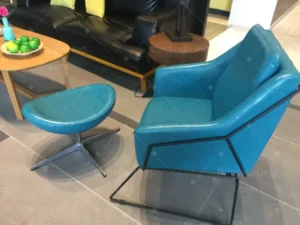
- Seating and loose furniture — waiting seating, advisory chairs, meeting chairs, task seating for back-of-house, occasional tables.
- Finishes and acoustics — flooring, wall panelling and wall protection, ceiling and wall acoustic treatment for conversation privacy, window film and privacy glazing.
- Signage, branding and lighting — exterior and interior signage, brand walls, feature lighting, and the digital display housings that are almost always joinery rather than AV.
The teller line is the long pole. It is custom joinery, it carries security requirements, it usually integrates equipment supplied by others, and it is the item that has to be site-measured. Everything else can be standardised; that one cannot be fully standardised until the shell of each branch is known.
Which Standards and Code Requirements Govern the Fit-Out?
A branch is a public accommodation with cash and staff in it, which puts three sets of requirements on the joinery package at once.
Accessibility
Under the 2010 ADA Standards, a portion of any sales or service counter must be no higher than 36 in (915 mm) above the finished floor and at least 36 in long, with a clear floor space at it — which means the accessible teller position is a design decision in the prototype, not a variation later. Equivalent provisions apply under AS 1428 in Australia and Approved Document M in the UK. Get this wrong once and it repeats across every branch in the programme.
Security
Where the format uses protective glazing, it is specified by tested class, not by thickness: UL 752 levels in the US market, or EN 1063 (BR classes) and EN 356 (P classes) for ballistic and manual-attack resistance in Europe and much of the Middle East. The joinery that carries the glazing must be detailed to the glazing system’s requirements, so the framing and the glass are one submittal rather than two.
Fire, emissions and durability
Wall and ceiling finishes are specified by surface burning characteristics — ASTM E84 Class A for most public areas in the US, Euroclass B-s1,d0 under EN 13501-1 in Europe. Upholstery is specified to CAL TB 117-2013 in the US or BS 5852 in the UK contract market. Composite wood in joinery should meet EPA TSCA Title VI or CARB Phase 2 where the destination requires it. Durability is specified rather than hoped for: HPL or compact laminate work surfaces on the teller line, contract-grade abrasion ratings on upholstery, and a slip rating on the floor finish. Our note on fabric or vinyl upholstery for commercial seating covers the seating side of that decision.
How Do You Keep 40 Branches Looking Like One Brand?
This is the real procurement problem in a rollout, and it is a batch-control problem rather than a design problem. Four controls do most of the work.
- Freeze the specification at the prototype. Named laminate codes, named fabric references with colourway, named paint and powder-coat codes, named hardware models. “Or equivalent” is how a rollout drifts.
- Buy the finish materials for several waves in one batch. Laminate, veneer, fabric and powder coat all vary between production batches; buying wave 3’s fabric at the same time as wave 1’s is the only reliable way to get the same colour in branch 30 as in branch 1.
- Keep a signed control sample. One retained set of approved finish samples, sealed and dated, against which every subsequent wave is checked before production.
- Order attic stock in the first run. Replacement panels, spare chairs and spare laminate for damage during the programme’s life, produced with the original batch.
The same discipline applies to any phased programme; the mechanics of matching a later order to an earlier one are set out in can you match existing finishes on a phase 2 order, and the wider multi-site logic in chain rollout furniture procurement.
Sourcing this for a commercial project?
FBM Sourcing works with project owners, developers, main contractors and FF&E contractors on hotel, apartment, school, office and other commercial building projects. Send us your BOQ, drawings or product list — our team will review it and get back to you.
How Should Shipping Be Structured Across a Rollout?
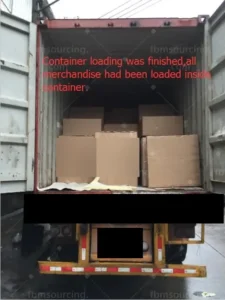
Branch fit-outs are small in volume and numerous, which is the opposite of the profile that suits containerised freight. The structure that works is consolidation at origin: several factories deliver into one warehouse, goods are sorted and packed by branch rather than by supplier, each branch’s cartons are labelled with the branch code and a room or zone reference, and containers are loaded so that a full branch kit — or several complete branch kits — arrives together. Nothing is worse on a rollout than a container arriving with the teller counters for four branches and the seating for none.
Timing follows the opening calendar with buffer built in. Production for custom joinery runs on the factory’s written lead time after drawing approval; ocean transit to the US, Northern Europe or the Gulf is confirmed by the carrier at booking. Free time at destination is limited and set by the carrier, so a branch whose landlord handover slips will start accruing demurrage unless the wave can be re-phased — which is exactly why the buffer described in lead-time buffer for a construction schedule should be programme-level, not per branch. Where a rollout crosses borders, one HS-coded document set per container keeps entries clean; see what port and local charges apply beyond ocean freight.
What Should Be Fixed Before the First Purchase Order?
Five things, all of which are expensive to change once wave one is in production: the branch formats and how many of each (a flagship, a standard and a compact format is a common structure); the kit content per format, line by line; the frozen finish schedule; the wave plan mapped to opening dates with buffer; and the responsibility split between the sourcing package, the local contractor and the AV/security integrators. That last one causes more rollout disputes than any other — particularly around who provides the cash equipment, who cuts the counter for it, and who is liable if the cut-out is wrong.
Similar programme logic applies across other office and public-sector fit-outs; see office building fit-out procurement from China and how government and public building projects source FF&E and building materials.
How FBM Sourcing Runs a Branch Rollout Package
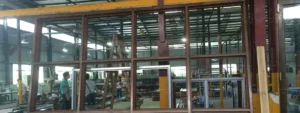
FBM Sourcing manages the entire China procurement package for overseas construction projects. On a branch programme that means taking the approved prototype and turning it into a produceable kit: holding one joinery factory for the teller line and client-facing casework, a seating factory, a finishes supplier and a signage maker on a single production calendar, running the site-measurement and shop-drawing cycle per branch for the items that need it, and keeping the standard items identical across every wave.
Inspection is carried out by our own team at the factory, as one inspection once bulk production is finished, before shipment recorded in photographs and video — checked against the retained control sample as well as the drawing, because on a rollout the question is not only “is this correct” but “is this the same as the last one”. Goods are consolidated and packed branch by branch with branch-coded labelling. All quotations, invoices and shipping documents are issued by FBM Sourcing — you deal with us, and we carry the responsibility. For suppliers you nominate, we charge a 5% commission; for products we source for you, we quote a direct price.
The same kit-of-parts and batch-control discipline applies to other rollout formats — see our guide to procurement for convenience store and retail chain rollouts.
Get a China Procurement Quote for Your Project
If you are running a branch or financial office rollout — new network, refresh programme or format change — send us the prototype drawings or the kit schedule per format, the number of branches and the opening calendar, the destination ports and the standards your market requires for accessibility, glazing and fire performance. Our team will review the programme and set out how the kit would be produced, finish-controlled across waves, inspected, consolidated and shipped branch by branch.
Use the quote button above or WhatsApp +86 135 6007 5057 to start the conversation.