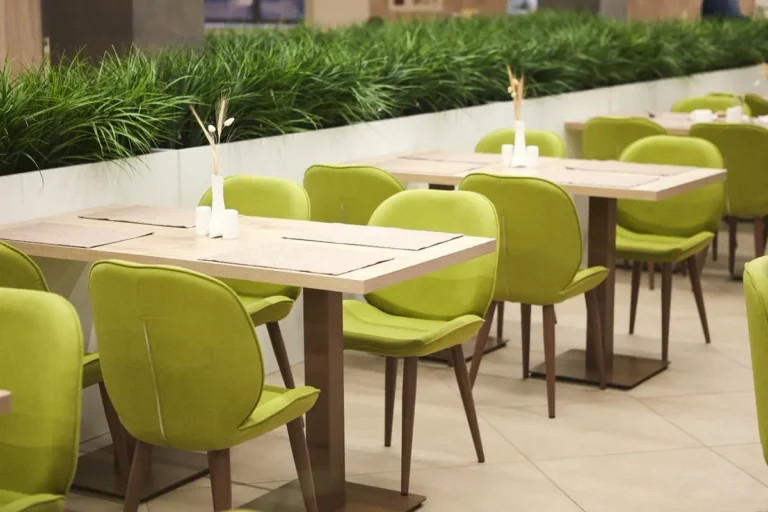
Furniture procurement for a restaurant chain rollout works differently from a one-off fit-out: instead of designing and buying once, the chain locks a master spec book with one production partner in China, then repeats orders store by store on a fixed batch rhythm. Done well, consolidating several store openings into one production run cuts per-store freight and tooling cost. This guide explains how the mechanics work — spec locking, brand consistency, batch delivery scheduling, container economics, reorder cycles and destination-country compliance — and where a China furniture and building materials procurement partner fits into the rollout machine. On projects like this, FBM Sourcing works as your dedicated sourcing partner.
- A locked spec book lets stores 2 through 20 skip design and sampling — repeat orders enter production sooner than the first store.
- One restaurant is a small shipment on its own; several stores consolidated can share containers and spread fixed costs.
- Production windows for chain furniture batches are confirmed by the factory in writing once specifications are locked.
- US-bound chains should specify CAL 117-2013 compliant upholstery fabrics and commercial-grade hardware from the first order, not retrofit later.
- A sourcing agent running the program works on a 5% commission for suppliers you nominate (products we source for you are quoted at a direct price) and manages the whole cycle: spec lock, production, QC, batching and shipping.
What Makes Chain Rollout Procurement Different from a One-Off Fit-Out?
A single restaurant buys furniture once. A chain buys the same furniture again and again — across months or years, in different cities or countries, sometimes through different local contractors — and every store has to look identical when it opens. That changes the procurement problem from “find good furniture at a good price” to “build a repeatable supply system.”
Three things matter far more in a rollout than in a one-off project. First, repeatability: the chair delivered to store 12 must match the chair delivered to store 1 in dimensions, finish color and fabric batch. Second, rhythm: orders, production slots and sailings have to align with a construction schedule that opens new stores at a steady cadence. Third, unit economics at small volumes: unlike a hotel that fills many containers in one shot, each restaurant is a small shipment, so the program lives or dies on how orders are consolidated.
The hard fact: chains that lock specifications up front shorten per-store procurement for every repeat store, because design, sampling and negotiation only happen once. If you are also outfitting kitchens, the same logic applies to back-of-house — see how chains handle kitchen equipment and OS&E sourcing for multi-unit rollouts.
How Do You Lock Specifications with a Master Spec Book?
The foundation of every rollout program is a master spec book — sometimes called a brand standards manual for FF&E. It is the single controlled document that defines every furniture item the brand uses: dining chairs, banquettes, table tops and bases, bar stools, host stations, outdoor terrace sets, waiting benches.
For each item the spec book locks: exact dimensions and tolerances; frame material and gauge (e.g. 25×25mm steel tube, 1.2mm wall); finish system and color code (RAL or Pantone reference, not “dark grey”); fabric or vinyl specification with flammability rating; foam density; glide and hardware type; and the approved “golden sample” photo set. A usable spec book pins every finish to a coded standard — RAL for metal, Pantone for laminates, a physical fabric cutting for upholstery — so batch 6 can be checked against the same reference as batch 1.
The mechanics are the same as a hotel program, and the structure translates directly — our guide to what an FF&E spec book should include for China procurement breaks down the document section by section. Once the first store’s golden samples are signed off, every later purchase order simply references the spec book code and a quantity. No re-quoting, no re-sampling, no drift.
How Is Brand Consistency Maintained Across Dozens of Stores?
Brand consistency is what customers actually see: the same green banquette vinyl, the same oak-stain table top, the same logo embossed on the chair back in Manchester and in Dubai. In production terms it is controlled through four mechanisms.
Color and material batch control. Fabrics and vinyls are dyed in lots; laminates and stains vary between production runs. The program keeps retained samples from every batch, and each new batch is checked against the master reference before cutting. For long programs it is often worth reserving fabric from a single dye lot to cover the next 2–3 store openings.
Logo and branding customization. Embossed logos on seat backs, laser-etched table edges, branded upholstery piping — these carry one-time tooling or artwork costs that are absorbed in store 1 and free from store 2 onward. That is a structural advantage of a locked program: custom branding tooling is a one-time cost typically amortized to near zero by the third store.
Golden sample governance. One signed sample set stays at the factory, one with the brand’s design team. Disputes are settled against the physical sample, not photographs.
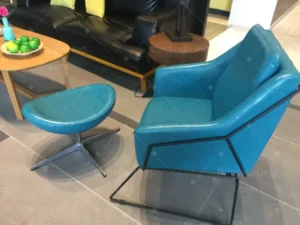
Inspection before shipment, with records. Once production is finished, FBM Sourcing’s own team carries out one inspection at the factory — frame welding, finishing, upholstery and packing — with photo and video records delivered before shipment, so the brand team can verify consistency remotely for every batch. You can see how this works in practice in our chain restaurant furniture project for a Dubai group, where outdoor and lounge pieces were produced to a locked brand standard.
Sourcing this for a commercial project?
FBM Sourcing works with project owners, developers, main contractors and FF&E contractors on hotel, apartment, school, office and other commercial building projects. Send us your BOQ, drawings or product list — our team will review it and get back to you.
How Do Batch Deliveries and Warehousing Fit a Rolling Opening Schedule?
Chains rarely open one store at a time in a neat line. Construction slips, landlords delay handover, two sites finish in the same month. The procurement program has to absorb that volatility without either starving a site of furniture or drowning the chain in storage costs.
The standard structure is batch production against a rolling forecast. The brand gives the program its opening pipeline; production is booked in batches sized to cover confirmed sites plus a small overage. Production windows for a locked chain furniture batch are confirmed by the factory in writing, and sea freight by the carrier at booking — so a confirmed store needs its furniture order released on a date worked back from those two confirmations. Region-by-region door-to-door numbers are in our sourcing and shipping timeline guide by project type.
Warehousing gives the schedule its slack. Finished goods can be held at origin (cheapest, but adds transit time when the site is ready) or in a destination-market warehouse near the rollout region (fastest to site, higher holding cost). Most mature programs use short origin holds to sync sailings, and destination holds only when a site slips after goods have shipped.
Single Store vs Multi-Store Orders: The Container Economics
This is where rollout procurement quietly makes or loses money. A single restaurant’s furniture — chairs, tables, banquettes, bar stools, host and waiting furniture — is a small shipment on its own, with the fill set in the load plan. Shipped alone, a half-empty container carries the same fixed costs as a full one: origin handling, documentation, destination port charges all land on one store.
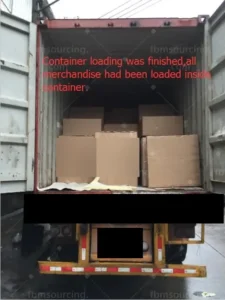
Consolidation changes the math. When several store packages are produced in one batch and shipped together, the program fills containers efficiently and spreads every fixed cost across multiple stores. Consolidating several stores into a single production-and-shipping cycle usually lowers per-store freight and handling cost compared with shipping each store individually, and it also means one inspection cycle, one document set and one customs entry per batch instead of five.
The practical rule: if the opening pipeline allows any two or more stores to share a sailing window, combine them. If a store is isolated in time, weigh the cost of shipping a part-loaded container against holding it to join the next batch. A furniture sourcing agent managing the whole pipeline can see these windows across all sites and make the consolidation call order by order — individual store managers or local contractors cannot.
Reorder Cycles, Buffer Stock and Replacement Parts
Restaurant furniture lives a hard life. Commercial seating in daily service takes damage — and a chain cannot have store 7 running mismatched chairs while a replacement is produced from scratch. Rollout programs therefore build in a replacement layer from day one.
Three practices cover it. First, overage on every batch: ordering a small allowance of extra seating per store costs little at production stage and gives each store an on-site attic stock of matching pieces. Second, program-level buffer stock: for larger chains, holding a small central reserve of high-wear items (dining chairs, bar stools) lets any location restock without waiting for a new production run. Third, spare parts kits: glides, bolt sets, touch-up finish and spare fabric per store, packed with the original delivery.
The reorder cycle itself is simple once the spec book exists: a purchase order referencing spec codes goes straight into the next production batch. This is also the moment to review the manufacturer relationship — if volumes have grown, the program renegotiates from strength. For a view of the production landscape, see our ranked guide to restaurant and cafe furniture manufacturers in China for chain projects.
What Compliance Standards Apply in the Destination Country?
Chain furniture crosses borders under commercial-use rules, not residential ones, and the requirements must be baked into the spec book before store 1 — retrofitting compliance across a live program is painful.
For the United States, the key upholstery standard is California TB 117-2013 (CAL 117), the smolder-resistance standard adopted as the US federal flammability standard for upholstered furniture in 16 CFR Part 1640 (effective 25 June 2021); commercial projects also commonly specify BIFMA-tested seating for durability. For the UK, upholstery must meet the Furniture and Furnishings (Fire) (Safety) Regulations with match and cigarette test compliance (BS 5852 sources). The EU and Australia lean on EN and AS/NZS commercial furniture standards respectively. Beyond fabrics: commercial-grade hardware — metal-to-metal fixings, reinforced joints, heavy-duty glides — should be specified explicitly, because the same chair design is often built in a lighter residential grade by default.
A china sourcing agent working commercial projects handles this at specification stage: the fabric mill certifies to the destination standard, certificates travel with each batch’s document pack, and the spec book records which standard each market version follows. One brand, several market variants, zero guesswork at customs or at the insurer’s audit.
Where Does a Sourcing Agent Fit in a Chain Rollout?
A rollout program is a system with many moving parts — specs, batches, inspections, containers, documents — repeating every few weeks. Chains generally choose between building an in-house procurement function or appointing a building material sourcing agent on the ground in China to run the program.
FBM Sourcing runs chain programs end to end from Guangzhou, one hour from Foshan — the center of China’s commercial furniture manufacturing belt: locking the spec book, managing golden samples, booking production batches against the opening pipeline, carrying out one inspection per batch with our own team at the factory once that batch is finished, before shipment (photo and video records for every batch), consolidating multi-store shipments and managing export documentation. The commercial model is a transparent a 5% commission for suppliers you nominate (products we source for you are quoted at a direct price) on purchase value — scaling naturally as store count grows.
Frequently Asked Questions
How long does furniture procurement take for one new chain store?
For a chain with a locked spec book, a repeat store moves faster than the first because design and sampling are already done; the production lead time is confirmed by the factory in writing and the sea freight by the carrier at booking. The first store takes longer — on FBM Sourcing projects we allow around four months from deposit to shipment — because design, sampling and golden-sample approval happen once up front.
How many stores should we consolidate into one furniture order?
Three to five stores per production batch is the sweet spot for most chains. A batch of several stores ships full containers, spreads fixed freight and handling costs across stores, and still fits inside a single production window.
Can Chinese factories customize furniture with our brand logo consistently?
Yes. Embossed, laser-etched or upholstered branding is set up as one-time tooling and artwork on the first order, then repeated identically on every batch. Consistency is enforced through retained golden samples and batch-by-batch inspection against coded color and material standards.
What fire-safety standard does US restaurant furniture need?
Upholstered seating for US commercial use should be specified with CAL 117-2013 compliant fabrics and fillings, the smolder-resistance standard used across the country. UK-bound furniture instead follows the Furniture and Furnishings (Fire) (Safety) Regulations. The destination standard must be written into the spec book before the first production run.
FBM Furniture
If your package is mainly public area and restaurant furniture, see public area and restaurant furniture on fbmfurniture.com, the site of FBM Furniture, the furniture sourcing line of FBM Sourcing Limited.
Get a China Procurement Quote for Your Project
If you are planning a multi-store rollout — whether the next 3 openings or a 30-store program — send us your furniture schedule, drawings or existing spec book. FBM Sourcing will come back with a program proposal covering specification lock, batch production planning, consolidated shipping and per-store landed cost structure, on a 5% commission for suppliers you nominate (products we source for you are quoted at a direct price). Use the quote button above or message us on WhatsApp at +86 135 6007 5057 — our team will review your requirements and get back to you.
Chain rollout procurement logic carries across sectors: the same phased-production and consolidation approach applies to gym and fitness center chain sourcing from China.