Specify woven contract fabric where comfort and acoustics matter and spills are occasional — guest room lounge chairs, office task seating, hotel bedroom benches. Specify vinyl, polyurethane or silicone coated fabric where the seat gets wiped down daily or disinfected — restaurant booths, school and cafeteria seating, healthcare and waiting-area chairs. The decision is made by three numbers on the spec sheet, not by appearance: the cleaning code (W, S, WS or X), the abrasion result in Wyzenbeek double rubs or Martindale cycles, and the flammability test the composite actually passed for your destination market. FBM Sourcing acts as your sourcing partner from specification through to shipment.
What follows is written for buyers ordering commercial seating in volume, where a wrong fabric call repeats across several hundred or several thousand units.
Fabric, Vinyl, Polyurethane and Coated Fabric Compared
Four material families cover almost all commercial seating. They behave differently in cleaning, in fire testing and — most importantly for a project with a defined life expectancy — in how they fail.
| Material | Cleanability | Fire rating route | Typical abrasion range | Best fit | How it fails |
|---|---|---|---|---|---|
| Woven contract fabric (polyester, olefin, poly blends) | Usually code W or WS; soil and stain finish helps but does not make it wipeable. Not disinfectable. | Passes CAL TB 117-2013 smolder as a composite; BS 5852 crib 5 normally needs an FR barrier and CM foam. | 30,000–100,000+ double rubs | Guest rooms, offices, meeting rooms, hotel bedroom seating | Soiling, staining, pilling, seam and edge abrasion, colour loss at headrests |
| PVC vinyl | Wipeable, usually code W or WS; many commercial grades tolerate diluted bleach. | Smolder-resistant surface, generally passes TB 117-2013; crib 5 still requires barrier plus CM foam. | 100,000–300,000+ double rubs | Restaurant booths, school and canteen seating, budget high-traffic areas | Plasticiser migration → stiffening and cracking; cold cracking; dye transfer from denim on light colours |
| Polyurethane (PU) | Wipeable, softer hand than PVC; bleach tolerance varies by grade and must be declared. | Same composite route as vinyl; test with the actual foam and barrier. | 100,000–500,000 double rubs | Hotel lobbies, lounge seating, headboards, anywhere leather-look is wanted | Hydrolysis → surface tackiness, peeling and delamination, accelerated by heat, humidity and alkaline cleaners |
| Silicone / high-performance coated fabric | Best of the four; resists most hospital disinfectants and denim dye transfer. | Same composite route; test reports normally available from the mill. | Often 250,000+ double rubs | Healthcare, senior living, transport hubs, 24-hour public areas | Highest cost; bonding and sewn detailing need factory experience, so sampling matters more |
Within each family the range is wide enough that grade, not category, drives cost and performance. A heavy contract woven will outlast a thin vinyl.
Which Fire Test Standard Actually Applies to Your Project?
This is where specifications most often go wrong, because buyers copy a standard number from a previous project in a different country.
United States
CAL TB 117-2013 is the de facto national requirement. The 2013 revision replaced the old open-flame test with a smolder resistance test using a lit cigarette, applied separately to cover fabrics, barrier materials and resilient filling. Upholstered furniture sold into California must carry the TB 117-2013 label, and under SB 1019 that label must also state whether the product contains added flame retardant chemicals — a question hotel and student housing clients increasingly ask about.
NFPA 260 classifies cover fabrics and other components for cigarette ignition resistance (Class I or Class II); NFPA 261 is the mock-up smolder test on an assembled cover-and-filling combination. Many US specs quote NFPA 260/261 alongside TB 117-2013, and the factory needs to know which one is actually required, because they are different reports.
For seating in some public assembly, healthcare and institutional occupancies, the specifier or the authority having jurisdiction may additionally call for CAL TB 133, a full-scale burn test on a finished chair rather than on materials. Identify that before sampling, not after.
ASTM E84 does not belong on a seat cushion. It is the surface burning characteristics test for building materials — wall panels, ceiling finishes, wallcovering — and produces the Class A rating of flame spread index 25 or less and smoke developed index 450 or less. If your FF&E schedule has ASTM E84 written against upholstery, it was copied from the wallcovering page.
United Kingdom and Europe
BS 5852 is the ignition source test series, and BS 7176 is the standard that sorts contract seating into hazard categories. Medium hazard requires ignition sources 0, 1 and 5 — the well-known crib 5 — and covers most hotel, office and education seating. High hazard adds crib 7 and is typically written for hospitals and secure accommodation. Two points matter commercially: crib 5 is a test on the composite, so it is normally met with combustion modified high resilience (CMHR) foam plus a fire barrier interliner under the cover, and a fabric that is crib 5 compliant in one build-up is not automatically compliant in another.
The five standard references worth locking into an upholstery specification before you go out for quotes:
- CAL TB 117-2013 — smolder resistance, US market default
- NFPA 260 / NFPA 261 — component classification and mock-up cigarette ignition test
- BS 5852 crib 5 within BS 7176 medium hazard — UK and Ireland contract seating
- ASTM D4157 (Wyzenbeek) or EN ISO 12947 (Martindale) — abrasion, with the cycle count stated
- Cleaning code declaration (W / S / WS / X) — issued for the specific fabric, in writing
How Many Double Rubs Do You Actually Need?
Abrasion is measured two ways and the two numbers are not interchangeable. In North America the Wyzenbeek test, ASTM D4157, reports double rubs. The Association for Contract Textiles guideline is 15,000 double rubs for general contract upholstery and 30,000 for heavy duty. In practice hospitality, education and healthcare specifications write 50,000 to 100,000 double rubs for lobby, dining and waiting-area seating, and that is a reasonable floor for anything that sees public use all day.
In Europe the Martindale test, EN ISO 12947, reports cycles; the ACT equivalents are 20,000 cycles general contract and 40,000 heavy duty, and contract seating fabrics are commonly specified at 40,000 cycles and above.
One caution: above roughly 100,000 double rubs the number stops predicting service life, and ACT itself states that results beyond 100,000 do not necessarily indicate greater longevity. A fabric advertised at 500,000 is not five times better than one at 100,000. What actually kills commercial seating covers is soiling, cleaning chemistry, UV exposure and seam construction, so specify colourfastness to light as well — ACT’s contract upholstery guideline is 40 hours at grade 4 under AATCC 16.
Sourcing this for a commercial project?
FBM Sourcing works with project owners, developers, main contractors and FF&E contractors on hotel, apartment, school, office and other commercial building projects. Send us your BOQ, drawings or product list — our team will review it and get back to you.
Cleaning Codes: What W, S, WS and X Commit Your Operator To
The cleaning code is a housekeeping instruction that gets decided at procurement and then lived with for a decade:
- W — clean with water-based cleaning agents
- S — solvent-based (dry cleaning) products only; water will ring or shrink the face
- WS — either water-based or solvent-based agents are acceptable
- X — vacuum or light brushing only, no liquid of any kind
Code X should never appear on restaurant booths, guest room seating, school furniture or lobby sofas. Housekeeping will use water, because that is what a cleaning trolley carries, and the fabric will be written off long before the frame is. Code S is similarly awkward wherever cleaning is done in-house.
For coated fabrics, ask separately for the disinfectant compatibility list. A material can be code W and still be destroyed by quaternary ammonium products or by a bleach concentration higher than the mill tested.
Healthcare, Senior Living and Anywhere That Gets Disinfected
Clinics, hospitals and senior living projects have a requirement the other sectors do not: the seat has to survive repeated disinfection. The benchmark is a coated fabric — polyurethane or silicone — that the mill has tested against a 1:10 dilution of household bleach (sodium hypochlorite), the dilution normally used for blood and body fluid spills, with a stated contact time and cycle count.
Three further construction details belong in the specification:
- A moisture barrier backing that is liquid-impermeable but breathable, so fluid cannot reach the foam through the seam and stitch holes
- An antimicrobial finish, understood correctly: in the US these finishes are registered to protect the material itself from bacterial degradation, staining and odour. They are not a claim of protecting patients or reducing infection, and no reputable mill will put that in writing
- Seam and welt construction — welded or sealed seams where the specification allows, since stitched seams are the entry point for fluid regardless of how good the face material is
Patient and resident seating also carries a structural requirement that has nothing to do with the cover. Weight-rated and bariatric seating should be evidenced with frame testing to the relevant ANSI/BIFMA test standards for commercial furniture, quoted with the standard reference and the tested load.
Why PVC and PU Fail in Completely Different Ways
Buyers treat vinyl and PU as interchangeable leather-look options. They age on different clocks.
PVC vinyl is a rigid polymer made flexible by plasticisers. Over time, faster with heat and UV, plasticiser migrates out; the material stiffens, then cracks, usually at the front seat edge and along seam lines first. PVC also picks up dye transfer from denim on pale colours, which is why light vinyl restaurant booths look tired within a couple of seasons.
Polyurethane fails by hydrolysis. Moisture breaks down the polymer and the surface turns tacky, then peels or delaminates from its backing. Polyester-based PU hydrolyses faster than polyether or polycarbonate-based PU, and heat, humidity, body oils and alkaline cleaners all accelerate it. For a Caribbean resort, a Gulf project or a poolside lounge, that makes one question decisive: which polyol system is the PU built on, and is there an accelerated humid ageing result to show for it? Silicone coated fabrics do not hydrolyse, which is why they dominate healthcare and high-humidity public seating despite the cost.
What to Specify by Space Type
Hotel guest rooms
Woven contract fabric on the lounge chair and bench, code W or WS, 50,000 double rubs or more, with a soil and stain finish. Coated fabric on the desk chair seat where turnover is fast. See how this sits inside the wider FF&E procurement process for hotels and apartment projects.
Lobbies and lounges
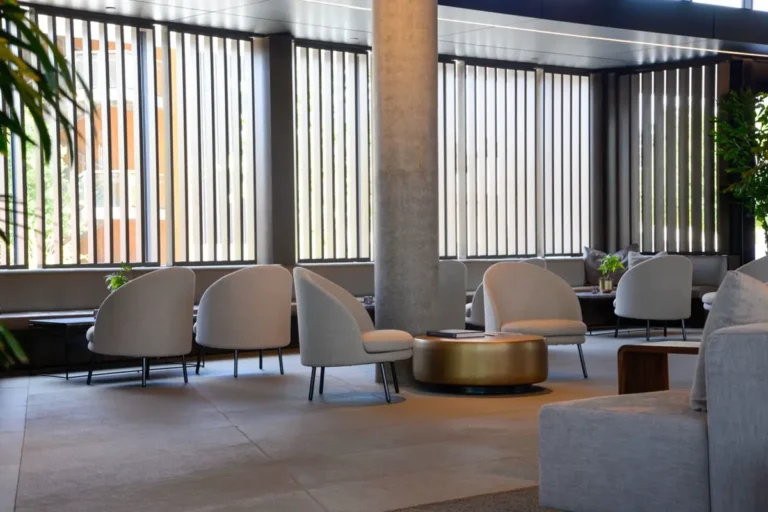
Mixed. Heavy contract woven or high-grade PU on sofas and lounge chairs, 100,000 double rubs, colourfastness checked if the seating sits near glazing. Avoid pale PVC.
Restaurant booths and banquettes
Coated fabric, not woven. Booths take food, grease and daily wiping. Mid to darker tones, wipeable, and specify the cleaning chemistry the operator actually uses.
Schools, canteens and student accommodation
Coated fabric on dining and common-area seating; woven only in study bedrooms. UK and Ireland projects need BS 5852 crib 5 evidence on the composite, not the cover alone.
Healthcare and senior living
Bleach-cleanable PU or silicone with a breathable moisture barrier, plus weight-rated frames as above.
Covered outdoor and pool-adjacent areas
Solution-dyed acrylic or an outdoor-rated coated fabric with UV data, quick-dry reticulated foam, and drainage in the frame. Standard indoor contract fabric put on a shaded terrace will fade and mildew within a season.
The Evidence to Request Before You Approve a Fabric
A fabric claim is only as good as the document behind it. Before approving any upholstery selection for a volume order, request the following in writing, each one issued for the specific material and colourway you are buying:
- Flammability test report naming the standard and revision — CAL TB 117-2013, NFPA 260/261, or BS 5852 crib 5 under BS 7176 — and stating the tested composite (cover + barrier + foam), not just the cover
- Abrasion test report with the method (ASTM D4157 or EN ISO 12947), the cycle or double rub count reached, and the end point criterion
- Cleaning code declaration (W / S / WS / X) plus, for coated fabrics, the disinfectant and bleach dilution compatibility list with contact times
- Composition and construction spec — face composition, backing type, coating chemistry (PVC, polyester-based PU, polyether-based PU, silicone), total weight, usable width, and pattern repeat
- Colourfastness to light result with method and hours, and crocking/rub-off results for dark colours
- Accelerated humid ageing (hydrolysis) result for any PU going into a hot or humid climate
- OEKO-TEX Standard 100 certificate, if the specification calls for chemical screening of the textile
- Production lot control — a signed reference swatch or strike-off, with a written commitment that bulk matches it for colour, hand and weight
One clarification that saves arguments: CARB Phase 2 and TSCA Title VI apply to composite wood panels — particleboard, MDF and hardwood plywood — not to upholstery fabric. If your specification demands CARB Phase 2 on a chair, it applies to the plywood or engineered panel in the frame and casegoods, which is a separate document trail covered in our comparison of plywood, MDF and particleboard for commercial casegoods. Asking a fabric mill for a CARB certificate signals inexperience and slows the quote down.
Where Direct Fabric Negotiations With Factories Go Wrong
Three failure patterns show up repeatedly on projects that handle upholstery specification themselves.
The description is not equivalent. “Commercial grade PU” means nothing. One factory prices a 0.8 mm polyester-based PU at 100,000 double rubs; another prices a silicone coated fabric at 250,000 with a bleach compatibility list. Both answer the same RFQ line. The fix is writing the fabric line with method, number, code and backing stated, so quotes land on the same basis — the wider discipline of comparing factory quotes like for like.
The certificate belongs to someone else. A flammability report from the fabric mill covers the mill’s material in a particular build-up. It is not automatically valid for your chair with your foam and no barrier. The report has to match the composite being built.
Bulk does not match the sample. Upholstery is the easiest line to substitute quietly, because a lighter weight or a different backing is invisible in a photograph. The control is a signed reference swatch tied to the order and a physical comparison against bulk goods.
This is the part FBM Sourcing locks down as your agent. We turn the fabric line into a specification a factory can be held to, run the sample and strike-off approval process so the approved swatch is signed and on file before production starts, and collect the flammability, abrasion and cleaning-code documentation into the order file rather than chasing it at the end. All goods are inspected before shipment by FBM Sourcing’s own team at the factory, with photo and video records sent to you — including a physical check of bulk upholstery against the approved reference swatch, plus seam, welt and stitch quality. Our agency fee is 5%.
For European projects the seat frame is judged against EN 16139 at a stated severity level: see EN 16139 strength and durability standards for contract furniture.
Salon and barbershop seating adds a test most commercial seating never faces: hair colour, developer and bleach on the upholstery every day. For chains buying salon furniture from China, we set out what a store kit should standardise, from chair pumps and upholstery to shampoo units and lit mirrors.
Get a China Procurement Quote for Your Project
If you have a commercial project with upholstered seating in the package — hotel, apartment building, student accommodation, school, clinic, office or restaurant chain — send us the drawings, BOQ or product list with quantities, your destination port and your project timeline. Include any fabric standards your specification already names (CAL TB 117-2013, BS 5852 crib 5, a double rub requirement, a cleaning code) so we can price against the correct grade from the start.
Our team will review the scope with you and come back with a comparable, like-for-like basis for the upholstery and the rest of the package. Start on our China building materials and FF&E procurement page, or message us directly on WhatsApp at +86 135 6007 5057.