Ocean freight is usually less than half of what it actually costs to move a container from a Chinese factory to a construction site. On top of the sea leg sit origin charges at the load port, carrier surcharges that travel with the booking, destination terminal and customs charges, and inland delivery — and on a typical project shipment these add up to a figure of the same order as the freight itself. The exact list depends on your Incoterm: an FOB quotation covers origin charges only, a CIF quotation stops at the destination terminal, and everything after that is invoiced to you locally. FBM Sourcing operates as a sourcing agent and sourcing partner, not a trading company.
What Charges Apply at the China Load Port?
Origin charges are the ones already included when a factory or a china sourcing agent quotes you FOB Shenzhen, FOB Guangzhou or FOB Shanghai. They are worth knowing anyway, because they tell you what an FOB price is actually buying and where a suspiciously cheap quotation has cut corners.
- Origin terminal handling charge (THC): the port’s charge for moving the container between the yard and the vessel, billed per container and varying by port and box size.
- Export customs declaration: the filing that gets the goods legally out of China, plus the commodity inspection filing where the HS code requires it.
- Documentation / bill of lading fee: issuing the B/L, plus telex release or courier if you need original documents moved quickly.
- VGM (verified gross mass): the SOLAS-mandated weight verification that must be filed before loading; no VGM, no load.
- ISPS / port security: a fixed per-container security levy.
- Fumigation or ISPM 15 treatment: applies to solid wood packing — pallets, crates, bracing. Heat-treated and stamped material avoids the charge and, more importantly, avoids the quarantine hold at the other end.
- Inland haulage factory to port: trucking from the factory in Foshan, Shunde, Ganzhou or wherever the goods are made to the container yard, plus loading labour.
Two of these regularly cause problems rather than costs. Wood packing that is not ISPM 15 stamped is one of the most common reasons a project container is held at destination quarantine, and it is entirely avoidable at the packing stage — our note on export packing standards for furniture shipped by sea covers what the stamp has to look like. The other is a wrong or careless HS code on the export declaration, which follows the shipment into the destination customs entry and turns into a duty dispute.
Carrier Surcharges That Travel With the Booking
Between origin and destination sit the surcharges the shipping line applies to the freight itself. These are quoted separately from the base ocean rate and change with fuel, season and trade-lane capacity, which is why a freight quotation with a single all-in number and no breakdown should be read carefully.
- BAF / FAF (bunker or fuel adjustment factor) — fuel cost pass-through, adjusted periodically.
- CAF (currency adjustment factor) — applied where the freight is billed in a currency other than the carrier’s operating currency.
- PSS (peak season surcharge) — applied on the Asia trades during peak periods, typically the run-up to Chinese New Year and the pre-Christmas window.
- GRI (general rate increase) — a scheduled rate rise, which is why a freight quotation has a validity date the same way a factory quotation does.
- Congestion or emergency surcharges — imposed at short notice when a port or canal routing is disrupted.
What Do You Pay at the Destination Port?
This is the part that surprises project buyers who budgeted from a CIF number, because a CIF price discharges the carrier’s obligation at the destination terminal and the local invoices start immediately afterwards.
Terminal and carrier charges
Destination THC is charged again at the arrival port. On top of it sit a delivery order or documentation fee from the carrier’s local office, a container cleaning or maintenance charge on some lanes, and in several markets an infrastructure or wharfage levy set by the port authority rather than the line.
Customs entry and government charges
Every market has its own entry mechanics. In the United States an ISF (importer security filing, the “10+2”) must be filed before the vessel loads at origin, a customs bond is required to clear commercial cargo, and two statutory fees apply on formal entries: the merchandise processing fee at 0.3464% of entered value, subject to published minimums and maximums (19 CFR 24.23), and the harbor maintenance fee at 0.125% on ocean arrivals (19 CFR 24.24). Duty and, on some categories, anti-dumping and countervailing duty sit on top — see our breakdown of US anti-dumping duties on cabinets, quartz and flooring from China, because AD/CVD is the single largest destination-side cost risk on those categories. Australia charges an import processing charge per declaration and applies GST at 10% of the value of the taxable importation under the GST Act; the EU applies duty plus import VAT at the member-state rate; the GCC markets apply a common external tariff with conformity documentation checked at entry.
Inland and site delivery
Drayage from the terminal to a warehouse or to site, chassis rental in the US market, and any transfer or unpacking labour. On construction projects this is where the real cost variable sits: a container that can be tipped straight into a receiving warehouse costs far less to handle than one that has to be devanned by hand at a kerbside with a two-hour driver waiting window. Classification sits underneath all of it — see which HS codes apply to furniture and building materials imports.
Sourcing this for a commercial project?
FBM Sourcing works with project owners, developers, main contractors and FF&E contractors on hotel, apartment, school, office and other commercial building projects. Send us your BOQ, drawings or product list — our team will review it and get back to you.
Demurrage and Detention: the Charge Nobody Budgets For
Demurrage runs when your container sits inside the terminal beyond the free period; detention runs when you have taken the box out but not returned it empty. Free time at destination depends on carrier, port and whether extra free days were negotiated at booking, and both clocks run on calendar days including weekends and public holidays. They are charged per container per day and escalate in tiers, so a delay that starts as an inconvenience can become the largest single line on the shipment invoice.
On project cargo the usual causes are predictable: customs documents that do not match the goods, a missing certificate or test report for a regulated category, no site or warehouse ready to receive on the arrival date, or a construction programme that slipped after the containers had already sailed. Our guide to demurrage and detention charges and how to avoid them sets out the sequence that keeps the clock from starting. The structural fix is the one covered in how much lead-time buffer a construction schedule should allow: containers should be timed to land against a site date that has slack in it, not against the optimistic date on the programme.
How Do You Get These Charges Into the Budget Before You Order?
The workable method is to price the shipment on a delivered basis from the start, rather than approving an FOB number and discovering the rest later. Three questions do most of the work.
- Which Incoterm is the quotation on, and what is the first charge after it? FOB stops at the ship’s rail, CIF stops at the destination terminal, DAP runs to a named delivery address but normally excludes duty and import tax. The charge immediately after your Incoterm is the one that will arrive as a surprise invoice.
- What is the HS code for each line, and what duty rate and special duty exposure does it carry in the destination market? This is the number that moves budgets, and it is set by classification, not by negotiation.
- Who is the importer of record, and who holds the customs bond? This decides who receives the government invoices and who carries the compliance liability — covered in who clears customs on a project import.
Once those three are answered, the destination charges can be estimated as a block rather than discovered one at a time. The full arithmetic, including how these lines combine with unit price, freight and duty, is set out in our guide to calculating landed cost for a China project order.
One Procurement Package, One Set of Documents
FBM Sourcing manages the entire China procurement package for overseas construction projects, and the document chain that drives these charges — commercial invoice, packing list, HS classification, bill of lading, certificates and test reports — is produced as one consistent set rather than assembled from several factories’ paperwork at the last minute. All quotations, invoices and shipping documents are issued by FBM Sourcing — you deal with us, and we carry the responsibility. For suppliers you nominate, we charge a 5% commission; for products we source for you, we quote a direct price.
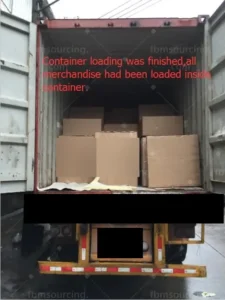
That matters at the destination port more than anywhere else in the chain. Consolidating several factories into full container loads at one warehouse means fewer bills of lading, fewer entries and fewer sets of terminal charges than shipping each factory’s goods separately. One HS-coded invoice per container, matched exactly to the packing list, is what keeps an entry moving instead of being flagged for examination — and an examination hold is how the demurrage clock usually starts. Goods are inspected once by our own team at the factory when bulk production is finished, before shipment, photo and video records included, so a container is not loaded with something the documents do not describe.
Get a China Procurement Quote for Your Project
If you are budgeting a container-scale package of building materials or FF&E from China and need the shipping side priced properly rather than left as an FOB figure, send us the product schedule or BOQ, the quantities, the destination port and the required-on-site dates. Our team will review the package and set out the quotation with the expected container count and the destination-side charges you should carry in the project budget.
Use the quote button above or WhatsApp +86 135 6007 5057 to start the conversation.