A construction programme should build its China procurement window from confirmed durations, not assumed ones, and it should show a deliberate buffer as buffer rather than hiding it inside working time. On FBM Sourcing projects we allow around four months from deposit to shipment: roughly two months for drawings and two months for production. Around that working chain sit the stages each party confirms in writing: the factory confirms its production lead time for each order, the carrier confirms transit time at booking, and the customs broker and trucking company confirm port release and delivery to site. On top of that base, add a schedule contingency, keep production clear of the Chinese New Year shutdown, allow for peak-season blank sailings, and plan for the container to land before installation is due to start. FBM Sourcing operates as a sourcing agent and sourcing partner, not a trading company.
Lead time and buffer are two different questions
This article answers a question that main contractors and project managers ask when they build the master programme: how much slack does the schedule need around each China order so that the site is never waiting on a container.
Lead time is a property of the product. Buffer is a property of the programme. A casegoods package with a realistic production time can still arrive late if the programme assumed the factory started on the PO date, ignored a second drawing approval round, or missed the fact that the sailing crossed Chinese New Year. The buffer model below breaks the journey into six stages so each one can carry its own allowance.
- Stage 1 – Pre-production: deposit, shop-drawing approval and finish samples.
- Stage 2 – Production: the lead time confirmed by the factory in writing, which differs by category.
- Stage 3 – Inspection, export packing, inland haulage, port cut-off: one inspection by our own team after bulk production is finished, then packing and gate-in before the carrier’s cut-off.
- Stage 4 – Ocean transit: transit time confirmed by the carrier at booking.
- Stage 5 – Destination port and customs: release timing confirmed by your customs broker.
- Stage 6 – Delivery, devanning and installation coordination: with the container landing before install start.
On FBM Sourcing projects, Stages 1 and 2 together take around four months from deposit to shipment: roughly two months for drawings and two months for production. The remainder of the window is buffer, and it should be shown as buffer on the programme, not hidden inside optimistic activity durations.
The six-stage China procurement timeline
Stage 1: Pre-production
Nothing is cut, cast or extruded until drawings are approved and the deposit has cleared. For custom casegoods and joinery, the shop-drawing approval cycle often runs more than one round, and finish samples (laminate, veneer stain, fabric, stone) travel in parallel. The deposit is the common trigger for the factory to book raw material and a production slot, so the pre-production clock only stops when the deposit lands, not when the PO is signed.
Standard-specification items – hotel mattresses to a fixed size, stock ceramic tiles, catalogue sanitary ware – can move through this stage quickly. Custom items rarely do.
Stage 2: Production by category
Production is counted from approved drawings plus cleared deposit, and each factory confirms its lead time in writing for your order. On FBM Sourcing projects production takes roughly two months of the around four months we allow from deposit to shipment. Categories do not all run the same:
- Casegoods (headboards, nightstands, desks, wardrobes, vanities).
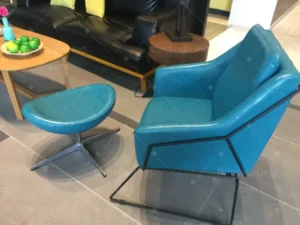
- Seating (lounge chairs, dining chairs, sofas, banquettes).
- Tiles and sanitary ware (kiln-fired, batch production).
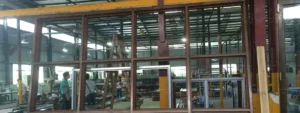
- Aluminium windows and curtain-wall units, which start only after site measurement and glass approvals.
- Custom joinery (reception desks, wall panelling, fitted wardrobes, kitchen runs).
Windows and joinery deserve a note. Both depend on site dimensions, so their production clock cannot start until the structure is far enough advanced to measure. On a high-rise apartment project this puts them on the critical path more often than casegoods, even when casegoods take a similar production time.
Stage 3: Inspection, export packing, haulage and cut-off
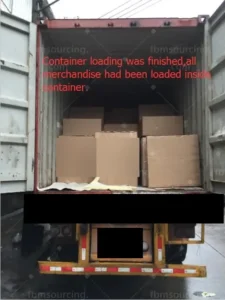
Once production is complete, FBM Sourcing’s own team carries out a full pre-shipment inspection on the factory floor and delivers photo and video records before anything is loaded. Export packing follows – ISPM 15 heat-treated crates or pallets, corner protection, film wrap – then inland haulage from the Guangdong factory clusters to Shenzhen or Nansha, customs declaration and container gate-in.
Container yards close to new cargo at a cut-off the carrier sets before the vessel’s departure. On lanes with one sailing per week, missing that cut-off costs the programme the next weekly sailing, which is why this stage carries its own allowance in the table further down.
Stage 4: Ocean transit by lane
Transit time is confirmed by the carrier at booking, port to port, for the lane your cargo actually takes. The main lanes from South China are:
- China to US West Coast (Los Angeles / Long Beach, Oakland, Seattle-Tacoma).
- China to US East Coast (New York, Savannah, Houston via Panama).
- China to Australia East Coast (Sydney, Melbourne, Brisbane).
- China to UK and North-West Europe (Felixstowe, Southampton, Rotterdam).
- China to Jebel Ali (Dubai) and Gulf ports.
- China to the Caribbean (Kingston, Bridgetown, Nassau, usually via transhipment).
These are port-to-port legs. Transhipment lanes – most Caribbean and many Gulf and Australian services – add connection time when the feeder does not line up with the mother vessel, and that connection risk is why the Caribbean lanes are the hardest to plan.
Stage 5: Destination port and customs
Discharge, terminal handling, customs release and pickup all need time after vessel arrival, and your customs broker confirms it. Free time on the terminal before storage charges start is set by the carrier and terminal; if the customs broker needs a physical exam, that adds more. Our guide on demurrage and detention charges covers why containers should not land at a port before someone is ready to clear them.
Stage 6: Delivery to site and installation coordination
The last mile is inland trucking to site or to a staging warehouse, devanning, room-by-room sorting and handover to the installation crew. A hotel package arriving in several containers needs its own unloading and staging capacity in the programme, not a single afternoon.
Sourcing this for a commercial project?
FBM Sourcing works with project owners, developers, main contractors and FF&E contractors on hotel, apartment, school, office and other commercial building projects. Send us your BOQ, drawings or product list — our team will review it and get back to you.
How much earlier should FF&E be ordered than the room-ready date?
The arithmetic is the six stages worked backwards from installation, plus the buffer rules in the next section. On FBM Sourcing projects the fixed part is around four months from deposit to shipment; the lane-dependent part is the transit time the carrier confirms at booking. Set installation start as the anchor and count backwards:
- Containers on the ground at site: with the landing buffer your site team needs before install start.
- Port release and trucking to site: as confirmed by your customs broker and trucking company.
- Sailing: the transit time the carrier confirms at booking gives the vessel departure date.
- Inspection, packing, haulage and cut-off: production must be complete before this, with the carrier’s cut-off as the hard deadline.
- Drawings and production: on FBM Sourcing projects we allow around four months from deposit to shipment, which gives the latest PO and deposit date.
- Contingency on the whole working chain: move the PO earlier again by that amount.
A longer sailing, such as a UK or US East Coast lane instead of the US West Coast, pushes the PO date earlier by the difference. If the production run would hit the Chinese New Year shutdown, the honest answer is to move the deposit so that production finishes before the holiday or starts cleanly after it.
The practical consequence for a programme manager is that FF&E for a hotel is normally ordered while the building is still a structural frame, and windows and joinery are ordered the moment site measurement is possible. That feels early on paper. It is not early once the six stages are laid end to end.
The four buffer rules for the master programme
Rule 1: Add contingency to the working chain
Every stage above has a plausible reason to slip: a third drawing round, a resampled fabric, a factory power restriction in a hot summer week, a rolled booking. Individually they are small; collectively they compound, and a programme without contingency on the working chain has nothing to absorb them.
Rule 2: Keep production clear of Chinese New Year
The productive gap in a furniture or building-materials factory around Chinese New Year is longer than the official public holiday: workers leave early, return late, and a share of the line does not return at all, so the first weeks back run below capacity. Trucking, port and carrier capacity are squeezed before the holiday as everyone tries to ship. Our full guide to the Chinese New Year factory shutdown explains how to time deposits so that production is either complete before the holiday or scheduled to start clean afterwards. Never straddle it and never let a programme assume a factory “works through”.
Rule 3: Allow for peak season and blank sailings
Two periods reliably stretch Stage 4. The August-October pre-holiday peak fills vessels and pushes bookings back a sailing; and around Golden Week (the first week of October) and Chinese New Year, carriers blank sailings, so a weekly service can skip departures. A rolled or blanked sailing on a weekly loop costs the programme the next sailing. Add a transit allowance to any shipment planned to leave China in those windows, and book space earlier than usual.
Rule 4: Land the container before installation start
Landing early buys the programme three things: time to resolve a customs exam, time to receive replacement pieces if the FBM Sourcing pre-shipment record and the on-site count disagree, and time to sort a full container into rooms and floors before the installers arrive. If the site itself is behind, do not pull the container forward into port storage; instead ask the factory to hold finished stock and ship in staggered phases so each container lands ahead of the floor that needs it. Holding at origin is almost always cheaper and safer than holding at destination.
Milestone buffer table for a China procurement schedule
The table below is a template that can be pasted into a programme narrative. The duration column says who confirms each duration; the buffer column is what should be shown as float against each milestone.
| Milestone | Duration confirmed by | Buffer to add |
|---|---|---|
| PO, deposit, shop-drawing and sample approval | On FBM Sourcing projects, drawings take roughly two months | Allow for an extra approval round |
| Production – casegoods | The factory, in writing (roughly two months on FBM Sourcing projects) | Contingency |
| Production – seating | The factory, in writing | Contingency |
| Production – tiles and sanitary ware | The factory, in writing | Allow for kiln batching and consolidation |
| Production – aluminium windows | The factory, in writing | Allow for glass supply and site measurement |
| Production – custom joinery | The factory, in writing | Allow for site measurement and finish approval |
| Pre-shipment inspection, export packing, haulage, cut-off | FBM Sourcing and the carrier’s cut-off | One missed vessel |
| Ocean transit (by lane) | The carrier, at booking | Extra allowance in peak season / blank-sailing windows |
| Destination port and customs | Your customs broker | Allow for a physical exam |
| Delivery, devanning, staging | Your trucking company and site team | Container to land before install start |
| Chinese New Year overlap | – | Keep production clear of the shutdown, no exceptions |
Applied to a hotel or apartment package, the table turns into a dated order-to-install window once the factory and the carrier have confirmed their durations; lanes to Europe and the Caribbean generally need a longer window than lanes with direct mainline calls.
Where the programme usually goes wrong
Three errors account for most late containers we see on commercial projects. First, the programme starts the production clock at the PO date instead of at approved drawings plus cleared deposit, silently deleting the pre-production stage. Second, every product category is given the same lead time, so slow casegoods and fast seating are ordered on the same day and the seating sits in the factory – or worse, casegoods are ordered on the seating date. Third, the sailing is planned as a door-to-door figure, so port clearance and last-mile trucking are missing entirely.
A building material sourcing agent that runs the whole chain from drawing approval to container gate-in can hand the programme manager a single dated schedule per category rather than a list of factory promises. FBM Sourcing manages the entire China procurement package for overseas construction projects. The six stages above are therefore tracked as one sequence, with the pre-shipment inspection record and the vessel booking tied to the same milestone. Bring us the programme early enough and the buffer becomes a planning decision rather than a rescue.
Related reading: how time zones and communication cadence work with a China sourcing agent.
Get a China Procurement Quote for Your Project
If you are building the master programme for a hotel, apartment block, school, hospital or office fit-out, send us the drawings or BOQ, approximate quantities, destination port and the target installation dates. As a China sourcing agent for building materials and FF&E, we will map the package by category against the six-stage timeline, flag any Chinese New Year or peak-season overlap, and set out a dated order sequence that fits your programme.
The earlier we see the programme, the more of the buffer stays as float rather than being consumed by the schedule. Reach us through the quote form or WhatsApp above.
When a date genuinely cannot move, the mode question is worth taking on its own terms: air freight versus sea freight on a project order.