Government and public building projects source FF&E and building materials from China the same way they source anything else: through a documented specification chain. The product has to be priced at tender against a written spec, proven at award through a submittal package of technical data sheets, certification references, shop drawings and physical samples, and then built exactly as approved, because substitution after award normally requires written approval from the design team or the awarding authority. The extra work compared with a private commercial job is not manufacturing, it is documentation and origin compliance. That is the role FBM Sourcing plays as a sourcing agent and sourcing partner on projects like this.
That is the whole difficulty of this sector. A hotel owner can accept a close-enough fabric on Tuesday and move on. A municipal office fit-out, a public school, a courthouse or a government agency headquarters cannot, because the specification is a contract document and the file has to survive audit years later.
What Are the Hard Gates on a Public Building FF&E Package?
Before pricing anything, work out which of these apply to your scope. On public projects these are pass or fail, not preferences.
- Origin and funding clauses — Buy American Act, Build America Buy America (BABA) or equivalent local content rules, applied per scope item, not per project.
- Accessibility — the 2010 ADA Standards in the United States, AS 1428.1 in Australia, and the equivalent local code elsewhere, applied to counters, reception desks, work surfaces and reach ranges.
- Furniture performance standards — ANSI/BIFMA X5.1 for general-purpose office chairs, X5.5 for desk and table products, X6.1 for educational seating.
- Interior finish fire performance — ASTM E84 surface burning characteristics (Class A means flame spread 0–25 and smoke developed 450 or less) and, for textile or expanded-vinyl wall coverings, the NFPA 286 room corner test.
- Upholstery flammability — CAL TB 117-2013 for upholstered seating, the US federal flammability standard for upholstered furniture under 16 CFR Part 1640.
If a factory cannot produce a certification or type-test reference for the exact model being supplied, that item is not submittable, whatever the sample looks like in the showroom.
How Is Public Procurement Different from a Private Commercial Fit-Out?
Three differences change how you buy.
The specification is frozen at award
On a private hotel or apartment job the owner can decide mid-production to change a laminate or a chair base. On a public contract the specification issued at tender is the thing you were awarded against. Any change, including a like-for-like swap in a different brand, generally has to go through a formal substitution request with supporting data showing equal or better performance, and it can be refused. That means the product you price at bid stage has to be a product you can actually build months later, at that spec, in that quantity.
You are pricing against a document, not a mood board
Public tenders come with specification sections, a finish schedule and a BOQ. The correct response is a line-by-line compliance matrix: for each item, the model offered, the standard it meets, and whether it is fully compliant or an alternate. This is exactly why the enquiry sent to Chinese factories has to carry the full specification: a vague enquiry produces a vague quote, and a vague quote on a public tender turns into a claim later.
The audit trail outlives the project
Approved shop drawings, signed sample approvals, origin declarations, inspection records and warranty documents all have to be handed over at closeout and kept. Sourcing decisions that were never written down become problems at handover.
Buy American, BABA and Country of Origin: What Actually Applies?
This is the question every US public project asks first, and it deserves an honest answer rather than a sales answer.
There are several separate regimes and they do not cover the same things. The Buy American Act applies to direct federal procurement and works on a domestic content percentage that steps up over time under the 2022 final rule. Build America, Buy America — the BABA provisions in the 2021 Infrastructure Investment and Jobs Act — applies to federal financial assistance for infrastructure projects and covers three separate categories with different tests: iron and steel permanently incorporated into the project, construction materials, and manufactured products. Transit and highway programs have their own long-standing Buy America rules on top of that. State-funded and municipally funded work may have its own local preference rules, or none at all.
The practical consequence: on a scope line covered by these clauses, imported product is often simply not allowed, and no sourcing arrangement changes that. We are not going to tell you otherwise. What is genuinely useful is separating the scope early:
- Which packages are structural or permanently incorporated — steel, rebar, curtain wall framing, certain construction materials — and therefore most likely to be restricted.
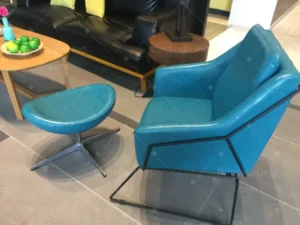
- Which packages are loose, movable FF&E — task seating, workstations, lounge and lobby furniture, casegoods, window treatments, decorative lighting — where the coverage test is usually different and frequently narrower.
- Which packages sit on funding that carries no domestic content clause at all, which is common on locally funded civic buildings and on public projects outside the United States.
Whether a specific item is covered depends on the funding source, the award date and the exact contract clauses, and any waiver route is a determination for your contracting officer and project counsel — not something a sourcing agent decides. Our job is to give you accurate origin and manufacturing information for every line so that determination can be made correctly, and to price only the scope that is genuinely open. Outside the United States this problem mostly disappears: Australian, UK, Gulf and Caribbean public projects are typically governed by performance standards and certification rather than origin, which is why they source a much larger share of their commercial FF&E and building materials from China.
What Documents Are Needed, and When?
This table is the backbone of a public project procurement plan. Build it at bid stage, not at award.
| Project stage | Procurement action | Documents required |
|---|---|---|
| Bid / tender | Price the specified scope; confirm what can be built to spec at quantity | Product data sheets, certification and type-test references, compliance matrix, country-of-origin statement, schedule of proposed alternates |
| Award | Lock the specification, open the submittal process | Full submittal package per spec section: technical data, finish and fabric samples, warranty statement, substitution requests if any |
| Shop drawing stage | Translate the spec into buildable, dimensioned drawings | Shop drawings with materials, hardware and finishes tagged; approved / approved-as-noted returns logged with revision numbers |
| Sample approval | Confirm the physical article before mass production | Control sample or prototype, finish and fabric swatches, hardware samples, signed sample approval record held as the production benchmark |
| Production | Build to the approved documents with no silent change | Production schedule broken down by building, floor or zone; written change requests only; material records for traceability |
| Pre-shipment | Verify against the approved sample before anything leaves China | Inspection report issued before shipment with photo and video records, packing list, carton marking coded to delivery zone |
| Shipping | Match arrival dates to the site handover programme | Staged delivery plan, container manifest per phase, bill of lading, commercial invoice, packing list, origin declarations |
| Installation and closeout | Hand over the documentation set | Care and maintenance data, warranty documents, replacement parts list, attic stock delivery record, as-built finish schedule |
Two stages consistently cause the most delay: shop drawing approval and sample approval. Public sector reviews often run two to three revision rounds before a drawing is released, and each round is a real calendar cost. Understanding the shop drawing approval cycle with Chinese factories and running the sample approval process in parallel rather than in series is usually where a public project timeline is won or lost.
Sourcing this for a commercial project?
FBM Sourcing works with project owners, developers, main contractors and FF&E contractors on hotel, apartment, school, office and other commercial building projects. Send us your BOQ, drawings or product list — our team will review it and get back to you.
Which Certifications Are Non-Negotiable in a Public Building?
Public buildings are occupied by the general public, staffed all day, and inspected. The certification floor is higher than a private office.
Accessibility
In the United States the 2010 ADA Standards drive the dimensions of anything the public touches. Accessible work surfaces and counters are set at 28 to 34 inches above finished floor, with knee clearance of at least 27 inches high, 30 inches wide and 11 to 25 inches deep; unobstructed side reach runs between 15 and 48 inches. Reception desks, service counters, library and classroom tables and clinic check-in stations all get caught by this. Australia uses AS 1428.1 for the equivalent design requirements. The same discipline we apply to ADA compliance in hotel FF&E transfers directly to civic and government interiors, and it has to be built into the shop drawing, not corrected on site.
Furniture performance
Task seating for government offices is normally specified to ANSI/BIFMA X5.1, desks and tables to X5.5, and school and lecture seating to X6.1. These are performance and durability standards with defined cyclic load tests, and they exist precisely because public sector furniture gets used harder and longer than domestic furniture. Our note on ANSI/BIFMA certification for commercial furniture made in China covers what to ask for and what the certificate actually proves.
Fire and interior finish
Wall panels, acoustic treatments, wood veneer and laminate surfaces in corridors and assembly spaces are usually specified as ASTM E84 Class A — flame spread index 0 to 25, smoke developed index 450 or less. Textile and expanded vinyl wall coverings in many occupancies additionally require an NFPA 286 room corner test. Seating foam supplied into US public buildings is normally required to meet CAL TB 117-2013.
How Long Does It Last, and Who Supplies the Spare Parts?
Public sector furniture is bought on a service life measured in decades, not on a refurbishment cycle. That changes the product decision. Substrate matters more than surface: for casegoods and joinery in high-traffic public areas, the choice between plywood, MDF and particleboard is a durability decision with a ten-year consequence, not a cost line to be shaved.
Two contract clauses show up on almost every public FF&E package and both need to be priced at bid, not discovered later:
- Warranty and replacement parts. Public contracts commonly require multi-year warranty cover on frames and mechanisms plus a commitment that replacement parts — casters, gas lifts, arm pads, drawer slides, hinges, edge trim — remain available for the warranty period. That is only real if the same product stays in production, which is a sourcing decision made at the start.
- Attic stock. Facilities teams are usually given a spare allowance of finish materials and furniture components, with the quantity stated in the project specification, delivered and logged at handover. It is cheapest to build it into the original production run, not to reorder a single carton two years later.
Staged Delivery, Site Access and Container Planning
Government projects are rarely handed over in one piece. A civic complex may be released floor by floor, a school block by block, a hospital department by department, and each release has its own snagging and acceptance. Site access is often the binding constraint: restricted delivery windows, no laydown area, one goods lift, and in secure facilities an escort requirement for every delivery crew.
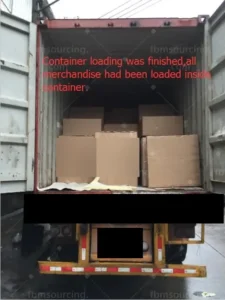
Container planning has to follow that programme. How you fill a 40ft high cube decides how much double handling happens on site. Loading by zone — one container per floor or per department, cartons marked to the room number on the finish schedule — costs nothing extra at the factory and saves days at the other end. The same logic we use for hotel FF&E container planning applies here, with the added constraint that a public handover date is usually contractual.
Plan transit realistically. From main Chinese ports, sea freight transit time is confirmed by the carrier at booking, before port congestion, inland haulage and customs clearance. For custom casegoods, joinery and seating, allow around four months from deposit to shipment (around two months for drawings and around two months for production). Work backwards from the handover date and the approval stages will tell you when the tender needs to be awarded.
Payment Terms, Bonds and Traceability
Public projects pay on certified progress, which means the money reaches the procurement chain later than on private work. Bonding is a related issue and worth being precise about: in the United States, federal construction contracts above the Miller Act threshold require performance and payment bonds from the prime contractor, and many state and municipal jobs mirror that. Those bonds sit with your prime or your FF&E contractor. A China-based sourcing agent is not a bondable party under those statutes and should not claim to be — what we do is sit inside your supply chain with transparent, documented terms so the risk you are carrying is visible rather than hidden.
Two things make that workable. First, a clear commercial structure: for suppliers you nominate, we charge a 5% commission; for products we source for you, we quote a direct price, so the project sees one accountable price from FBM Sourcing. Second, clarity on where responsibility transfers — whether the goods are bought FOB, CIF or DDP decides who is exposed if a vessel rolls or a customs entry stalls, and on a public job carrying liquidated damages that is not an academic question.
Why Public Projects Need a Sourcing Agent on the Ground in China
The manufacturing is not the hard part. Chinese factories build public-grade furniture, joinery, doors, flooring and lighting to international standards every day. What fails on public projects is the gap between a specification written in Sydney, Chicago or Abu Dhabi and a production line 12,000 km away that has never read that specification section.
That gap is what a sourcing agent closes. In practice it means four things: aligning the specification with what can actually be produced before you commit at tender; assembling the submittal package so that data sheets, certification references, drawings and samples arrive as one coherent set rather than in fragments; inspecting the goods before shipment against the approved control sample, with photo and video records supplied to the project; and coordinating staged shipments so containers land in the order the site can receive them. FBM Sourcing carries all of it as one line of responsibility — selection, sampling, production follow-up, pre-shipment inspection by our own team, consolidation and booking — which is why project owners and FF&E contractors use us instead of managing a dozen separate relationships from another continent.
Museums, galleries and visitor centres add one more layer to a public building package: their showcases are specified against conservation, security and loan requirements as well as building codes. Our guide to museum display cases from China covers the materials testing, security glazing and documentation points that change the order.
Public-realm packages often include benches, bins and shelters. Our guide to street furniture manufacturers in China explains which production line fits each item and the evidence to compare.
FBM Furniture
If you are an FF&E contractor, see furniture sourcing in China for FF&E contractors on fbmfurniture.com, the site of FBM Furniture, the furniture sourcing line of FBM Sourcing Limited.
Get a China Procurement Quote for Your Project
If you have a government office, civic building, public school, clinic or other publicly funded project going to tender or already awarded, send us the specification sections and finish schedule, the BOQ or product list with quantities, any drawings you have, the destination port, and the site handover programme. Tell us which packages you believe are covered by domestic content clauses and which are open — we will price only the open scope and give you clear origin and manufacturing information on every line so your team can verify the rest.
Our team will review the scope with you, flag anything in the specification that will cause a submittal problem, and come back with a structured quotation and a procurement programme mapped to your handover dates. Start on the China building materials and FF&E procurement page, or message us directly on WhatsApp.