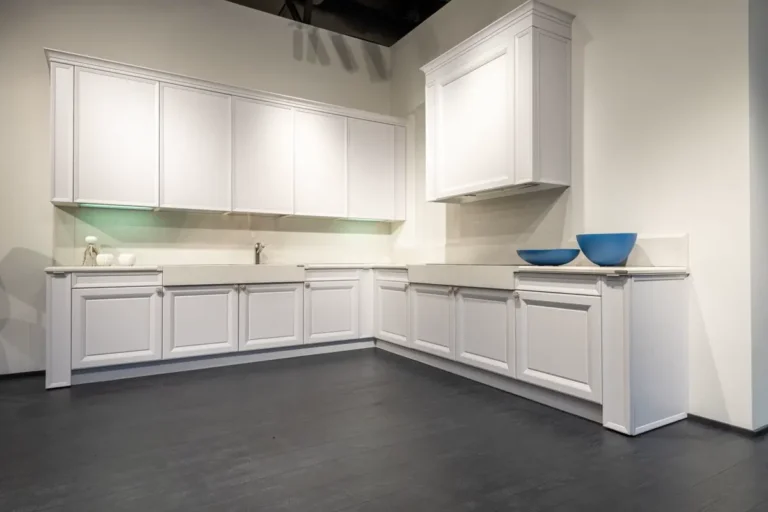
Kitchen cabinets for a Gulf project are bought from three different kinds of Chinese supplier, and the difference matters more in the GCC than almost anywhere else. The listed custom-home groups — Oppein, Suofeiya, Zbom, Gold Medal Kitchen and Holike — are retail-led businesses with project divisions whose disclosures a buyer can actually check. Below them sit export-oriented cabinet mills built around board processing and flat-pack shipping, and below those, trading companies that book capacity they do not own. What decides whether any of them can serve a Riyadh, Dubai or Doha project is not the catalogue: it is whether the carcass, edge banding, film and hardware are specified for 45 °C ambient heat and high coastal humidity, and whether the conformity paperwork the destination requires exists before the container is booked rather than after it arrives.
This guide is written for developers, general contractors, builders, commercial project owners, interior design and construction companies and FF&E solution providers delivering apartment towers, hotels, staff accommodation and mixed-use schemes in Saudi Arabia, the UAE, Qatar, Oman, Kuwait and Bahrain. It names the companies whose listings are public and checkable, describes the rest of the market by supplier type, and sets out the evidence that has to be in hand before a Gulf kitchen order is placed.
What Are You Actually Buying When You Buy “Kitchen Cabinets” from China?
A kitchen order is four separable purchases that a single quotation usually hides: the carcass board and its edge banding; the door front and its finish; the hardware, meaning hinges, runners, lift systems and handles; and the worktop, which is frequently a different factory and sometimes a different country. A quotation that gives one rate per linear metre without breaking these out cannot be compared with another quotation, and it cannot be checked against a Gulf specification either, because every one of the four behaves differently in heat.
The finish choice is the one most often made on appearance and regretted on site. PVC and thermofoil-wrapped doors are the cheapest way to get a painted look, and they are also the finish most likely to lift at the edges beside an oven or a south-facing window in a Gulf kitchen. Lacquer and acrylic behave better under heat; melamine on a moisture-resistant substrate is the workhorse for staff accommodation and mid-market apartments. The trade-off between the three is set out in melamine vs PVC vs lacquer cabinet finishes.
Publicly Listed Companies a Gulf Project Buyer Can Verify
We name only companies whose listing and disclosures are public and checkable, and we state plainly what each one does. Everything else in this guide is written as a supplier type.
- Oppein Home Group (欧派家居), Shanghai Stock Exchange: 603833. Guangzhou-based, founded 1994, the largest disclosed revenue in the custom-home category. Built on domestic franchise showrooms selling kitchens, wardrobes, bathroom cabinets and wooden doors, with a separately disclosed project channel serving developers. Role note: a retail brand with a project division, not an export cabinet mill. Evidence to request: which subsidiary and plant would contract with you, whether that entity has shipped complete kitchens into the GCC before, and whether the conformity route for the destination market has already been walked.
- Suofeiya Home Collection (索菲亚家居), Shenzhen Stock Exchange: 002572. Guangzhou-based, listed 2011, historically a wardrobe-led custom furniture group that added kitchens under a separate brand. Role note: strongest in wardrobes and wall systems; kitchens are a second business. Evidence to request: whether the kitchen plant and the wardrobe plant are the same legal entity, and which one holds the board and hardware evidence you will rely on.
- Zbom Home Technology (志邦家居), Shanghai Stock Exchange: 603801. Hefei-based, listed 2017, with kitchens as its original and largest category and a disclosed bulk-project business alongside retail. Role note: one of the few listed groups where kitchens rather than wardrobes are the core. Evidence to request: the project-channel contact rather than the export-trade desk, and multi-unit kitchen references outside China.
- Gold Medal Kitchen (金牌厨柜), Shanghai Stock Exchange: 603180. Xiamen-based, listed 2017, kitchen-led with a disclosed developer channel. Role note: a kitchen specialist by origin, smaller in overall scale than the two Guangzhou groups. Evidence to request: capacity commitment for phased handover across several hundred units, and how colour-batch consistency is controlled between phases.
- Holike Creative Home (好莱客), Shanghai Stock Exchange: 603898. Guangzhou-based, listed 2015, wardrobe-led with kitchens added later. Role note: relevant when the same package covers fitted wardrobes and kitchens, which is common in Gulf apartment towers; less so for kitchen-only orders.
The equivalent lists written for other destination markets, with the same companies seen through a different compliance lens, are at top kitchen cabinet manufacturers in China for UK housing and build-to-rent projects, for Australian apartment and BTR projects and for US multifamily.
The Supplier Types That Make Up the Rest of the Market
1. Export-oriented cabinet mills
- Where: Guangdong, Zhejiang, Shandong and Jiangsu, with a concentration of export mills around Foshan and Ningbo.
- What they are: private factories built around panel saws, edge banders and CNC machining, shipping flat-packed or rigid carcasses to overseas distributors and projects. No retail network.
- Strength: price and container efficiency on repetitive apartment or staff-accommodation kitchens; willing to build to the buyer’s drawings rather than to a house range.
- Evidence to request: board emission test on the substrate actually being used, moisture-resistant board confirmation for sink and wet units, edge-banding adhesive and its heat rating, hardware brand and model with cycle-test data, and photographs of a completed export order rather than of a showroom.
2. Worktop and stone suppliers
- Where: quartz surfacing in Guangdong, Shandong and Fujian; granite and sintered stone from separate plants again.
- What they are: a different industry from cabinet manufacture, with different lead times, different packing and different breakage risk in transit.
- Evidence to request: slab thickness and tolerance, edge profile capability, template and fabrication responsibility, and who carries the risk for breakage in transit and for site re-measure.
- Note: many Gulf projects fabricate worktops locally from imported slabs because template accuracy on site beats pre-cutting in China. That is usually the right call on anything with an island or a complex return.
3. Trading companies and showroom intermediaries
- What they are: companies that quote a kitchen package without owning the production line, then place it with whichever mill has capacity at the time.
- Why it matters in the Gulf: the conformity paperwork, the Arabic-language documentation and the heat specification all depend on knowing which plant actually built the goods. When the plant changes between phase one and phase two of a tower, the colour batch and the edge-banding adhesive change with it, and nobody tells the buyer.
- How to tell: ask for the manufacturing entity’s name on the test reports and on the invoice, and check whether they match the company you are contracting with.
Pricing a kitchen package for a Gulf project?
FBM Sourcing works with developers, general contractors, builders, commercial project owners, interior design and construction companies and FF&E solution providers on apartment, hotel and staff-accommodation schemes across the GCC. Send the kitchen schedule or BOQ and we will return it priced by carcass, front, hardware and worktop separately, with the heat and humidity specification written in.
What Gulf Evidence Must Be in Hand Before You Order?
- Saudi conformity through SABER. Goods entering Saudi Arabia are cleared through the SABER platform. Where the HS code falls under a SASO technical regulation, the importer needs a Product Certificate of Conformity for the product and a Shipment Certificate of Conformity for each consignment. The first question to settle is therefore whether the cabinet and its components fall under a regulation at all, and if any electrical items travel in the same container they almost certainly do. The route is described in SASO and SABER certification for building materials to Saudi Arabia.
- UAE conformity. Furniture is not generally a regulated product under the Emirates Conformity Assessment Scheme, but appliances, extraction and lighting built into the kitchen are, and they are usually bought on a separate line. See ESMA and UAE conformity requirements for building materials from China.
- Qatar, Kuwait, Oman and Bahrain. Each runs its own conformity route and each differs on which products are caught and on whether a certificate is needed per shipment. The comparison is at which conformity rules apply in Qatar, Kuwait, Oman and Bahrain.
- Arabic documentation. Invoices, packing lists, certificates of origin and product labelling frequently have to be presented in Arabic or bilingually, and the certificate of origin usually needs attestation. What a Gulf project actually needs from a Chinese supplier is set out in what Arabic-language documents a Gulf project requires.
- Heat and humidity specification. Moisture-resistant substrate on all sink and wet-area units; edge-banding adhesive rated for the temperature the kitchen will actually reach; PVC or thermofoil avoided beside ovens and hobs; hardware finish selected for corrosion resistance on coastal projects; and a delivery and storage plan that does not leave flat-packed board standing in an uncooled site store through the summer. The last of these causes more Gulf kitchen failures than any factory defect.
- Local content on government-funded work. Saudi public-sector and semi-public projects increasingly carry local-content requirements, which can affect whether a fully imported kitchen is acceptable or whether final assembly has to happen in the Kingdom. Confirm this with the employer before the package is scoped, not after.
Which Supplier Route Fits Which Gulf Project?
| Project scenario | Which route fits | Why | What would change the answer |
|---|---|---|---|
| 400-unit apartment tower in Dubai or Riyadh, repeating kitchen layouts | Export cabinet mill, consolidated by a China sourcing partner, worktops fabricated locally | Repetition rewards a mill built for flat-pack volume; local worktop fabrication removes the highest-risk transit item | If the developer wants a recognised brand on the sales brochure, a listed group’s project channel becomes relevant |
| Hotel with guest-room pantries plus back-of-house joinery | Casegoods or joinery factory rather than a kitchen mill | Pantry units are joinery, not modular kitchen, and usually match guest-room finishes | If there is also a staff canteen, a commercial kitchen equipment supplier joins the package |
| Staff accommodation or labour village, several thousand units | Export mill on a melamine and moisture-resistant board specification | Durability and replaceability matter more than finish; phased delivery is the main risk | — |
| Villa compound or high-specification residences with fitted wardrobes in the same package | Listed custom-home group covering kitchens and wardrobes, or a mill plus a wardrobe factory | One design language across kitchens and wardrobes is easier from one source | If the design calls for veneer or lacquer at a high standard, a specialist joinery factory beats a volume mill |
How Do Kitchen Cabinets Ship to the Gulf?
Flat-packed carcasses use container volume far better than assembled units and arrive with less transit damage, but they transfer assembly labour to site, which is a real cost and a real programme item on a tower with a tight handover. Assembled or rigid carcasses cut site labour and speed handover but cost roughly twice the container space and are more easily damaged. The trade-off is set out in do FF&E orders from China arrive assembled or flat-packed.
Sea freight from South China to Jebel Ali is commonly around three weeks port to port, with Dammam, Jeddah, Hamad, Shuwaikh and Khalifa bin Salman varying by service and transhipment. Two calendar items decide whether a Gulf kitchen programme holds: the Chinese New Year shutdown, which stops production for several weeks and slows it either side, and Ramadan, which changes site working hours at the receiving end. Port options and transit differences are compared in shipping from China to Saudi Arabia: Dammam vs Jeddah vs Jebel Ali.
Why This List Has No Scores, Ratings or Supplier Links
A numbered ranking of private Chinese cabinet factories would be an opinion presented as a finding. There is no audited disclosure behind a private mill’s claim about capacity or completed projects, and a scoring column invites a buyer to treat a guess as data. So this page names only the listed companies, whose filings can be read, describes the remainder by supplier type, and gives the evidence to request in each case. We also do not link out to manufacturers: the useful thing a buyer can do with this page is take the evidence list into their own enquiries.
Where FBM Sourcing Fits
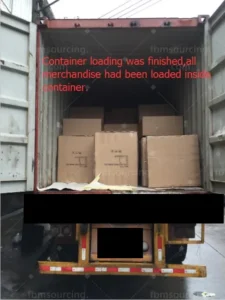
FBM Sourcing is the China sourcing partner in this picture, not a manufacturer and not a showroom. We work for developers, general contractors, builders, commercial project owners, interior design and construction companies and FF&E solution providers, and we do not sell to individual homeowners. On a Gulf kitchen package we shortlist the factory that actually runs the line, fix the carcass, front, hardware and worktop specification in writing before sampling, confirm the conformity and documentation route for the destination market, inspect the bulk order at the factory with photo and video records before it is packed, and plan the loading into full containers for Jebel Ali, Dammam, Jeddah, Hamad or Khalifa bin Salman. The wider industry view is at the China kitchen cabinet industry in 2026, and the broader Gulf procurement route at how UAE and Middle East contractors source from China.
Pricing a kitchen package for a Gulf project?
FBM Sourcing works with developers, general contractors, builders, commercial project owners, interior design and construction companies and FF&E solution providers on apartment, hotel and staff-accommodation schemes across the GCC. Send the kitchen schedule or BOQ and we will return it priced by carcass, front, hardware and worktop separately, with the heat and humidity specification written in.
Frequently Asked Questions
Are there listed Chinese companies making kitchen cabinets for export projects?
Yes. Oppein (SSE 603833), Suofeiya (SZSE 002572), Zbom (SSE 603801), Gold Medal Kitchen (SSE 603180) and Holike (SSE 603898) are all listed and publish audited accounts, and each has a disclosed project channel alongside its retail business. They are retail-led groups with project divisions rather than export mills, so the practical question is which subsidiary and which plant would contract with the buyer, and whether that entity has shipped complete kitchens into the GCC before.
Do kitchen cabinets from China need SASO or SABER certification for Saudi Arabia?
Goods entering Saudi Arabia clear through the SABER platform, and whether a Product Certificate of Conformity and a per-shipment Shipment Certificate of Conformity are needed depends on whether the HS code falls under a SASO technical regulation. That has to be checked for the specific goods before shipping rather than assumed. Any electrical items travelling in the same container, such as hobs, hoods or lighting, are much more likely to be regulated than the cabinets themselves.
What cabinet specification survives Gulf heat and humidity?
Moisture-resistant board on all sink and wet-area carcasses, edge-banding adhesive rated for the temperature the kitchen will reach, lacquer or acrylic rather than PVC or thermofoil beside ovens and hobs, corrosion-resistant hardware finishes on coastal projects, and controlled site storage so flat-packed board is not left in an uncooled store through summer. Site storage causes more Gulf kitchen failures than manufacturing defects do.
Should worktops be cut in China or fabricated locally in the Gulf?
On anything with an island, a complex return or a tight tolerance against a wall, local fabrication from imported slabs is usually the safer route, because site template accuracy beats pre-cutting to drawings and because slab breakage in transit is a real risk. Pre-cut worktops make sense on highly repetitive layouts where the same unit is built hundreds of times and the site dimensions are verified.
What is the minimum order for kitchen cabinets from China?
FBM Sourcing works on full-container-load orders for commercial projects and does not consolidate part loads. In practice that means the kitchen package needs to be large enough to fill containers on its own or to be consolidated with other lines from the same project.
About FBM Sourcing
FBM Sourcing manages the entire China procurement package for overseas construction projects. Sourcing since 2014, we work with developers, general contractors, builders, commercial project owners, interior design and construction companies and FF&E solution providers as their sourcing partner in China — from the BOQ or kitchen schedule through factory selection, sampling, inspection by our own team, consolidation and shipping, with every quotation and shipping document issued in our own name. If you have a kitchen package for a Gulf project to price, start at https://fbmsourcing.com/china-building-materials-ffe-procurement/.