Building materials shipped from China to the UAE fall under three layers of conformity: the federal ECAS and EQM schemes now run by the Ministry of Industry and Advanced Technology (MoIAT, which absorbed ESMA), the GCC-wide GSO Technical Regulations such as the G-mark for low-voltage electrical products, and emirate-level approvals such as Dubai Civil Defence for anything with a fire-life-safety function. In practice a UAE contractor needs, per product line, a certificate or Declaration of Conformity issued against the relevant UAE.S or GSO standard, backed by test reports from an ILAC-MRA accredited laboratory and, for EQM products, a factory audit. None of this is a per-shipment platform like Saudi SABER; the certificates sit with the product and the factory, and the paperwork must be complete before the container is booked. On projects like this, FBM Sourcing works as your dedicated sourcing partner.
For a contractor sourcing doors, windows, tiles, sanitary ware, lighting, cables, insulation, paints or cement and steel from China, the compliance sequence looks like this:
- Step 1 — Classify each BOQ line against the current MoIAT regulated-product lists (ECAS, EQM, RoHS, energy and water efficiency), the GSO Low Voltage Technical Regulation, and the UAE Fire and Life Safety Code of Practice.
- Step 2 — Collect factory test reports against the named UAE.S / GSO / EN / ISO standard, from a lab accredited under ILAC-MRA (CNAS-accredited labs in China are accepted where the scope matches).
- Step 3 — Apply through an ESMA/MoIAT-notified certification body for ECAS, EQM or G-mark; EQM adds an on-site factory audit and annual surveillance.
- Step 4 — Secure emirate-level approvals (Dubai Civil Defence product registration, Dubai Municipality / DCL registration for some building products) before the material reaches site.
- Step 5 — Package the file — certificates, DoC, test reports, marking photos and Arabic/English labels — with the commercial and shipping documents so customs and the consultant can clear the material without a hold.
Which UAE conformity schemes apply to building materials?
ESMA, the Emirates Authority for Standardization and Metrology, was merged into MoIAT in 2020, and the schemes it created continue under the ministry’s name. Consultants and QS teams in the UAE still say “ESMA certificate” on tender documents, so a Chinese factory will hear both names for the same thing.
The federal toolkit has three parts. ECAS (Emirates Conformity Assessment Scheme) is the mandatory product-certification route for regulated categories: the certificate is issued against a UAE.S standard, and the product carries the ECAS mark. EQM (Emirates Quality Mark) is a higher-tier scheme that combines product testing with a factory quality-management audit; it is voluntary for many products but has been made mandatory for a defined list of building materials since 2019, and it is renewed on a three-year cycle with annual surveillance. UAE.S standards are the national standards, most of them adoptions of GSO, ISO or EN texts.
Above the federal layer sits the GSO (GCC Standardization Organization). Its Technical Regulation for Low Voltage Electrical Equipment (BD-142004-01) covers equipment rated 50–1000 V AC and requires the G-mark plus a Gulf Conformity Tracking Symbol for listed products; the same certificate is recognised across the seven GCC states, including the UAE and Saudi Arabia. Below the federal layer sit the emirates: Dubai Civil Defence (DCD) and its counterparts in Abu Dhabi and Sharjah control fire-rated doors, fire-resistant cables, cladding, insulation and passive fire products under the UAE Fire and Life Safety Code of Practice, while Dubai Municipality and the Dubai Central Laboratory register certain building products for use inside the emirate.
The MoIAT portal publishes the current regulated-product lists, and the lists have been expanded in stages since 2019, so a classification done for a 2022 project cannot be copied onto a 2026 BOQ without rechecking.
Which product categories need certification, and under which scheme?
The table below maps the categories most commonly sourced from China for hotel, apartment, school, hospital and office projects to the scheme that usually applies. Treat it as a planning grid, not a legal opinion: the deciding factor is the specific product, its rating and its end use as shown on the drawings.
| Product category | Applicable UAE scheme | Key document the factory must supply | Typical timeline (weeks) |
|---|---|---|---|
| Cement, concrete blocks, steel rebar | EQM under the UAE building-materials control scheme; DM/DCL registration in Dubai | Test reports to the UAE.S / GSO / EN standard, ISO 9001 factory audit report, EQM certificate | 8–12 |
| Ceramic and porcelain tiles | EQM / ECAS building-materials scope; DM/DCL registration in Dubai | ISO 13006 / ISO 10545 test reports (water absorption, breaking strength, slip), DoC | 6–10 |
| Sanitary ware, taps, showers, WCs | MoIAT water-efficiency labelling (ECAS-based); consultant spec often adds WRAS/CE-type test data | Flow-rate and flush-volume test reports, water-efficiency label registration, DoC | 4–8 |
| Thermal insulation boards, mineral wool | EQM building-materials scope; DCD product listing where used in facades or fire compartments | Thermal conductivity report, EN 13501-1 reaction-to-fire report, DCD certificate of conformity | 10–16 |
| Interior paints and coatings | ECAS (VOC limits) within the building-materials scheme | VOC content test report, DoC, labelling in Arabic and English | 4–8 |
| LED luminaires, lamps, drivers | GSO G-mark (low-voltage), MoIAT lighting energy-efficiency and RoHS ECAS | IEC 60598 / IEC 62560 safety reports, energy-performance report, RoHS declaration, G-mark certificate | 6–10 |
| Cables and wiring accessories | ECAS for cables; G-mark for switches, sockets and accessories; DCD listing for fire-resistant/low-smoke cables | IEC 60227 / IEC 60502 reports, BS 6387 or IEC 60331 fire-resistance report where specified, DCD certificate | 8–14 |
| Fire-rated doors and doorsets | Dubai Civil Defence product approval (per emirate) | EN 1634-1 or UL 10C fire test report from an accredited lab, DCD certificate, factory production control evidence | 10–16 |
| Aluminium windows, curtain wall, glass | No federal ECAS for the window itself; safety glass to UAE.S/EN 12150, DCD for cladding and spandrel systems, DM/DCL for glass in Dubai | Glass fragmentation and impact test reports, thermal/air/water performance reports, DoC | 4–8 (glass); 10–16 if cladding is DCD-listed |
Two hard rules sit behind the table. First, an ECAS or EQM certificate is issued to the manufacturer and the product model, not to the shipment, so a certificate obtained for one Chinese factory cannot be transferred to a second source if the order is split. Second, DCD approvals are emirate-specific: a fire door listed with Dubai Civil Defence still needs Abu Dhabi Civil Defence listing for a hospital in Abu Dhabi, and that second listing adds its own processing time unless the factory already holds it. Our guide to fire-rating standards for building materials and finishes explains how EN, BS and UL test classes map to the ratings that DCD asks for.
Sourcing this for a commercial project?
FBM Sourcing works with project owners, developers, main contractors and FF&E contractors on hotel, apartment, school, office and other commercial building projects. Send us your BOQ, drawings or product list — our team will review it and get back to you.
How is UAE conformity different from Saudi SASO and SABER?
Contractors working across the Gulf often assume one GCC certificate covers both markets. It does not, except for G-mark low-voltage electrical products, where the same GSO certificate is accepted in Riyadh and Dubai. For everything else the two systems differ in structure, not just in name.
Saudi Arabia runs SABER, an online platform on which every regulated product needs a Product Certificate of Conformity and then a separate Shipment Certificate of Conformity for each consignment before it can clear customs; the shipment certificate is tied to the invoice and issued by the certification body once the product certificate is in place. The UAE has no equivalent per-consignment platform for building materials. ECAS and EQM certificates are product-level and stay valid for the period each scheme sets; the shipment itself clears on the commercial invoice, packing list, certificate of origin and the product certificate copies. The practical consequence is that a UAE order fails earlier — at product registration — while a Saudi order can fail later, at the shipment stage, if the SABER file is incomplete.
The second difference is the weight of emirate-level fire approval. Saudi Civil Defence relies largely on SASO product conformity plus consultant sign-off, whereas Dubai Civil Defence runs its own product-listing regime and site inspections, so a fire door or cable that is fully SASO-compliant still has no standing in Dubai without a DCD certificate. If your programme covers both countries, our article on SASO and SABER certification for building materials in Saudi Arabia covers the Saudi side in the same detail, and the GCC and Saudi Arabia project sourcing page explains how we run parallel compliance tracks for a single factory order.
What documents must a Chinese factory supply?
A certification body will not open an ECAS, EQM or G-mark file on a factory’s word. The file has to be built from documents that the factory either already holds or can obtain, and the gaps in that file are the single most common cause of a delayed container. For a typical building-materials line the checklist is:
- Test reports against the exact standard named in the scheme (UAE.S, GSO, IEC, EN or ISO), issued by an ILAC-MRA accredited laboratory. Reports must fall within the validity period the certification body sets and match the model, dimensions and materials of the product being shipped; a report for a 44 mm door leaf does not cover a 54 mm leaf.
- Manufacturer’s Declaration of Conformity (DoC) on company letterhead, quoting the standard, model numbers, factory address and signatory, in English with an Arabic version where the scheme requires it.
- Quality-management evidence — a valid ISO 9001 certificate for ECAS and G-mark, and for EQM an on-site factory audit by the certification body covering production control, calibration and traceability.
- Technical file: drawings, bill of materials, critical-component list (drivers, glass, hardware, insulation core), user or installation instructions, and marking artwork showing the ECAS/EQM/G-mark and the certificate number as it will appear on the product.
- Labelling proof: photographs of the product, packaging and rating plates with the marks applied, since UAE customs and consultants check the physical mark, not just the paper.
The most useful screening question for a sourcing team is not “are you certified?” but “send the certificate number and the test report it was issued on.” It is common for a factory quoting into a Gulf tender to hold a certificate for a neighbouring model or an expired report, and that only surfaces when the file is opened. Our broader guide to certifications for importing building materials from China covers how the same test-report logic plays out for CE, UKCA and North American markets.
How does the certification timeline fit into a container order?
Certification and production must run in parallel, and the certification track is usually the longer one. Production for doors, windows, tiles, sanitary ware and lighting runs on a lead time confirmed by the factory in writing for each order from approved shop drawings and deposit; sailing time from South China ports to Jebel Ali is confirmed by the carrier at booking; and port and customs clearance at Jebel Ali follows. Against that, G-mark or ECAS files, EQM files with a factory audit and DCD product listing each carry processing times set by the certification body or authority, so they should start alongside production. A category that needs new fire testing rather than a review of existing reports adds the laboratory’s test slot on top.
The planning rule that follows is simple: the compliance file for any regulated product must be opened at or before shop-drawing approval, never at pre-shipment inspection. For a hotel taking multiple 40HQ containers of doors, wardrobes, tiles and sanitary ware, that means the fire-door and cable listings are running before the first deposit is paid, while lighting G-mark and paint ECAS certificates are secured while the joinery is still in production. Where the project falls across Chinese New Year, add the factory shutdown, with dates confirmed by each factory, to both tracks, because certification bodies’ China offices and CNAS labs close for the same period.
Ordering sequence matters as much as duration. Long-certification, long-production items — fire doors, insulation, fire-resistant cable — go into the first purchase orders; short-certification items such as tiles and paints can follow in later containers without holding up the site. Splitting a single supply into two shipments with the same certificate is straightforward in the UAE, since the certificate is product-level; splitting between two factories is not, because each factory needs its own file.
How does a China sourcing agent package the paperwork before shipment?
FBM Sourcing manages the entire China procurement package for overseas construction projects. On a UAE order that package has a compliance layer built into it from the RFQ stage: each BOQ line is tagged with the scheme it falls under, factories are shortlisted on the certificates and reports they already hold, and the RFQ states the required marks so quotes are like-for-like from the start.
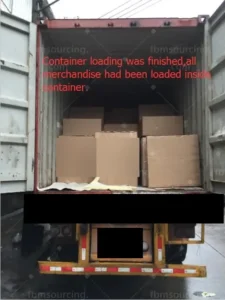
Once production is finished, our own team carries out a full pre-shipment inspection on the factory floor, with photo and video records delivered before the container is sealed. That inspection includes a marking check — ECAS, EQM, G-mark and DCD certificate numbers on the product, packaging and rating plates — because a certified product shipped without the physical mark is treated by the consultant as uncertified. The compliance documents are then bound into the shipping file with the commercial invoice, packing list, certificate of origin and bill of lading, so the customs broker and the site QA/QC engineer receive one indexed set rather than a chain of factory emails.
The value of a building material sourcing agent on a Gulf project is that these steps happen in China, at the factory, weeks before the goods reach Jebel Ali or Khalifa Port. Our page for UAE and Middle East contractors sourcing from China sets out how the same team handles the shop-drawing cycle, consolidation and container loading for mixed material packages, with a 5% commission for suppliers you nominate (products we source for you are quoted at a direct price).
Where a package also has to satisfy Saudi requirements, or the same product family is being specified across several markets at once, the regimes are compared side by side in window and door export certifications by market, and the way conformity fits into a hospitality procurement programme is set out in hotel FF&E procurement from China for Saudi and GCC projects.
Fire-rated products carry a further obligation on top of general conformity, administered by Civil Defence and issued against a specific manufacturing location: which fire safety approvals a Gulf hotel project needs.
Get a China Procurement Quote for Your Project
If you are pricing a UAE hotel, apartment tower, school, hospital or office fit-out, send us the drawings or BOQ, the quantities per product line, the destination port and the site programme. We will map each line to the ECAS, EQM, G-mark or Civil Defence requirement that applies, identify which items need new testing versus a review of existing reports, and return a procurement plan that puts certification and production on the same calendar.
The earlier the compliance track starts, the less it costs the programme; a file opened at RFQ stage is a routine part of the order, while a file opened after the goods are made is a container waiting in Jebel Ali.