On a container-scale project order from China, FF&E arrives in a mix of both: items whose finished geometry is mostly air ship knocked down, and items whose strength or finish depends on being assembled in a controlled environment ship built. Wardrobes, desks, tables, bed bases, shelving and most joinery normally ship flat or knocked down; upholstered seating, casegoods with mitred veneer wraps, headboards and anything with a continuous finished face normally ships assembled with only legs or brackets removed. The format is a decision, not a default — it changes container count, site labour, installation programme and damage exposure — and it should be fixed line by line at specification stage, because the packing method has to be engineered before the first sample is approved. FBM Sourcing is your sourcing partner in China: it holds no inventory and has no product range of its own.
What Determines Whether an Item Ships Assembled or Knocked Down?
Four factors decide it, and they pull in different directions. The point of setting the format early is that only one of them is about the factory.
- Volume efficiency: knocking down a wardrobe or a desk removes the enclosed air. Across a full FF&E package, flat-packing the items that can be flat-packed typically saves 30–40% of container volume compared with shipping everything built.
- Structural integrity: a joint that is glued and clamped under press conditions in a factory is stronger than the same joint assembled with cam fittings on a corridor floor. Load-bearing and heavily used items — chair frames, bench seating, bed frames in student accommodation — are usually better built in the factory.
- Finish continuity: mitred veneer wraps, continuous grain match across a face, seamless post-formed edges and sprayed lacquer over a whole carcase cannot be created on site. If the design depends on the finish running across a joint, the item ships assembled.
- Site conditions: lift dimensions, corridor widths, stair turns and floor loading limits sometimes make an assembled item physically impossible to place. That constraint overrides the other three, and it is a site measurement question — see site measurement before custom joinery production.
The trade-off is therefore not “cheaper versus better”. It is a per-line decision where volume savings on some items subsidise the assembled shipping of others, and the total is what a project should be optimising.
Which FF&E Items Normally Ship Which Way?
Normally knocked down or flat
Wardrobes and closet systems, desks and work tables, dining and meeting tables (tops separate from bases), bed bases and platform frames, shelving and bookcases, minibar and luggage units where the carcase is a simple box, wall-hung panels and headboard panels supplied as flat elements, and almost all joinery supplied as elements for site fixing. In most of these, the finished item is a box or a plane, and the factory’s assembly step adds volume without adding much value that cannot be reproduced on site.
Normally assembled
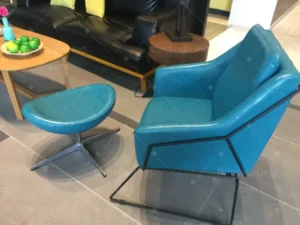
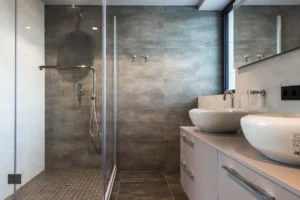
Upholstered seating — lounge chairs, sofas, banquette modules, desk chairs — because the frame, webbing, foam and cover are one process. Casegoods with continuous veneer or a wrapped mitred edge. Upholstered headboards. Bathroom vanities with a bonded top and integrated basin. Anything with a factory-fitted mechanism that has to be aligned under load: drawer runners on soft-close, sliding wardrobe tracks, lift-up mechanisms.
Usually partially knocked down
A large middle group ships with only the projecting parts removed: seating with legs off, tables with bases detached, wardrobes with doors hung but shipped separately from the carcase, mirrors and glass removed from frames. This “semi knocked down” format is often the best answer on hospitality projects because it keeps the factory-made joints intact while removing the volume penalty of the parts that stick out.
Where an item is fixed to the building rather than loose, the assembly question merges with the scope question of who installs it. Our comparison of fixed versus loose FF&E on hotel projects sets out where that boundary usually falls, and FF&E installation drawings and assembly documents covers what has to travel with a knocked-down package for site teams to build it without a factory technician present.
How Much Container Volume Does Flat-Packing Actually Save?
This is where the decision becomes arithmetic rather than preference. A 40ft high cube holds roughly 68–76 m³ of well-packed goods, and project FF&E is almost always volume-limited rather than weight-limited — the container fills before it gets heavy.
Three numbers that matter on a real package:
- Volume saving: flat-packing the flat-packable lines across a full FF&E scope typically removes 30–40% of shipped volume. On a package that would otherwise be ten containers, that is the difference between ten and six or seven.
- Carton efficiency: knocked-down panels ship in rectangular cartons that stack without voids. Assembled items ship in cartons shaped around their geometry, and the unusable space between them is real cost that does not appear on any line of a quotation.
- Packing weight: knocked-down items need more corner protection, more edge board and more internal separation per cubic metre, because panels chafe. That is a small weight and cost addition against a large volume saving — the specification for it is covered in export packing standards for furniture moving by sea freight.
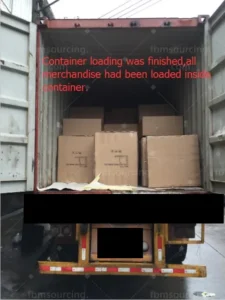
Container count is not just a freight figure. It also sets how many arrivals the site has to receive, how many unloading windows it has to book, and how the delivery sequence maps to the floor-by-floor handover. That planning side is set out in hotel FF&E container planning.
Sourcing this for a commercial project?
FBM Sourcing works with project owners, developers, main contractors and FF&E contractors on hotel, apartment, school, office and other commercial building projects. Send us your BOQ, drawings or product list — our team will review it and get back to you.
What Does Knocked-Down Shipping Cost You at the Other End?
Volume saved in the container reappears as labour, time and risk on site. A project that budgets the freight saving without budgeting the site consequence has moved a cost rather than removed one.
Site labour and programme. Every knocked-down item needs an assembly operation in a building that is usually still under construction. On a room-by-room fit-out, that operation has to be sequenced against flooring, painting and commissioning, and it competes for the same lifts and corridors. The realistic question is not whether site labour is cheaper than factory labour but whether the programme has the float and the working area for it.
Hardware completeness. A knocked-down package is only assemblable if every fitting arrives. Fixings should ship in item-matched bags inside the carton rather than in a bulk box, and a spare allowance — commonly a few per cent on small fittings — should be specified and shipped, because a project cannot stop for one missing cam lock. The counting and labelling discipline that makes this work is the same one described in room-by-room labelling on a hotel FF&E order.
Damage profile. Knocked-down panels are vulnerable at edges and corners and are easy to scuff during handling; assembled items are vulnerable to racking and to point loads on a finished face. Neither format is safer in general — they fail differently, so the protection specification differs, and a package should carry a replacement allowance either way. How defects and shortfalls are handled before the container closes is covered in handling defects and rework before a container ships.
Rectification distance. An assembly error on site is fixed on site, at site rates, with whatever material is available. A factory assembly error is caught at inspection, before the container closes. That is the strongest single argument for shipping the difficult items assembled: the control point sits where the capability is.
How Should the Decision Be Made on a Project Programme?
The workable method is to decide format line by line at specification stage and record it in the BOQ, so that it is priced, packed and drawn consistently. In practice that means answering five questions per line: does the finish run across a joint; is the joint load-bearing; will an assembled unit physically reach its final position; does the site have labour and float to build it; and does the volume saving on this item actually change container count.
Two programme habits make the outcome much better. First, decide before sampling, because a factory engineers the joint for the format it expects — a wardrobe designed as a glued carcase does not become a good knock-down product by unscrewing it later. Second, agree the format at the same time as the labelling and delivery sequence, so the cartons that arrive first are the ones the floor being handed over first actually needs.
Because most project packages are produced across several factories, the format decision also affects consolidation: knocked-down panel goods stack with each other efficiently, while assembled seating needs planned void space. How that is loaded across a mixed package is covered in consolidating multiple factories into one container.
How FBM Sourcing Sets Assembly Format on a Project Package
FBM Sourcing manages the entire China procurement package for overseas construction projects, and assembly format is one of the decisions that is settled with the client before purchase orders are issued rather than left to each factory’s habit. We go through the BOQ line by line and mark each item as assembled, knocked down or partially knocked down against the five questions above, then hold the factories to that format in the sample approval, in the packing specification and in the carton labelling.
Because we always ship by full container, the volume arithmetic is done against the actual container plan: where flat-packing a group of lines removes a container from the shipment, that saving is identified and put in front of the client as a choice, and where it does not change container count we favour the format that reduces site risk. Fixings are specified to ship item-matched with a spare allowance, installation and assembly documents are compiled as part of the package rather than requested afterwards, and all inspection is carried out by FBM Sourcing’s own team at the factory with photo and video records delivered before shipment — including verification that knocked-down cartons contain their complete hardware sets before the container closes.
All quotations, invoices and shipping documents are issued by FBM Sourcing — you deal with us, and we carry the responsibility. For suppliers you nominate, we charge a 5% commission; for products we source for you, we quote a direct price. Where a package spans several factories, they are consolidated into one shipment and one document set so the site receives a coherent delivery rather than a series of unrelated arrivals.
Get a China Procurement Quote for Your Project
If you are pricing a hotel, apartment, student accommodation, office or restaurant FF&E package from China and need the assembly format resolved before it is priced, send us the BOQ or product schedule with quantities, the destination port, the site access constraints and the required-on-site dates. Our team will mark the format line by line, show what it does to container count, and set out the quotation.
Use the quote button above or WhatsApp +86 135 6007 5057 to start the conversation.