On a commercial project order you should expect a written production update on a fixed weekly rhythm plus a report at each production milestone — materials received, first article approved, line-off, packing, and a full inspection before shipment with photo and video records. The weekly update is reporting: what has been made, what is behind, and what decision is needed from you. The milestone reports are evidence: dated photographs tied to the item numbers in your BOQ. If your only visibility is a WhatsApp message saying “production going well”, you do not have a reporting system, you have a relationship. This kind of coordination is what a sourcing partner like FBM Sourcing is for.
What Should a Weekly Production Report Actually Contain?
The test of a production report is whether a project manager who has never visited the factory can read it and know whether the container will sail on time. That requires the same five fields every week, in the same order, against the same item numbering as the purchase order.
- Line-by-line status against the PO: item code, description, ordered quantity, quantity completed, quantity packed — not a percentage for the whole order, which hides the one late item that holds the container.
- Planned versus actual dates for the current milestone, with the variance in days shown rather than described.
- Dated photographs of work in progress, showing the actual item, not a catalogue shot or a photo reused from a previous week.
- Open issues and decisions required from the buyer, each with the date it was raised and the date a response is needed to protect the shipping window.
- Confirmed or revised ex-factory date and the effect on the booking.
A report without the fourth field is the one that causes damage. Most schedule slips on a China project order are not manufacturing failures — they are decisions sitting unanswered on the buyer’s side: a fabric substitution, a finish approval, a dimension query raised against a site condition. If those are not listed with dates, the delay surfaces four weeks later as the factory’s fault when it was a two-day email.
Which Production Milestones Should Be Reported?
Five gates cover almost every furniture, joinery and building materials order. They matter because each one is the last cheap moment to fix a category of problem.
Materials in and verified
Board, aluminium, fabric, foam, stone slabs, hardware and glass arriving at the factory and being confirmed against the approved specification. This is where a substituted fabric batch or a different board grade is visible for a few days before it disappears into an assembled product. On regulated categories it is also when the mill certificates and test documentation should be collected, not at the end — the difference between a mill certificate and a type-test report is covered in factory test reports versus accredited lab testing.
First article / pre-production sample approved
One complete unit built on the production line with production materials and production tooling, photographed from every face, measured and signed off. Everything after this is repetition. The shop drawing approval cycle should already be closed before this gate, so the first article is checking execution rather than reopening design.
Line-off / bulk production underway
Real units coming off the line in volume. The useful report here is quantity completed against quantity ordered, plus the first finished units photographed alongside the approved first article so drift is visible. On a multi-factory package this is also the gate where the slowest factory becomes obvious — and on a consolidated shipment the slowest factory, not the average, sets the container date.
Packing
Cartons, corner protection, edge board, film, crating for glass and stone, labelling and carton marks. Packing is reported as a milestone rather than assumed because it is the stage most often compressed when production runs late, and compressed packing is what turns a clean production run into transit damage. What the packing should look like is set out in export packing standards for furniture shipped by sea.
Full inspection before shipment
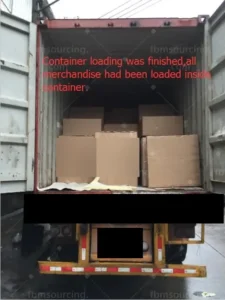
The formal quality gate. Inspection is carried out once by our own team at the factory when bulk production is finished, before shipment, recorded in photographs and video and issued against the item numbering in the order. Sampling method and acceptance criteria are covered in pre-shipment inspection and AQL sampling explained. This is the point at which goods are either loaded or held, so the report has to arrive with enough of the shipping window left to act on it.
How Is a Progress Update Different From an Inspection Report?
Project buyers frequently conflate the two, and suppliers are happy to let them. A progress update tells you where the order is. An inspection report tells you whether the goods conform. A weekly photograph of a half-assembled wardrobe is evidence of activity, not evidence of quality — it says nothing about hinge cycle testing, moisture content, finish adhesion or dimensional tolerance against the drawing.
The practical consequence is what you accept as a release condition. Release of the container should follow the pre-shipment inspection — anything below standard is recorded in the report — not progress photographs. If a supplier offers weekly photos as a substitute for a formal inspection before shipment, the offer is a downgrade. How the whole QC chain fits together is covered in how factory QC and inspection work when sourcing from China.
Sourcing this for a commercial project?
FBM Sourcing works with project owners, developers, main contractors and FF&E contractors on hotel, apartment, school, office and other commercial building projects. Send us your BOQ, drawings or product list — our team will review it and get back to you.
What Reporting Cadence Suits a Construction Programme?
Weekly is right for the production phase of a furniture or joinery run. Fortnightly is enough during the long quiet stretch of a curtain wall or custom stone programme, provided the milestone gates are still reported as they happen. Daily reporting on a standard order is a warning sign rather than a service level — it usually means nobody has agreed what the milestones are, so activity is being substituted for structure.
Two calendar realities should be written into the reporting plan rather than discovered. Chinese New Year shuts most factories for a period around the holiday and staffing returns gradually afterwards, so a report issued in the week before the holiday should state what is finished and secured, not what is planned. And on a multi-site rollout or phased FF&E delivery, reporting should be organised by shipping wave rather than by factory, because the wave is the unit the site programme actually cares about. Both are reasons to keep the schedule buffer described in what lead-time buffer a construction schedule should allow for China procurement.
What to Write Into the Purchase Order
Reporting only happens reliably when it is a contract term. Four lines are enough: the frequency and the day of the week the report is issued; the named milestones that trigger a report regardless of the weekly cycle; the requirement that photographs are dated and tied to item numbers; and the rule that the ex-factory date can only be changed in a written report, not verbally. Add the response window you commit to for buyer decisions, because the obligation runs both ways and a supplier who is waiting on you needs that on record too.
It is also worth stating who the reports go to. On projects with an owner, a main contractor and an FF&E contractor in the chain, a single distribution list avoids the situation where the site team learns about a three-week slip from the freight forwarder’s booking notice. The wider set of clauses that belong around this one is covered in contract terms that protect project buyers ordering from China.
Progress reporting is what makes a slip visible in time to act; what to do once a date has actually moved is covered in what happens if a Chinese factory misses its production deadline.
How FBM Sourcing Handles Quality Control and Documents
FBM Sourcing manages the China procurement package for overseas construction projects, so you deal with one team rather than with each factory separately.
The quality check is one full inspection by our own team on the factory floor once production is finished, before shipment, with photo and video records; you are welcome to attend it. All quotations, invoices and shipping documents are issued by FBM Sourcing — you deal with us, and we carry the responsibility. For suppliers you nominate, we charge a 5% commission; for products we source for you, we quote a direct price.
Get a China Procurement Quote for Your Project
If you have a hotel, apartment, school, office or retail package in production or about to be placed and you want reporting that a project programme can actually be run from, send us the BOQ or product schedule, quantities, destination port and required-on-site dates. Our team will review the package and get back to you.
Use the quote button above or WhatsApp +86 135 6007 5057 to start the conversation.