
A Chinese factory can legitimately provide three kinds of test documents: its own in-house QC data (moisture content, dimensional checks, hardness, salt-spray hours from its own chamber, cycle counts from its own rigs), third-party type-test reports it already holds for the product family (ASTM E84 or EN 13501-1 fire class, EN 12150 tempered glass, ANSI/BIFMA X5.1, CAL 117 or BS 5852, CARB Phase 2 / TSCA Title VI, AS 2047, ISO 10545, EN 1935), and product certificates or marks issued under a scheme. What it cannot provide is a report on your specific spec: a fire test on your fabric-and-foam combination, hurricane impact on your window size and glass make-up, an acoustic or seismic rating, or a scheme certificate the destination authority requires to be recent. Those must be commissioned fresh at an ILAC-MRA accredited laboratory (CNAS in China, NATA in Australia, UKAS in the UK), and the factory’s own QC sheets never substitute for them. FBM Sourcing operates as a sourcing agent and sourcing partner, not a trading company.
A quote pack from a Foshan furniture factory or a Guangdong window fabricator often arrives with 40 to 60 pages of PDFs, some stamped by the factory, some carrying a laboratory logo. The developer, contractor or spec writer needs a fast way to sort them into “this proves something to my building authority” versus “this is the factory telling me it checked its own work”. This article gives you that sorting method, a validity table, and the checklist FBM Sourcing uses when we collate the document pack before a project ships.
The three document types in a factory quote pack
Every test-related document from a China factory falls into one of these buckets, and the bucket determines who issued it, what it proves, and how long it stays useful.
- Factory in-house QC / test data — issued by the factory’s own QC department; proves the batch met the factory’s internal control points; valid for that batch only.
- Third-party type-test report — issued by an external laboratory (accredited to ISO/IEC 17025 if it is worth anything) on a sample of the product family; proves that a representative sample met a named standard on a named date; typically accepted for 2 to 5 years depending on the standard and the authority.
- Certificate or mark under a scheme — issued by a certification body (CARB-approved TPC, BIFMA registrant, an ESMA/SASO-notified body, an NRTL for a UL or ETL listing mark); proves the product is listed under an ongoing scheme with factory surveillance; valid while the listing is maintained, usually renewed annually.
- Project-specific fresh test — commissioned on your actual spec at an accredited lab; proves your exact fabric/foam/finish/size combination performs; validity is whatever the reviewing authority accepts, often the life of the project submission.
The number to remember: a report from a laboratory accredited to ISO/IEC 17025 under the ILAC Mutual Recognition Arrangement is recognised by more than 100 accreditation bodies worldwide, which is why a CNAS-accredited report from Guangzhou is generally accepted by an Australian certifier or a UK building-control officer, and a factory-stamped sheet is not.
What test data can a Chinese factory provide from its own QC?
Well-run factories generate useful test data on the floor; it just needs to be labelled for what it is. Typical in-house data on a hotel or apartment FF&E order includes:
- Timber and panel moisture content, checked with a pin meter, kiln-dried to the moisture content stated in the specification for the destination climate and measured at inspection.
- Dimensional checks against the approved shop drawings, usually to a stated tolerance such as ±1 mm on casegoods and ±2 mm on window frames.
- Coating hardness (pencil hardness 2H to 4H is common on catalysed lacquer) and cross-hatch adhesion on painted or powder-coated metal.
- Salt-spray hours from the factory’s own chamber on hardware and aluminium, reported in hours to ASTM B117 or ISO 9227 methodology.
- Cycle counts on the factory’s own test rigs — drawer slides, hinges, chair swivels — often reported as 30,000 to 50,000 cycles.
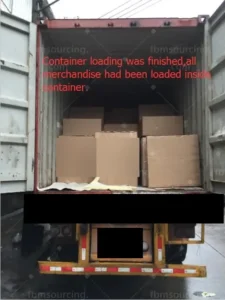
These figures tell you the factory has a functioning QC department, and we ask for them. But an in-house salt-spray result is not an EN 1670 corrosion-grade classification, and 50,000 cycles on the factory’s rig is not an ANSI/BIFMA X5.1 report; when a spec writer asks “is this hardware Grade 4 to EN 1670?”, the answer must come from an accredited lab. Our team treats in-house data as a production-control input and verifies it on the factory floor: FBM Sourcing’s own inspectors carry out a full pre-shipment inspection with photo and video records before any container is sealed. That floor inspection is visual, dimensional and functional — it is not laboratory testing, and we never present it as such.
Which third-party type-test reports do factories already hold?
Export-oriented factories in the main clusters — Foshan for furniture, Zhongshan for lighting, Guangdong and Shandong for windows and doors — usually hold a library of type-test reports on their standard product families, commissioned once at an accredited lab to open a market. Common ones:
- Fire performance of finishes: ASTM E84 (Class A = flame spread index 0 to 25) for North America, EN 13501-1 (Euroclass A1 to F, typically B-s1,d0 or C-s2,d0 for wall panels) for the UK, EU and much of the Middle East — see our guide to fire rating standards for building materials and finishes.
- Glass: EN 12150-1 for thermally toughened glass (fragmentation test: minimum 40 particles in a 50 x 50 mm square for 4 to 12 mm glass) and ANSI Z97.1 / CPSC 16 CFR 1201 for North America — see our comparison of EN 12150 and ANSI Z97.1 glass safety standards.
- Commercial seating and casegoods: ANSI/BIFMA X5.1 (office chairs), X5.4 (lounge and public seating), X5.5 (desk products), X5.9 (storage) — our note on ANSI/BIFMA certification for commercial furniture from China explains what a “BIFMA tested” claim covers.
- Upholstery flammability: CAL 117-2013 (smoulder test on cover fabric, barrier and filling components) for the US; BS 5852 Source 0/1/5 and BS 7176 for UK contract furniture.
- Composite wood formaldehyde: CARB Phase 2 / TSCA Title VI limits — 0.05 ppm hardwood plywood, 0.09 ppm particleboard, 0.11 ppm MDF, 0.13 ppm thin MDF — evidenced by the panel mill’s TPC certificate plus a chain-of-custody statement from the furniture factory.
- Windows and doors: AS 2047 (Australia) and AS 1288 glazing; NFRC / AAMA-WDMA-CSA 101/I.S.2/A440 for North America; EN 14351-1 for the EU/UK.
- Tile: ISO 10545 series (Part 3 water absorption, against the limit set for porcelain, Part 4 breaking strength, Part 6 deep abrasion, Part 13 chemical resistance) or ANSI A137.1.
- Architectural hardware: EN 1935 hinges (grade 13 = 200,000 cycles at 120 kg for fire-door use), EN 12209 locks, EN 1154 door closers.
These reports are real and useful — for the product family they describe. The question for every one is whether the sample tested matches what you are buying: an EN 13501-1 B-s1,d0 report on 12 mm MDF with a melamine face does not cover the same panel with a 60-micron PU lacquer, and an X5.1 report on the standard-height task chair does not cover the drafting-height variant. Our overview of certifications needed when importing building materials from China lists the report families by product category. A management-system certificate is a different document again — see what ISO 9001 and ISO 14001 certificates mean on a Chinese factory quote.
Sourcing this for a commercial project?
FBM Sourcing works with project owners, developers, main contractors and FF&E contractors on hotel, apartment, school, office and other commercial building projects. Send us your BOQ, drawings or product list — our team will review it and get back to you.
When does a project need a fresh test at an accredited laboratory?
Fresh testing is unavoidable in three situations: the item is project-specific, the destination authority demands a recent report, or the product falls under a scheme that requires testing in a designated lab. Accredited fire and impact tests take time from sample delivery to report, and the sample has to be built first, so a fresh test discovered late goes straight onto the critical path; the laboratory confirms its timetable when the test is booked.
Project-specific combinations. Upholstery fire performance is tested as a composite of cover fabric, interliner and foam; change the fabric and the earlier report is void, so a hotel with a designer-specified fabric almost always needs a fresh CAL 117 or BS 5852 composite test. The same applies to a wall panel with a custom veneer and finish system or a fire-rated door leaf at a non-standard size — EN 1634-1 or UL 10C fire-door tests are run on a specific leaf construction, and scope-extension rules limit how far a size can deviate.
Site-condition ratings. Hurricane impact resistance (ASTM E1886/E1996 large-missile, or TAS 201/202/203 for a Miami-Dade Notice of Acceptance) is tested on the exact frame profile, glass make-up and size range. Acoustic ratings — STC to ASTM E90 or Rw to ISO 10140 — and seismic qualification (ICC-ES AC156 shake-table testing) are assembly-specific. Windows for a Caribbean resort or a Gulf Coast apartment tower usually need a fresh impact report unless the factory can show a valid one on the identical series and glass build.
Scheme-driven testing. Saudi Arabia’s SASO/SABER system requires a Product Certificate of Conformity from a SASO-notified body, and the underlying test report typically has to be recent — often no older than 1 to 3 years depending on the technical regulation. UAE ECAS/EQM listings, the GSO G-mark for low-voltage electrical, and UL or ETL listing marks for lighting all require testing at a laboratory designated under the scheme, plus factory surveillance. Our guide to SASO and SABER certification for building materials into Saudi Arabia covers the PCoC and per-shipment SCoC sequence.
Test report vs certificate vs mark: what is the difference?
A test report is a snapshot: a named laboratory tested a described sample on a stated date against a stated method and recorded the result. It says nothing about units made after that date. A certificate or listing mark is a commitment from a certification body that the product is enrolled in a scheme with periodic factory audits and re-testing, so this year’s units are expected to match the original sample. Reviewers accept reports for many performance claims, but electrical, gas, pressure and some fire-door categories require the ongoing scheme, not a one-off report.
In practice: a CARB TPC certificate is renewed annually with quarterly mill testing; an NRTL listing mark carries follow-up factory inspections, typically four per year. A test report has no surveillance behind it, which is exactly why authorities cap how old they will accept one.
How to read a test report before you accept it
These five checks take under ten minutes per report and catch most of the problems we see in factory quote packs.
- Accreditation logo and number. Look for the CNAS, NATA, UKAS, A2LA or equivalent ILAC-MRA symbol and the lab’s accreditation number on the front page, and verify it on the accreditation body’s public register.
- Sample description matches your spec. Compare material, thickness, finish, size, and model number in the report’s sample section against your approved shop drawing. If any parameter differs, the report does not cover your item.
- Standard edition and full method. Check the report cites the current edition (for example ANSI/BIFMA X5.1-2017 R2022) and every clause the spec requires — a partial test to three of eight clauses is common.
- Report date and validity window. Note the issue date and apply the authority’s rule: each authority, scheme and brand reviewer sets its own maximum report age; scheme certificates must show a current validity date.
- Applicant name and scope. The applicant should be the factory you are buying from, or the panel or fabric mill in its supply chain with a traceable chain-of-custody statement.
Document type, issuer, validity and when to re-test
| Document type | Issued by | What it proves | Shelf life / validity | When a fresh test is needed |
|---|---|---|---|---|
| Factory in-house QC sheet (moisture, dimensions, hardness, own-chamber salt spray, own-rig cycles) | Factory QC department | The batch met the factory’s internal control points | That batch only | Never accepted as a substitute; always paired with an accredited report where the spec calls for one |
| Third-party type-test report (ASTM E84, EN 13501-1, EN 12150, ANSI/BIFMA X5.1, CAL 117, BS 5852, ISO 10545, EN 1935, AS 2047) | ISO/IEC 17025 accredited lab (CNAS, NATA, UKAS, A2LA etc.) | A representative sample of the product family met the standard on the test date | 2 to 5 years by authority; ASTM E84 often 5 years, EN 13501-1 classification reports commonly 5 years, many specifiers ask for 3 years | Any change to material, finish, thickness, size range or standard edition; report older than the reviewer’s limit |
| Composite-wood formaldehyde (CARB Phase 2 / TSCA Title VI) | CARB/EPA-approved TPC via the panel mill | Panels meet 0.05 / 0.09 / 0.11 / 0.13 ppm limits | Mill certificate renewed annually; quarterly testing | Change of panel mill or panel grade; furniture factory must show chain-of-custody |
| Upholstery composite fire test (CAL 117-2013, BS 5852, BS 7176) | Accredited lab on the actual fabric/interliner/foam build-up | Your specified composite meets the ignition source | Valid for that composite; typically accepted 3 to 5 years | Every new fabric or foam specification — almost every designer-led hotel project |
| Hurricane impact / acoustic / seismic (ASTM E1886/E1996, TAS 201-203, ASTM E90, ISO 10140, ICC-ES AC156) | Accredited lab on the exact assembly | The assembly performs at the tested size and configuration | Miami-Dade NOA and Florida Product Approval carry stated expiry dates, typically 5 years | New profile series, glass make-up, size outside the tested range, or expired approval |
| Scheme certificate or listing mark (SASO PCoC, ECAS/EQM, G-mark, UL/ETL listing, CE/UKCA DoP) | Notified/approved certification body or NRTL | Product is enrolled in a surveillance scheme | PCoC 1 year; listings maintained through follow-up inspections; SCoC per shipment | On expiry, on model change, and per shipment where an SCoC is required |
How a sourcing agent collates the document pack before shipment
On a container-scale order — say 120 hotel rooms of casegoods, seating and lighting across four 40HQ containers — the document pack can run to 30 or more reports from a dozen factories and mills. A building material sourcing agent earns its keep partly by owning this paperwork. FBM Sourcing manages the entire China procurement package for overseas construction projects. The document pack is a defined deliverable within it.
Our sequence is fixed. At quotation stage we build a certification matrix from your spec: every line item, the standard it calls for, the report the factory already holds, and a gap flag where a fresh accredited test is needed. Before deposit we agree who commissions and pays for any fresh test — commonly the factory for product-family tests it can reuse, the project for one-off composites — and book the lab slot so the test window sits inside the production period rather than after it. Before the containers close, our own team carries out a full pre-shipment inspection on the factory floor with photo and video records. The final pack that goes to your customs broker and consultant contains the accredited reports, scheme certificates, chain-of-custody statements and our inspection record — each labelled by bucket, so the reviewer on your side never has to guess which document proves what.
Get a China Procurement Quote for Your Project
If you are specifying a hotel, apartment building, school, hospital or office fit-out and want to know which reports the factories already hold and where fresh accredited testing will be needed, send us your drawings, BOQ or product schedule with quantities, the destination port and your project timeline. We will map the standards your market requires against the documents available for each line item, so testing lead time is planned into the production schedule instead of discovered at customs.
Use the quote button above or WhatsApp our team directly. Attaching the specification pages that reference standards (fire, glass, BIFMA, formaldehyde, SASO/ESMA) lets us build the certification matrix from the first review.