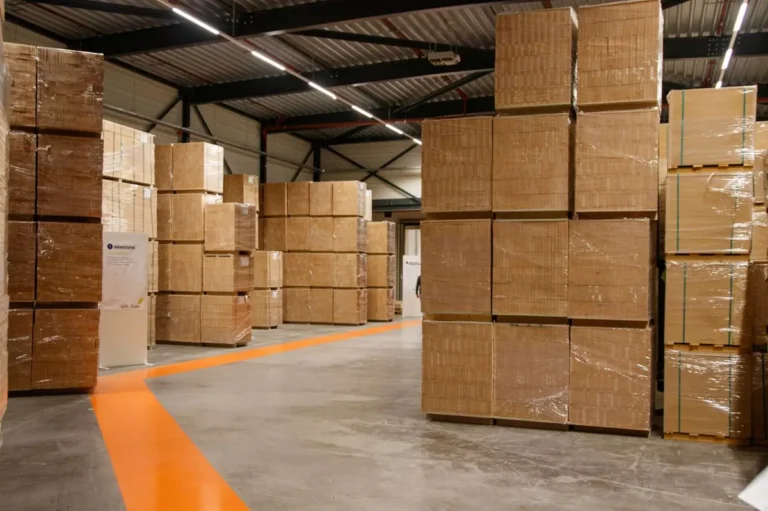
Furniture and building materials for a project order are packed for sea freight in layers: a soft inner wrap (EPE foam or foam film), rigid corner protectors, a 5-ply or 7-ply corrugated carton or honeycomb-board sleeve, and, for stone, glass, doors and other fragile or heavy items, an ISPM 15 heat-treated timber crate or pallet. Cartons are marked with shipping marks, room or unit numbers and handling symbols, then loaded against a load plan with dunnage and lashing inside the container. Export packing standards for furniture on a hotel, apartment or office order are written into the RFQ before quotation, and packing and loading are supervised on the factory floor with photo and video records issued before the vessel sails. FBM Sourcing operates as a sourcing agent and sourcing partner, not a trading company.
Poor packing is the single most common reason project FF&E arrives with chipped edges, cracked stone and swollen veneers. It is also the cheapest problem to prevent, because the fix is a specification, not a product change. This guide sets out what a hotel, apartment or office project buyer should specify and expect when a container-scale order leaves China.
The four protection layers every project carton should have:
- Layer 1, surface: EPE foam sheet or foam film on all finished faces; kraft or VCI paper on bare metal parts.
- Layer 2, edges and corners: EPS, EPE or moulded-pulp corner blocks on every corner, plus L-profile edge protectors on long panel edges.
- Layer 3, outer shell: 5-ply (double-wall) corrugated carton for standard casegoods and seating; 7-ply (triple-wall) or honeycomb board for oversized headboards, tabletops and wardrobes.
- Layer 4, structural: ISPM 15 heat-treated timber pallet, skid or full crate for stone, glass, doors, sanitary ware and any item over roughly 60 kg.
What “Export Packing” Means on a Project Order
Domestic packing in China is designed for a truck journey of a few hundred kilometres and one or two handling points. Export packing is designed for 25 to 45 sailing days, high humidity inside a steel box, and six to ten handling points between the factory floor and a hotel corridor on the other side of the world. The specification has to reflect that difference, otherwise the factory will quote domestic-grade packing by default.
The practical test for a carton is a stack: a 5-ply corrugated carton at 6–7 mm board thickness should carry a three-high stack of the same product without side-wall bulge, and a 7-ply carton at 10–11 mm should carry a four- to five-high stack for a full sea voyage. Where a piece is too large for a single carton, such as a 2.4 m headboard or a 1.8 m desk top, honeycomb board panels bound with PP strapping and full corner blocks replace the carton.
Anything that touches the container floor needs a timber base. Under the international phytosanitary standard, solid-wood packaging must be heat treated to a core temperature of 56°C for at least 30 minutes and stamped with the IPPC mark showing the country code and treatment code (HT). Untreated or unstamped timber is grounds for fumigation, re-export or destruction at ports in the US, Australia, the EU, the GCC and most Caribbean states, and it will hold the whole container. The full standard is published by the IPPC (ISPM 15); the point for a project buyer is simply that every pallet and crate must carry the stamp, or the alternative is plywood or engineered board, which is exempt.
Should FF&E Ship Assembled or Knocked Down?
The answer is decided item by item, not order-wide, and it is one of the biggest levers on freight cost. Knocked-down (KD, flat-pack) casegoods typically occupy much less volume than the same pieces shipped assembled; KD dining and desk chairs with legs removed also save volume; a wardrobe shipped as flat panels packs into a fraction of its assembled volume.
The trade-off is on site. Every KD piece needs assembly labour, hardware packs, and clear assembly documents, and every extra joint is a potential wobble or misalignment if the installer is untrained. For a hotel with a professional FF&E installer on site, KD wardrobes, desks, headboard frames and bed bases are normal. For a remote resort or an island destination where skilled labour is scarce, buyers frequently choose to pay for the extra volume and ship nightstands, luggage benches and desks fully assembled.
Upholstered seating, mattresses and lounge sofas are almost always shipped assembled or with legs removed only. Mattresses can be roll-packed to save volume, but roll-packing is only suitable for foam and some pocket-spring constructions; bonnell-spring and thicker hotel mattresses should ship flat and upright. Sofas ship at one or two high in the container, never with weight on the arms.
Where an item is knocked down, the packing specification should require that all hardware for one unit is bagged, labelled and packed inside the carton of the largest panel of that unit, so a room set is never waiting on a missing screw bag from a different pallet.
Packing Specification by Product Category
The table below shows the packing standard FBM Sourcing writes into project RFQs. The packed volume of each item comes from the factory’s packing list once shop drawings are approved.
| Product category | Packing spec | Notes |
|---|---|---|
| Casegoods (wardrobe, desk, nightstand, TV unit) | EPE film + corner blocks + 5-ply carton; 7-ply or honeycomb for panels over 1.5 m; KD panels with hardware bag inside | Veneer and lacquer faces need a paper interleaf between panels |
| Upholstered seating (lounge chair, sofa) | PE bag + fabric-safe foam wrap + 5-ply carton or honeycomb sleeve; legs removed and bagged | Stack maximum two high; no strapping across cushions |
| Beds and mattresses | Headboard in 7-ply/honeycomb with full corners; base KD in carton; mattress PE bag + carton or roll-pack | Mattresses upright on edge, never on top of casegoods |
| Dining and task chairs | Foam wrap + 5-ply carton, 2–4 per carton KD or nested | Metal legs in kraft or VCI paper |
| Doors and door sets | Foam wrap + corner protectors + carton; ISPM 15 pallet or A-frame crate, 10–20 leaves per unit | Pre-hung frames crated separately; ironmongery bagged per door |
| Stone slabs and vanity tops | Foam-faced ISPM 15 timber A-frame or fully closed crate; slabs on edge, foam interleaves, strapped | Weight, not volume, sets the container count |
| Tiles and porcelain | Cartons on ISPM 15 pallet, shrink-wrapped, corner boards, PP strapping | Payload-limited |
| Windows, glazing, mirrors | Closed ISPM 15 crate, glass on edge, cork or foam separators, silica gel inside, “GLASS – THIS WAY UP” marking | Fork-pockets on crate; never top-loaded |
| Sanitary ware and lighting | Factory retail carton inside 5-ply master carton with foam inserts; palletised | Fittings and glass shades packed separately |
Two things stand out from the table. Wooden furniture is volume-limited, so the KD decision drives container count. Stone, tile and glazing are weight-limited, so a 40HQ loaded with tile reaches its payload limit long before its volume is used. Mixed loads that combine both are the most efficient use of a container, which is one reason to plan the whole project package rather than ship each trade separately.
Sourcing this for a commercial project?
FBM Sourcing works with project owners, developers, main contractors and FF&E contractors on hotel, apartment, school, office and other commercial building projects. Send us your BOQ, drawings or product list — our team will review it and get back to you.
Moisture Control Inside the Container
The inside of a container crossing the equator or sitting on a quay in Jeddah in July can swing from 25°C to over 60°C in a single day, and every swing pushes air past its dew point. The result is “container rain”: condensation forming on the roof and dripping onto cartons. Veneered casegoods, MDF panels, leather and lacquer finishes are the usual casualties, and the damage is often invisible until a wardrobe door refuses to close three weeks after installation.
Moisture control is specified at three levels. Inside each carton or crate, silica gel or clay desiccant sachets are placed against the product; the quantity is set by the packing specification, with more for tropical destinations and monsoon-season sailings. At container level, calcium-chloride “container dry bags” or poles are hung on the side walls, in the quantity set by the factory’s packing plan. Around metal components, hinges, bed frames, table bases and light fittings, VCI (vapour corrosion inhibitor) paper or kraft wrap replaces plastic film, because sealed plastic traps condensation against the metal.
Buyers should also ask that timber for crates and pallets is kiln-dried to the moisture content set in the packing specification before treatment and stamping. Green timber inside a sealed container releases moisture for weeks and will undo everything the desiccant is doing.
Carton Marking, Load Plans and Lashing in a 40HQ
A carton that arrives undamaged but unidentifiable still costs money, because it sits in a warehouse while someone opens it. On a project order every carton should carry, on two adjacent faces, the shipping mark and PO number, the item code and description, the room, unit or floor destination, carton X of Y for multi-carton items, gross and net weight, dimensions, and the international handling symbols for fragile, this way up, keep dry and stacking limit. How the room and floor codes are structured so the installer can move cartons straight to the door is covered in our guide to room-by-room FF&E labelling.
The load plan is prepared before loading day, not on it. How much of a 40HQ’s volume a mixed load actually uses is set in the load plan once cartons of different sizes are combined, and its payload is capped at roughly 26 t by the box itself and at 18–22 t by road weight limits at many destinations. The plan sets which items go where: heavy crates and pallets on the floor against the front wall, casegoods cartons in stable columns behind them, seating and mattresses upright at the door end, and nothing fragile in the top tier of the last two rows, which take the most shock in handling. Our separate article on 40HQ loading, CBM and weight limits works through the numbers in more detail.
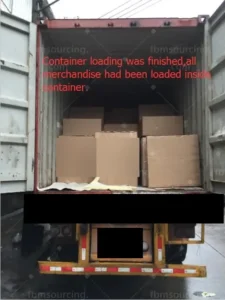
Inside the box, dunnage and lashing stop the load moving. Timber bracing across the door end, inflatable dunnage bags in gaps over 10 cm, corner boards on pallet edges, and polyester lashing through the container’s lashing rings for crates all belong in the specification. Stacking limits are enforced on the floor: cartons marked three-high stay three-high even if there is headroom, and stone crates are never stacked. Glazing crates and windows on window and glazing import orders are lashed upright to the side walls, always in the front half of the container.
How Packing Supervision Is Documented Before Shipment
A packing specification only has value if someone checks it before the doors close. On FBM Sourcing projects the pre-shipment inspection and the loading are supervised on the factory floor by our own team, and the record is delivered to the buyer before the vessel sails, not after the container arrives.
The documentation package normally includes: photographs of each product type at every packing layer, from bare product through inner wrap, corner protection and sealed carton, so the buyer can see the standard actually used; photographs of the ISPM 15 stamps on a sample of pallets and crates; a copy of the packing list reconciled against carton marks; a stuffing photo sequence taken as each tier goes in, showing bracing, dunnage bags and desiccant placement; a photo of the closed doors with the seal number legible; and a short loading video for each container. Where an order ships in five or more containers, a container-by-container summary of which rooms or floors are in which box is added so the receiving team can call off deliveries in installation order.
This record is what supports a claim if a container is dropped or flooded in transit. Marine underwriters and carriers will ask how the goods were packed and secured, and a dated photo set answers that in minutes; the process for a claim is set out in our guides on what to do when hotel FF&E arrives damaged and marine cargo insurance for project shipments. Well-documented, specification-grade export packing on project orders keeps transit damage down, and it moves the conversation with an insurer from “was it packed properly” to “here is the loss”.
Moisture is the packing failure that shows up most often at destination; the moisture content targets, desiccant dosage and container checks are set out separately in how furniture is protected from moisture and mould in sea containers.
The Packing Spec to Write into Your RFQ
Factories quote what they are asked for. If the RFQ says nothing about packing, the quotation assumes standard export packing as the factory defines it, and the definition varies enormously between a hotel casegoods plant in Foshan and a stone yard in Xiamen. Five lines in the RFQ remove the ambiguity and let quotes be compared like for like:
- Layers: EPE foam wrap on all finished faces, corner protectors on all corners, 5-ply corrugated carton minimum; 7-ply or honeycomb board for any panel over 1.5 m or any carton over 40 kg.
- Timber: all pallets, skids and crates ISPM 15 heat-treated and IPPC-stamped, timber kiln-dried to the moisture content set in the packing specification; stone, glass, doors and sanitary ware crated or palletised, no loose cartons on the floor.
- Configuration: a KD or assembled decision listed item by item, with hardware bagged and labelled inside the primary carton for each unit and assembly documents included.
- Moisture and marking: desiccant inside cartons plus container dry bags, in the quantity set by the packing specification; VCI or kraft on metal; every carton marked with PO, item code, room/floor code, carton X of Y, weight, dimensions and handling symbols on two faces.
- Loading and records: a written load plan per container respecting stacking limits, with dunnage and lashing; supervised loading with photo and video records, packing list reconciliation and seal photos delivered before shipment.
Packing is one line of the scope, but it touches production, freight, insurance and installation at the same time, which is why it sits naturally with a building material sourcing agent managing the whole order rather than being left to each factory. FBM Sourcing manages the entire China procurement package for overseas construction projects. That includes writing the packing standard into every RFQ, checking that the packing quoted is the packing used, and supervising the stuffing of each container against the load plan.
How much protection a line needs also depends on whether it ships built or in pieces — see whether FF&E orders from China arrive assembled or flat-packed and what that decision does to container count.
Get a China Procurement Quote for Your Project
If you are planning FF&E or building materials for a hotel, apartment building, school, office or other commercial project, send us your drawings or BOQ, the quantities by room type or floor, the destination port and the project timeline. We will review the package, advise on KD versus assembled configuration and container planning, and come back with a like-for-like quotation covering product, packing, inspection and shipping.
Use the project quote button above or message us on WhatsApp with a short description of the project and its programme.