A property developer can buy doors, windows and tiles directly from Chinese factories at project volumes. There are three ways to do it: with its own team in China, through a sourcing agent that places the orders with the factories that run the production lines, or through a trading company. On every route the minimum order is a full container, and the three packages come from three different factory types. What decides the outcome is not whether a factory will sell, but who does the work a direct purchase involves: documents a factory can quote, test evidence matched to the exact product and market, sample and shop drawing approval, inspection before shipment, and container loading timed to the construction programme.
What “Direct from the Factory” Means for Doors, Windows and Tiles
Buying direct means the goods are made by the factory that runs the production line for that product, not resold by a company that buys them in. In China the distinction is easy to lose: in our experience, most Alibaba listings and most wholesale-market stock are sold by traders, and even real factories often make one category and buy in the rest.
Doors, windows and tiles are three separate production lines — door factories, aluminium window and door system factories, and ceramic tile plants — and door hardware is often a fourth source. A supplier offering all three from one address is, in most cases, buying some of them in. Why one factory rarely covers a project range is set out in how specialized China’s building materials supply chain is, and how we confirm that a supplier makes what it quotes is described in is that Chinese supplier a real factory.
Sourcing this for a commercial project?
FBM Sourcing works with project owners, developers, main contractors and FF&E contractors on hotel, apartment, school, office and other commercial building projects. Send us your BOQ, drawings or product list — our team will review it and get back to you.
Three Routes Compared
| Question | Developer’s own team in China | Through FBM Sourcing | Through a trading company |
|---|---|---|---|
| Who the purchase order is placed with | Each factory, by the developer | FBM Sourcing, which issues all quotations, invoices and shipping documents | The trading company |
| Who confirms the producing factory | The developer’s team | FBM Sourcing, by looking at the production line for the product before working with the factory | Often not disclosed |
| Who checks test evidence and samples | The developer’s team | FBM Sourcing, before quoting; the developer approves samples and shop drawings | The trading company, on the documents it obtains |
| Who inspects before shipment | The developer’s own staff | FBM Sourcing’s own QC team at the factory | Depends on the company |
| Who consolidates and ships | The developer arranges consolidation and freight | FBM Sourcing, into complete container loads, with a loading report | The trading company |
| What the developer carries | Every step and every factory relationship | Sample and shop drawing approval, customs clearance and delivery at destination | Checking what arrives against the specification |
Our sourcing agent vs trading company comparison covers which route fits which project type, and developer vs contractor procurement paths covers what changes when the purchase order sits with the main contractor instead of the developer.
The Work a Direct Purchase Transfers to the Developer
- Documents a factory can quote: a door schedule, a window and glazing schedule, a finishes schedule for tile, and drawings in DWG, DXF or PDF. Where the schedules do not exist yet, they can be produced from the drawings — see window and door drawing takeoff.
- Test evidence matched to the exact product: a report or certificate that covers the system, size and configuration actually being supplied, to the standard the destination market names — AS 2047 in Australia, NFRC ratings in North America, CE or UKCA documentation in Europe and the UK. See which certificates to ask for.
- Samples and shop drawings: door leaf and finish, window corner sample and colour, tile shade and calibre, approved against the schedule; production starts only after written sign-off on the shop drawing.
- Batch control: tile shade and calibre, powder coat batch and veneer recorded against the order, so that later deliveries match.
- Inspection before shipment: quantities, dimensions, finish, hardware and packing checked against the signed-off specification — see how factory QC works.
- Sequencing against the programme: windows are needed before the building can be closed in, door sets follow the wet trades, and tile follows the screed. See phased delivery aligned to the construction schedule.
- Destination-side steps: customs clearance needs an importer of record in the destination country; site storage, delivery into the building and installation labour are separate from the supply.
What has to be specified for each of the three packages, what evidence to require per market and where each package goes wrong is set out in detail in doors, windows and tiles from China for property developers.
Minimum Orders and Containers
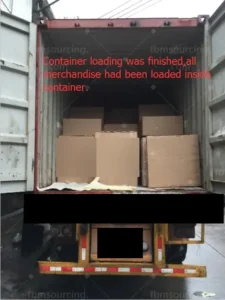
Factories quote and sell at project volumes, and the minimum order is a full container. Sometimes, on a large project, the doors, windows and tiles alone fill full containers; sometimes the doors, windows and tiles share containers with the other product categories of the same project; and sometimes, in one batch, we combine a dozen or more product categories from several projects of the same client into a few containers — always full containers, and for us this is routine, well-practised work. See mixed-container consolidation for apartment projects and minimum orders for building materials.
Contracts, Payment and Documents
When the packages are bought through FBM Sourcing, your purchase order is placed with FBM Sourcing, not with each manufacturer, and all quotations, invoices and shipping documents are issued by FBM Sourcing. Payment goes only to the company account named on the proforma invoice — never to an individual, never to a factory. We do not change bank details by e-mail; if you receive such a message, video-call us before sending anything.
Quotations are EXW as standard, C&F to your port on request, and for certain markets such as the United States we can quote DDP. The trade terms are compared in FOB vs CIF vs DDP for building materials, and the document set that travels with each container is listed in shipping and customs documents for China project orders.
Where FBM Sourcing Fits
FBM Sourcing manages the entire China procurement package for overseas construction projects. We have sourced building materials and FF&E from China since 2014 and have shipped 1,000+ containers to 20+ countries. For doors, windows and tiles we review the drawings and schedules, split them into factory-level RFQs by factory type, return one quotation mapped to your own references, manage samples and shop drawing sign-off, inspect before shipment with our own team, and load complete containers in the order the building needs them.
All quotations, invoices and shipping documents are issued by FBM Sourcing — you deal with us, and we carry the responsibility. For suppliers you nominate, we charge a 5% commission; for products we source for you, we quote a direct price.
We do not sell to individual homeowners; this work is for developers, general contractors, builders, commercial project owners, interior design and construction companies, and FF&E solution providers. See also China procurement for property developers.
Frequently Asked Questions
Can a property developer buy doors, windows and tiles directly from Chinese factories?
Yes, at project volumes, with a full container as the minimum order. The three packages come from different factory types, so buying direct means placing and controlling three sets of orders, or having one party place them on your behalf.
How does FBM Sourcing confirm it is buying from the factory that makes the product?
Before we work with a factory we look at its production line for the product we intend to buy; if it makes A and resells B, we use it for A only.
Who is responsible for compliance in the destination market?
The first step in choosing a factory is checking that it holds the test reports or certifications for that specific product, confirmed before we quote — for example NFRC or Florida hurricane approvals in the United States and AS 2047 in Australia for aluminium windows and doors, and UL for fire-rated steel and wood doors in US-code markets.
Can we keep our existing Chinese door, window or tile supplier?
Yes. For suppliers you nominate, we manage the order for a 5% commission: specification and PI check, drawings, production follow-up, quality control, consolidation into full containers, loading and documents. After-sales is not included, as claims fall under the supplier’s own warranty, but we help you communicate with the supplier.
Who issues the documents, and who do we pay?
All quotations, invoices and shipping documents are issued by FBM Sourcing, and your purchase order is placed with FBM Sourcing. Payment goes only to the company account named on the proforma invoice — never to an individual, never to a factory.
Send the door schedule, the window schedule, the finishes schedule or the drawing set through our China building materials and FF&E procurement page, and our team will review it and get back to you.