
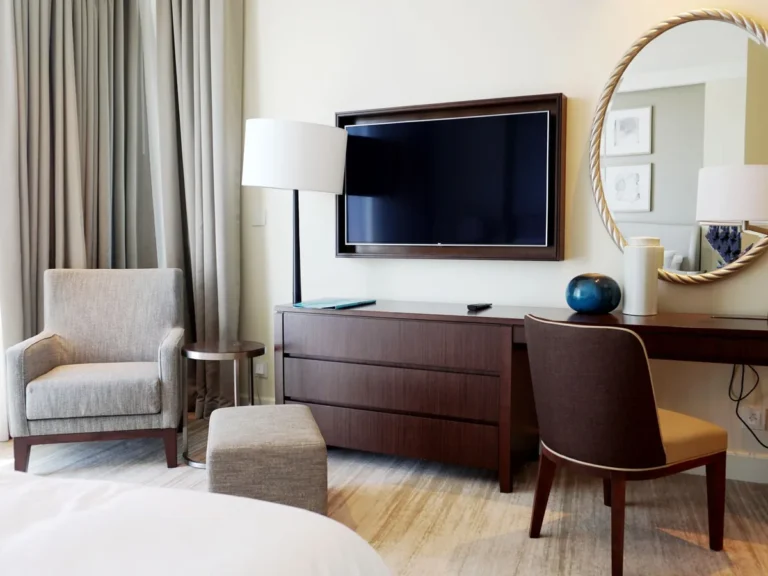
FF&E stands for furniture, fixtures and equipment. It describes the durable, installed, design-led items that fill a building interior once the structure is complete: on a hotel project, for example, beds and headboards, casegoods, seating, lighting, mirrors, wall panelling and décor. The same letters appear on apartment, student accommodation, office, school and healthcare projects, where the examples change but the idea does not. Which items count as FF&E on a given project is decided by that project’s documents, so the definition below is a starting point and not a legal test.
This guide is written for developers, contractors, designers and procurement teams who meet the term on a schedule or a drawing and need to know what it covers. It explains the three words, gives examples by project type, separates FF&E from OS&E and from the building works, shows how an FF&E schedule lists items, and sets out who buys and installs them. It then describes how an FF&E package is sourced from China. For the accounting or tax treatment of FF&E, ask the project owner’s advisers; this guide does not give that advice.
What does FF&E stand for?
Each word names a different kind of item. The groupings below follow the way hotel projects describe them, and the project documents may draw the lines elsewhere.
- Furniture: beds and headboards, casegoods such as wardrobes, desks and nightstands, lounge and dining seating, and reception and lobby furniture.
- Fixtures: decorative and architectural lighting, mirrors, wall panelling and built-in millwork.
- Equipment: in-room items such as minibars, safes and televisions, depending on the project.
- Soft finishes: carpets, rugs, curtains and upholstery can be grouped with FF&E, and some schedules list them separately.
The words “depending on the project” matter. A built-in wardrobe, a mirror fixed to a wall or a television bracket can sit under FF&E on one project and under the building works on another. The answer is written in the contract and in the FF&E schedule, so settle it before pricing starts. Our guide to OFOI, OFCI and CFCI explains the codes that record who supplies and who installs each item, and our glossary of FF&E and procurement terms defines the other words you will meet.
What are examples of FF&E on different projects?
The categories repeat from project to project, but the mix changes with the building. These examples show the kinds of lines that appear on a schedule; they are not a checklist for any one project.
- Hotel guest rooms: casegoods, seating, soft goods, lighting, and artwork and accessories. Our guide to a complete hotel FF&E package from China sets out the six scopes, which add public areas such as the lobby, food and beverage outlets, corridors and meeting spaces.
- Student accommodation and apartments: a bedroom furniture pack for each bed or unit, a share of communal and amenity furniture, soft furnishings, and appliances. See how FF&E cost is structured per bed for the blocks that make up a package.
- Offices: desks, task and meeting chairs, meeting tables, storage and reception furniture, with lighting and acoustic items where the design calls for them.
- Schools and healthcare buildings: classroom or ward furniture, seating, storage and loose equipment, specified to the operator’s standards.
- Restaurants and public areas: dining tables and chairs, bar stools, banquette seating, reception and service counters, and outdoor furniture for terraces.
What is not FF&E? FF&E, OS&E and the building works
Three groups of purchases are easy to confuse. The first is the building works: the structure, envelope and fixed services that the construction contract delivers. The second is FF&E. The third is OS&E, short for operating supplies and equipment.
OS&E covers the consumable and operational items a property needs to open and run day to day: linens, towels, crockery, glassware, kitchen smallwares, guest amenities and uniforms. FF&E is where design intent, custom manufacturing and long lead times are concentrated; OS&E is more standardised and is reordered once the property is operating. Our guide to FF&E versus OS&E in hotel procurement sets the two packages side by side, including how they are specified, quality-checked and shipped.
The boundary between FF&E and the building works is a place where gaps open on a project. A pendant light, a built-in bench or a reception counter may be priced twice or by nobody if the contract is silent. Write the boundary into the project documents, and keep it visible on the schedule item by item.
How does an FF&E schedule list the items?
An FF&E schedule is the project-specific table that lists every item of furniture, fixtures and equipment a commercial interior needs, one row per specified item. In construction documents the word “schedule” means a summary of components in tabular form, and not a calendar of dates. Each row carries the fields a manufacturer must see before it can price and build that item: item code, location and room type, quantity, dimensions, material and finish, upholstery, power and data, lead time, cost, supplier and approval status.
On drawings, an item reference points to its row on the schedule. The drawings show design intent and the specification sets the quality, while the schedule is what is converted line by line into prices, samples and purchase orders. Our guide to the FF&E schedule: fields, item codes and approval steps goes through each field and shows how approvals are recorded against the item.
For hotels and other repeated layouts, quantities start from the room mix and not from the total room count. A hotel with several room types has several schedules, and public areas are added on top. Spare stock is agreed at order stage; see how to agree attic stock for hotel FF&E.
Sourcing this for a commercial project?
FBM Sourcing manages the entire China procurement package for overseas construction projects. We work with Developers · General Contractors · Builders · Commercial Project Owners · Interior Design & Construction Companies · FF&E Solution Providers. Send your BOQ, drawings or product schedule for review.
Who buys and who installs FF&E?
The project agreements assign the roles. The owner or developer funds the budget. A brand or operator may set minimum specifications through its standards. The interior designer documents the design intent as a room-by-room specification. A procurement company, FF&E contractor or sourcing agent may source, purchase, inspect, consolidate and ship the package, and the general contractor delivers a building ready to receive the goods. These roles can differ from one project to the next, so confirm them in the signed agreements; our guide on who is responsible for FF&E in a hotel project sets out the common arrangements.
The responsibility codes OFOI, OFCI and CFCI record who furnishes and who installs each item: owner furnished, owner installed; owner furnished, contractor installed; and contractor furnished, contractor installed. They are industry and contract terms and not legal definitions, so the duties behind each code are whatever the owner’s standards and the contract say. For a comparison of the people who offer to run the purchasing, see what an FF&E procurement company does.
How is an FF&E package sourced from China?
No single factory makes a whole package. Casegoods, upholstered seating, soft goods, lighting and accessories come from different kinds of workshops, so the sourcing work is to turn one schedule into several factory-level requests and bring the answers back onto one quotation. The steps below describe the way FBM Sourcing runs it.
- Start from the schedule or BOQ. Send the dated FF&E schedule, drawings and any BOQ. Open questions stay visible beside the item they affect.
- Compare quotations line by line. Any substitution is flagged against the specified item, and a named person on the project approves it.
- Review shop drawings and samples. For custom products the factory prepares shop drawings and a material list for review and sign-off before production. Read how the shop drawing approval cycle works. Where the room is repeated many times, a mock-up room is a useful approval gate.
- Follow production. We coordinate drawings with the factories and follow production against the accepted references.
- Inspect once, after bulk production. Our own team performs one inspection at the factory once bulk production is complete and before shipment, with photo and video records, and the client’s project team is welcome to attend.
- Load and document. Our minimum order is a full container, and goods from several factories can share containers. We arrange loading and provide a container loading report. Sea freight is quoted to you before shipment.
FF&E questions buyers ask
What does FF&E stand for?
FF&E stands for furniture, fixtures and equipment. It covers the durable, installed, design-led items in a building interior, such as beds, casegoods, seating, lighting, mirrors and décor. The project documents decide which items are listed.
What is the difference between FF&E and OS&E?
FF&E covers the durable items that shape the interior, such as beds, seating and lighting. OS&E means operating supplies and equipment, the consumable and operational items a property needs to run day to day, such as linens, crockery, glassware and uniforms. The two are specified, ordered and shipped as separate packages.
What does FF&E mean on construction plans?
An item reference on a plan points to a row on the FF&E schedule, which gives the quantity, dimensions, material and finish for that item. Ask the designer for the schedule together with the plans, and for the contract wording that says who supplies and who installs each item.
Is a built-in wardrobe or a wall mirror FF&E?
It depends on the project. Built-in millwork and fixed mirrors are grouped under fixtures on some schedules and under the building works on others. The contract and the FF&E schedule decide, so settle it before pricing so the item is neither priced twice nor missed.
How does FBM Sourcing support an FF&E package from China?
We review the schedule or BOQ, collect comparable quotations and manage the package for the project. For suppliers you nominate, we charge a 5% commission; for products we source for you, we quote a direct price. Our own team performs one inspection after bulk production is complete and before shipment, and the client’s project team is welcome to attend.
FBM Sourcing manages the entire China procurement package for overseas construction projects. We work with Developers · General Contractors · Builders · Commercial Project Owners · Interior Design & Construction Companies · FF&E Solution Providers.





