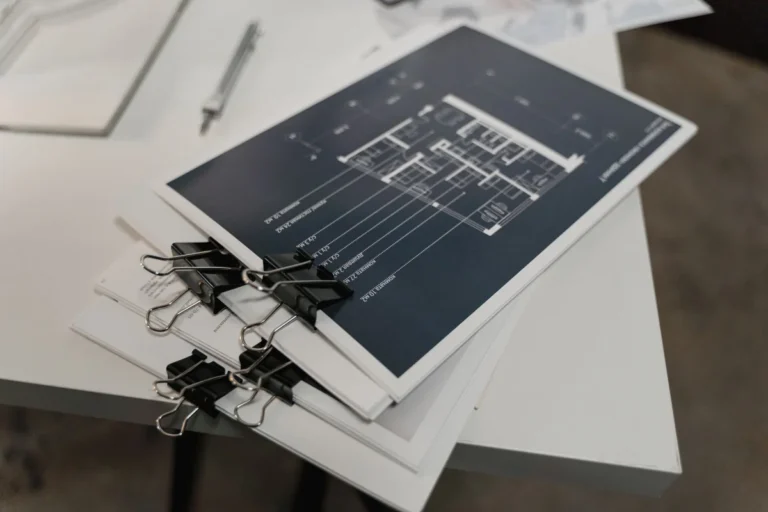
An FF&E schedule is the project-specific table that lists every item of furniture, fixtures and equipment a commercial interior needs, one row per specified item, carrying the fields a manufacturer must see before it can price and build that row: item code, location and room type, quantity, dimensions, material and finish, upholstery, power and data, lead time, cost, supplier and approval status. In construction documents a schedule means a summary of components in tabular format, not a calendar of dates. It is the document a Chinese factory actually quotes from: the drawings show intent and the specification sets quality, but the schedule is what gets converted line by line into prices, samples and purchase orders.
It is written for developers, general contractors, builders, commercial project owners, interior design and construction companies and FF&E solution providers sending a schedule to China. It covers which columns a factory reads, which it ignores, and which blank cell stops a quotation before it starts.
Why Is It Called a Schedule and Not a List?
Guidance published through the Construction Specifications Institute on shop drawings and submittals describes schedules in this sense as a project-specific summary of systems and components — of HVAC equipment, of doors and door hardware, or of paint systems by room and surface — in tabular format. A progress schedule and a schedule of values are different documents entirely: they track time and money, not components.
Three documents are routinely mistaken for each other. The schedule is the register, one row per specified item. The specification, or spec book, is the narrative behind the rows, and what belongs in it is covered in our guide to what a hotel FF&E spec book should include for China procurement. The BOQ measures quantities against trade sections, so it is organised by trade rather than by item; where only drawings exist, those quantities come from a BOQ and drawing takeoff.
What Sits Inside an FF&E Schedule, and What Sits Outside It
FF&E covers case goods, seating, tables, beds, decorative and architectural lighting, mirrors, soft goods, window treatments and artwork. In common industry usage OS&E, operating supplies and equipment, sits on a separate schedule and covers the consumable items a completed building needs in order to trade; no standards body fixes the boundary between the two, so it is agreed in writing before either schedule is issued. The terminology is set out in our explainer on what FF&E means.
A second boundary runs through the schedule: who supplies an item and who installs it. Industry guidance defines owner furnished / contractor installed, OFCI, as equipment, materials and services furnished directly to the contractor by the owner for incorporation into the project; OFOI and CFCI cover owner-furnished owner-installed and contractor-furnished contractor-installed items. Chinese factories price the product and its packing, not site labour, so a responsibility column tells everyone where product scope stops.
The Fields, Column by Column
Column sets vary between practices, and no standards body publishes a mandatory field list. The table below sets out the fields that appear in the schedules FBM Sourcing quotes from, what each controls at the factory, and what happens when the cell is empty.
| Field | What it controls at the factory | When it is blank |
|---|---|---|
| Item code | Carried through quotation, sample tag, order, carton label and packing list | Near-identical items merge or duplicate |
| Location / room number | Carton consolidation and installation sequence | The shipment cannot be sorted by area |
| Room type | Whether one specification repeats, driving tooling and batch size | Repeating items are quoted as one-offs |
| Quantity, attic stock, spares | Batch size, material purchasing, carton count | No price can be issued |
| Dimensions | Cutting lists, frame drawings, carton size, volume | No price can be issued |
| Material and finish | Substrate, coating system, edge detail, hardware grade | Quoted on the mill’s default build |
| Upholstery, COM or COL | Whether fabric is bought by the factory or sent in | Quoted on an assumed grade, then re-quoted |
| Power and data | Voltage, plug standard, certification route, cable entry | Built to the wrong market standard |
| Compliance requirement | Which test reports or certificates the product carries | Built to a domestic baseline |
| Lead time | Production sequencing against the site programme | Items needed first are made last |
| Cost | Nothing; it exists for the project team | No effect at the factory |
| Supplier | Which rows belong to which RFQ package | Packages are split by guesswork |
| Status / approval | Whether the row may be released to production | Nothing is released, or the wrong revision |
Three of them cause most of the re-quoting.
Material and Finish
A row reading "oak veneer nightstand, dark stain" can be built five ways, each with a different cost and service life: solid oak, veneer on plywood, veneer on MDF, oak-effect foil, or printed laminate. A hand-applied stain and a UV-cured finish photograph alike and wear very differently. The column needs substrate, finish system, sheen level and a reference. The same precision applies to any row with a cable on it: destination voltage and frequency, socket standard, certification route, and where the cable enters the carcase.
Upholstery, COM and COL
COM stands for customer’s own material and COL for customer’s own leather. Manufacturers publishing these terms use them to indicate that they will accept fabric sent in by the client or the designer and apply it to the furniture they build, rather than supplying it from their own graded ranges. Two consequences are stated openly in manufacturers’ published COM and COL policies: the material normally has to be pre-approved by the factory before the order can be processed, and cuttings are submitted with the order so that actual yardage requirements can be determined. So the row needs more than the word COM: fabric reference and supplier, yardage allowance, pattern repeat, railroading instruction, flame-retardancy requirement.
Status and Approval
A usable value set distinguishes at least: specified, out for quotation, quoted, value engineered, sample requested, sample submitted, sample approved, released to production, and superseded. Two rows sharing an item code with different statuses is the most common reason a factory builds the wrong revision, so the revision letter and date belong in the schedule header.
Have an FF&E schedule that needs turning into factory line items?
Developers, contractors, commercial project owners and FF&E solution providers can send the schedule or BOQ as it stands, open cells included. FBM Sourcing groups the rows into factory-level packages and returns each line with the assumptions written against it.
How Are Item Codes Built?
There is no industry-wide standard for FF&E item coding; every practice has its own. What they share is that a code reads left to right from general to specific, so sorting by code groups the project the way it is procured. In the schedules FBM Sourcing quotes from, the segments are usually:
- A zone or area prefix — guestrooms, public areas, food and beverage, back of house, or a building and level reference.
- A room type — king, twin, accessible, suite, studio, classroom, ward. This segment tells a factory that one specification repeats.
- A category prefix — commonly CG for case goods, SE for seating, LT for lighting, AC for accessories, AR for artwork, WT for window treatments, MW for millwork.
- A sequence number, often with a suffix for variants such as a finish option or a handed pair.
The value of a code is persistence, not elegance. The same string should appear on the quotation line, the sample tag, the shop drawing title block, the purchase order, the carton label and the packing list, so that an installation team can match a carton to a room without opening it. The discipline behind this is covered in our note on room-by-room FF&E labelling. Codes are project-specific, though: CG-KG-04 means nothing on its own, so a bare code list is never enough.
Which Fields Does a Chinese Factory Actually Price From?
Turning a schedule into factory-level RFQ packages is a sorting job before it is a pricing job. Rows are grouped by what a single production line can make, not by the room they sit in, because one corridor holding a case good, a chair, a lamp and a mirror is four different factories; our piece on how a sourcing agent splits a BOQ into factory-level RFQs sets out that split. Within a package, the factory reads a narrow set of columns and needs all of them:
- Quantity and dimensions. Without both there is no cutting list, no material calculation, no carton size.
- Material, substrate and finish, which set the bill of materials.
- Hardware and moving parts, costed as named components. A named grade or an equal-and-approved instruction is quotable; the words "soft-close drawers" are not.
- Upholstery and yardage, which change both cost and the sequence of the order.
- Compliance requirements — fire performance evidence for upholstered and textile components, formaldehyde emission class for panel products, stability test reports for storage and seating, electrical certification for powered items.
- Packing and labelling. Flat-packed or assembled, carton construction, edge protection, label content.
The columns it does not use — cost, budget code, internal status flags, inspiration images — stay in the schedule for the project team. The exception is lead time, read as a sequencing input.
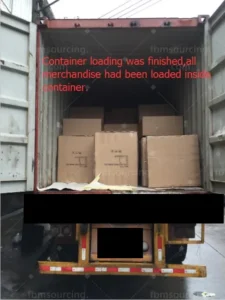
Quantity also drives how a project is shipped. Sometimes, on a large project, the furniture items alone fill full containers; sometimes the furniture items share containers with the other product categories of the same project; and sometimes, in one batch, we combine a dozen or more product categories from several projects of the same client into a few containers — always full containers, and for us this is routine, well-practised work.
The Approval Steps a Schedule Has to Carry
The vocabulary comes from construction contract documents. AIA A201–2017 defines shop drawings as drawings, diagrams, schedules and other data specially prepared for the Work, and samples as physical examples that illustrate materials, equipment or workmanship and establish standards by which the Work will be judged. EJCDC C-700–2018 defines a submittal as a written or graphic document, prepared by or for the contractor, which the contract documents require the contractor to submit. On a row manufactured in China, the sequence normally reads:
- Quotation against the row, returned with a written list of what the factory assumed wherever the row was silent.
- Shop drawing submittal. The item is redrawn as it will be built, with joinery details, hardware positions, finish callouts and tolerances, which is where a specification that cannot be built at the stated dimensions shows up. The mechanics are covered in our article on the shop drawing approval cycle with Chinese factories.
- Material and finish samples — finish panels, fabric cuttings, leather hides, stone pieces, hardware. These become the control samples everything later is judged against, so both sides sign and retain them.
- Prototype or first article: a full item built to the approved drawing and finishes, reviewed against the specification rather than a photograph.
- Mock-up room. On hospitality, student accommodation and multi-unit residential projects a complete room is assembled so items are judged together, catching clashes no single item review can — a nightstand blocking a socket, a chair that will not tuck under a desk.
- Sign-off and release. The row changes status, the revision is locked, and the code on the approved sample becomes the code on the order.
This belongs in the schedule, not a separate tracker: a row with no recorded approval state is one two people will remember differently.
Which Gaps Send a Schedule Back for Re-Quoting?
- Dimensions in one direction only, or a plan dimension with no height.
- Millwork rows sitting in the loose furniture section, or two revisions in circulation with no revision letter in the header.
- A finish named but not referenced: "walnut" with no stain code or control sample.
- Upholstery marked COM with no yardage, repeat or railroading instruction.
- Quantities that exclude attic stock, forcing a short second order later.
- Powered items with no destination voltage or socket standard.
- Compliance requirements raised after quotation, which change the build itself.
- No responsibility coding, so items needing site fixing are quoted free-standing.
A schedule does not have to be complete to be sent out, but it has to be honest about which cells are open: a factory can quote around a declared gap, never an invisible one.
How FBM Sourcing Works From an FF&E Schedule
When a schedule arrives, the first pass is a completeness read, not a pricing exercise: which rows are quotable as written, which need one more field, and which are in the wrong category. Rows are then grouped into factory-level packages by production capability, quoted, and returned with the assumptions written against each line.
From there the schedule stays the control document. Sample and shop drawing approvals are recorded against the item code, the approved code goes onto the purchase order, and inspection by our own team at the factory before shipment, with photo and video records, is carried out against the approved samples and drawings for those same codes. Cartons are labelled with the item code and room reference so that schedule, packing list and installation sequence all read the same. As the client’s sourcing partner in China, FBM Sourcing works from the project team’s own coding rather than imposing a separate numbering system, because that code is what the installation team reads on site.
Have an FF&E schedule that needs turning into factory line items?
Developers, contractors, commercial project owners and FF&E solution providers can send the schedule or BOQ as it stands, open cells included. FBM Sourcing groups the rows into factory-level packages and returns each line with the assumptions written against it.
Frequently Asked Questions
Is an FF&E schedule the same as a BOQ?
No. An FF&E schedule is a register of specified items — one row per item, with an item code, quantity, dimensions, finish and approval status. A BOQ measures works and materials against trade sections, so it is organised by trade rather than by item. Both often exist on one project, but a factory quoting furniture works from the schedule.
What is the minimum information a row needs before a factory can price it?
Quantity, overall dimensions, material and substrate, the finish with a reference or control sample, the hardware where there are moving parts, the upholstery specification with yardage, and any compliance requirement. Rows missing quantity or dimensions cannot be priced at all; rows missing finish or hardware can be, but the figure will change.
What do COM and COL mean on an FF&E schedule?
COM is customer’s own material and COL is customer’s own leather: the fabric or hide is specified and supplied by the client or the designer rather than taken from the manufacturer’s graded ranges. Manufacturers that accept them normally require the material to be pre-approved before the order is processed, and ask for cuttings so actual yardage can be determined.
Should an FF&E schedule be organised by room or by category?
Both views are needed, and a well-built item code gives you both. Sorting by location tells the installation team what goes where and drives container consolidation; sorting by category shows which rows form a single factory package. A code built from an area prefix, room type, category prefix and sequence number lets one table be read either way.
Does a schedule replace the specification and the drawings?
No. The schedule is the register, the specification sets performance and quality requirements, and the drawings show intent and context. A factory sent only a schedule fills any silence with its own standard build; a factory sent only a specification has nothing to count. The item code ties a row to its specification page and drawing.
About FBM Sourcing
FBM Sourcing manages the entire China procurement package for overseas construction projects. Since 2014 we have worked with developers, general contractors, builders, commercial project owners, interior design and construction companies and FF&E solution providers across more than 20 countries and over 1,000 containers, as their sourcing partner in China — from the schedule or BOQ through factory selection, sampling, inspection by our own team before shipment, consolidation and shipping. All quotations, invoices and shipping documents are issued by FBM Sourcing, and sea freight is quoted to you before shipment. If you have an FF&E package to price, start at China building materials and FF&E procurement.