
In a hotel project, the owner (or developer) is responsible for FF&E — it is funded from the owner’s budget, sits outside the general contractor’s construction contract, and the goods belong to the owner from the moment they are paid for. The hotel brand sets the minimum specifications through its brand standards, the interior designer converts those standards into a spec book, and the actual buying is executed by one of three parties: the owner’s own project team, a dedicated FF&E procurement company, or a china sourcing agent and sourcing partner working on a 5% commission for suppliers you nominate (products we source for you are quoted at a direct price). The general contractor is normally not responsible for FF&E — its role is limited to site readiness and coordination.
That single paragraph answers the question, but the responsibility map underneath it decides real money on every hotel project: who signs the purchase orders, who carries the risk when a container arrives late, and who answers for a wardrobe that does not match the approved sample. This guide sets out each party’s scope, the three project organization models we see on hotel and apartment projects, and where the responsibility lines blur in practice.
- Owner / developer — funds the FF&E budget, owns the goods, carries procurement risk.
- Brand / operator — sets minimum specifications via brand standards and approves substitutions.
- Interior designer — documents the design intent as a room-by-room FF&E specification.
- FF&E contractor, procurement company or sourcing agent — sources, purchases, inspects, consolidates and ships the package.
- General contractor — delivers a finished building ready to receive FF&E; coordinates access, not procurement.
Why Is FF&E Outside the Construction Contract?
FF&E — furniture, fixtures and equipment — is deliberately separated from the construction contract on almost every hotel project, and the separation is financial before it is practical. FF&E is movable property, not part of the building, so it is capitalized separately: in US practice FF&E depreciates over 7 years while the building shell depreciates over 39, which means lenders, appraisers and tax accountants all need it broken out as its own budget line. Folding furniture into the GC’s contract would bury a fast-depreciating asset class inside a slow one and add the contractor’s markup on top of every chair.
The practical logic points the same way. A general contractor builds; it does not typically maintain relationships with the 8–15 specialized factories that produce a complete hotel package — casegoods, seating, drapery, lighting, mattresses and artwork all come from different production lines. Owners therefore procure FF&E as a parallel workstream that runs alongside construction and lands on site in the final months before opening. What that parallel workstream must contain is covered in our guide to the complete hotel FF&E package from China.
Who Pays for FF&E — the Owner, the Brand or the Contractor?
The owner pays, in every standard structure. In a franchised hotel — the dominant model in the US market — the owner funds and procures FF&E directly, and the brand’s leverage is contractual: the franchise agreement obliges the owner to meet brand standards and to complete property improvement plans on the brand’s schedule. In a managed hotel, the operator may run procurement on the owner’s behalf, but the purchase orders are still funded by the owner’s FF&E budget.
The brand never buys the furniture, but it controls the refresh cycle that keeps the owner buying: soft goods are typically renovated every 6–7 years and full guest-room renovations run on a 12–15 year cycle under most brand standards. This is why FF&E responsibility is a live question long after opening day — the party who owns the budget at year 7 is the same owner, facing the same procurement decision at renovation scale.
Who Sets the Specification: Brand Standards vs the Designer?
Responsibility for what gets bought is split between two parties. The brand publishes standards that set minimums — fire-safety compliance such as CAL 117 upholstery flammability for US projects, mattress specifications, durability grades for casegoods and fabric abrasion counts. The interior designer then works inside those minimums to produce the project’s design intent: drawings, finishes and a coded FF&E specification for every room type and public area.
The spec book is the controlling document for everyone downstream. When a factory proposes an alternative fabric or a different drawer runner, the substitution goes back up the chain — designer recommendation, brand sign-off where standards are touched, owner approval on cost. A procurement party that changes specifications unilaterally is exceeding its responsibility, which is why disciplined buying agents document every deviation against the spec code. The difference between the designer-controlled FF&E scope and the operator-controlled small-wares scope is explained in FF&E vs OS&E in hotel procurement.
Who Actually Procures It? Three Project Organization Models
Model one: owner-direct procurement. The owner’s project team buys directly from manufacturers. It works when the owner has in-house procurement staff and repeat volume — multi-property groups and apartment developers running standardized unit packages. The owner keeps the full trade margin but also keeps every risk: specification errors, factory follow-up, inspection and shipping coordination across a dozen suppliers and time zones.
Model two: FF&E procurement company. A professional purchasing firm contracts to buy the package on the owner’s behalf, typically strongest on budget administration and brand paperwork in the owner’s home market. Its weakness sits at the factory end of the chain — production follow-up and inspection in China are usually managed remotely.
Sourcing this for a commercial project?
FBM Sourcing works with project owners, developers, main contractors and FF&E contractors on hotel, apartment, school, office and other commercial building projects. Send us your BOQ, drawings or product list — our team will review it and get back to you.
Model three: the sourcing agent model. A furniture sourcing agent based at the production end — for hotel FF&E, that means Foshan and the wider Guangdong manufacturing belt — takes responsibility for the China side of the chain on a 5% commission for suppliers you nominate (products we source for you are quoted at a direct price): factory selection against the spec book, sample and shop-drawing management, production scheduling, in-factory quality inspection, consolidation and export shipping. The owner or its procurement company retains budget control and brand approvals; the agent owns execution where the goods are actually made. On projects shipping to the US, Australia, Europe and the Caribbean, this is the model that closes the distance problem: someone accountable is standing in the factory while your order is in production.
The three models are not mutually exclusive. A common structure on larger hotels pairs an owner-side procurement manager with a China-side agent — one party administers the budget and the brand, the other delivers the goods.
Who Handles Freight, Customs, Warehousing and Installation?
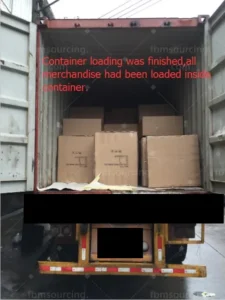
Responsibility for logistics follows the purchasing model and the Incoterms on each purchase order. Under FOB terms the owner’s side arranges ocean freight and import clearance; under DDP the procuring party carries the goods to site. Either way, someone must own the container plan — a 100-key hotel package loads into roughly 10–11 forty-foot high-cube containers, and sequencing which rooms’ furniture arrives in which week is a planning task in its own right, covered in our guide to hotel FF&E container planning.
Between port and site sits a scope that belongs to nobody by default: receiving and staging. On phased projects the building rarely absorbs eleven containers in one week, so someone must contract local warehousing, schedule drayage against floor handovers, and manage the deconsolidation sequence — a cost line that surprises owners who assumed “delivered” meant “installed”. The responsibility matrix should name the warehouse holder explicitly, because storage insurance, demurrage and re-delivery trucking all follow that name.
Installation is a separate responsibility again: FF&E installers (sometimes the procurement company’s crew, sometimes a specialist subcontractor) receive, uncarton, place and level the furniture. The general contractor’s obligation is to hand over floors that are ready — keyed, climate-controlled, with elevators available and finishes protected. The most common responsibility failure on hotel projects is exactly here: furniture arriving to floors that cannot receive it, or floors waiting on furniture stuck in production. Mapping the two schedules against each other is the core of the hotel FF&E procurement timeline, which runs months, not weeks — casegoods alone typically need 45–90 days ex-factory before sea freight of 18–40 days even begins.
Where the Lines Blur: OS&E, Attic Stock and Damage
Three scopes generate most responsibility disputes. First, OS&E — the operating supplies and small equipment — belongs to the operator’s pre-opening budget, not the FF&E budget, and projects that fail to draw that line discover it as an unbudgeted seven-figure line item late in the program. Second, attic stock: the spare fabric, components and shades the hotel holds for repairs is an FF&E procurement deliverable that must be written into the original purchase orders — the working standard is 2–3% on soft goods, 1–2% spare components on casegoods and seating, and 3–5% on lighting, detailed in our hotel attic stock guide. Third, transit and installation damage: the party who procured the goods is the party who documents, claims and replaces, which is why the procurement contract — not the construction contract — should name the insurance holder and the claim process.
The punch list deserves its own line in the matrix. FF&E snagging — a drawer that binds, a headboard hung out of level, a scratched nightstand top — is inspected room by room in the final weeks, and the resolution path depends on the defect’s origin: installation faults go back to the installer, transit damage goes to the insurance and spares process, and manufacturing defects go back through whoever placed the purchase order. Projects that assigned FF&E procurement clearly resolve punch items in days; projects where the owner, GC and a purchasing firm can each point at the other spend the pre-opening period arguing instead.
A useful rule for owners drawing the responsibility matrix: whoever signs the purchase order owns everything that happens to that line item until it stands installed in the room. If that party is your own team, budget the time; if it is a procurement company, check who stands in the factory; if it is a sourcing agent, the China-side execution — sourcing, inspection by the agent’s own QC team documented in photos and video, consolidation and shipping — is exactly the scope you are buying with the fee.
Get a China Procurement Quote for Your Project
If you are an owner, developer, general contractor or FF&E company defining who does what on a hotel or apartment project, FBM Sourcing takes full responsibility for the China side of the FF&E chain — factory sourcing against your spec book, sample management, in-factory quality control by our own team, consolidation and shipping to your destination port. Submit your drawings or FF&E schedule, room count, destination port and target timeline through our China procurement inquiry page, and our team will review your requirements and get back to you.
Where the whole package is bought through one procurement contract rather than split across suppliers, the scope question changes shape: see what a single FF&E procurement contract actually covers.