A container loading report is the document that proves what physically went into the box, in what condition, in what order, and how it was secured. For a commercial project it should contain five things: the container and seal identifiers, a carton-by-carton reconciliation against the packing list, a photo sequence that runs from empty container to sealed doors, a record of the loading and bracing method, and a note of any damage, shortage or substitution found during loading. If a report shows only a few photos of a full container, it is a photo set, not a report — it cannot be used to resolve a claim.
This matters because the loading report is the last independent record created before the goods leave your control for the sea voyage. Once the doors are sealed, everything you can later prove about quantity, marking and condition comes from this document.
Shipping a commercial project from China?
Send your BOQ, schedule or packing list, and our team will review it and get back to you.
Section 1: Container and Seal Identity
The report opens with the facts that tie it to a specific shipment: container number and type (20GP, 40GP, 40HQ), seal number, the date and time loading started and finished, the loading location, and the purchase order or shipment reference. A photograph of the container number plate and a separate photograph of the applied seal — close enough to read the digits — are both required, because a seal number recorded in text but never photographed cannot be verified against the number the consignee reads at the destination.
The report should also record the container’s pre-loading condition: a photograph of the empty interior with the doors open showing all four walls and the floor, plus a note of any holes, previous cargo residue, odour or water staining. A container rejected before loading costs a few hours; one accepted with a roof pinhole costs a claim.
Section 2: Reconciliation Against the Packing List
This is the section that most reports omit and the one that carries the most commercial weight. The report should state, per item code: quantity on the packing list, quantity physically loaded, carton count, and any variance. On a mixed project shipment consolidating several factories, this is the only place where the totals from each factory are added up and checked against what the order says.
- Carton marking — photographs of the shipping marks showing item code, quantity per carton, destination and carton number in an n of N format
- Room or zone labelling — where the project is being fitted out floor by floor, cartons labelled to their destination area, photographed as evidence
- Variance note — any short, over or substituted item recorded with a photograph, not resolved silently
- Documents inside the container — where a copy packing list is placed in the box, its location noted
Section 3: What Does the Photo Sequence Need to Cover?
A usable photo sequence follows the load rather than sampling it. The accepted structure is:
- Empty container, doors open, all walls and floor visible
- Container number plate and empty-container condition close-ups
- Goods staged at the door before loading, showing carton marks
- Progressive loading stages — at several points as the load builds — so stacking pattern and bracing are visible at each stage
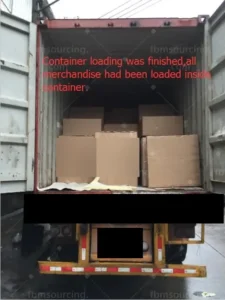
- Full load, door face, before the doors are closed
- Doors closed with the seal applied, seal number legible
- Any damage, defect or variance found during loading, photographed individually
Timestamps matter. A photo sequence with consistent timestamps across a single loading window is verifiable; a set of undated images is not. Our team records loading as a continuous sequence rather than as a handful of representative shots.
For the EU rules on cartons, pallets and importer duties from 12 August 2026, see our reading of the Packaging and Packaging Waste Regulation (EU) 2025/40.
Sourcing this for a commercial project?
FBM Sourcing works with project owners, developers, main contractors and FF&E contractors on hotel, apartment, school, office and other commercial building projects. Send us your BOQ, drawings or product list — our team will review it and get back to you.
Section 4: Utilisation, Stacking and Bracing
The report should state the volume and weight loaded against the container’s capacity. Take the internal volume from the carrier’s published container specification. Furniture and sanitaryware cannot fill the whole nominal volume once packaging, stacking limits and load stability are accounted for, so a report claiming near-full utilisation on a furniture load is usually measuring the wrong thing. The detail behind these figures is in our guide to 40ft container loading, CBM and weight limits.
Alongside the numbers, the report should show how the load was secured: airbags or dunnage between stacks, strapping to lashing rings, edge protection on strapped cartons, heavy items on the floor with lighter above, and no load bearing on cartons marked stack-limited. Where the container will be tipped or handled at an inland depot, the bracing at the door face is the critical detail, because that is where a shifting load bursts out when the doors are opened.
Section 5: Moisture and Condition Protection
An ocean transit produces repeated condensation cycles inside a steel box. The report should record what was used against it: container desiccant bags with the quantity and placement noted, kraft or PE covering over the load, pallet or dunnage separation from the floor, and whether any moisture-sensitive item — timber, upholstery, casegoods, MDF vanity carcasses — received additional wrapping. Our page on moisture and mould protection for furniture in sea containers covers the failure modes this prevents.
Who Produces the Report, and What to Check on Arrival
At FBM Sourcing, the inspection (once bulk production is finished) and loading supervision are carried out by our own team at the factory or the consolidation warehouse. Loading is attended, not reported after the fact by the factory, and the report is issued to you with the shipping documents — one of the practical reasons a project buyer uses a sourcing partner on the ground rather than relying on a factory’s own account of its own load. Where a shipment consolidates several factories into one container, the same team runs the consolidation, which is what makes a single reconciliation against one packing list possible — the process described in our guide to consolidating multiple factories into one container.
On arrival, three checks take fifteen minutes and protect the whole shipment. Photograph the seal before it is cut and compare the number against the loading report. Photograph the door face before anything is unloaded and compare it to the door-face photo in the report. Count cartons against the packing list before signing the delivery receipt clean, and note any discrepancy on the receipt itself. A clean signed receipt is difficult to walk back later, and the loading report only helps you if the arrival record is equally specific.
Sourcing this for a commercial project?
FBM Sourcing works with project owners, developers, main contractors and FF&E contractors on hotel, apartment, school, office and other commercial building projects. Send us your BOQ, drawings or product list — our team will review it and get back to you.
Frequently Asked Questions
How many photos should a container loading report contain?
Enough to follow the load from empty to sealed: empty container and container number, staged goods with carton marks, progressive stages as the load builds, the full load at the door face, and the sealed doors with a legible seal number, plus individual shots of any variance. A handful of full-container photos is not a report.
What container utilisation is realistic for a furniture load?
Less than the full nominal volume: packaging, stack limits and load stability mean furniture and sanitaryware never fill the whole container, and the realistic figure for a given order is set in the load plan.
Who should carry out loading supervision?
At FBM Sourcing, loading is attended and documented by our own team at the factory or the consolidation warehouse, with photo and video records, rather than reported after the fact by the factory.
What should the consignee check before signing for a container?
Photograph the seal before cutting it and compare the number with the loading report, photograph the door face before unloading and compare it with the report’s door-face photo, and count cartons against the packing list before signing the receipt clean. Note any discrepancy on the receipt itself.