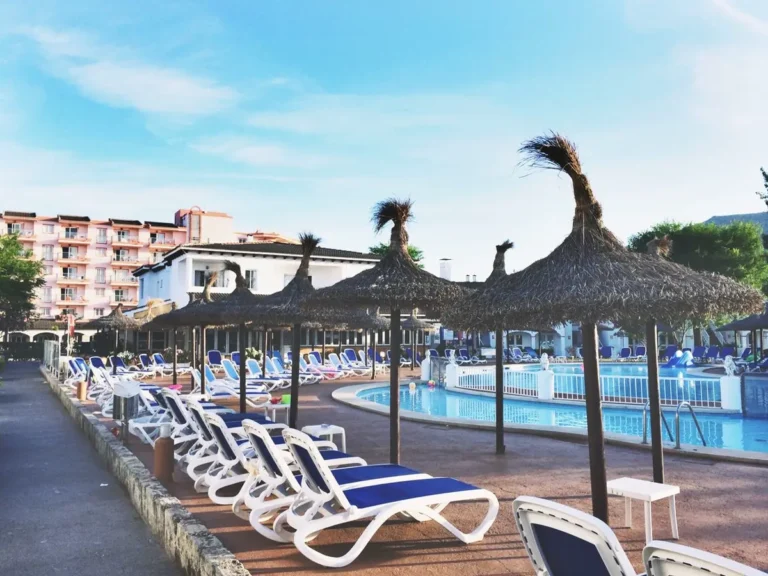
Sourcing FF&E and building materials from China for a resort or beach club is a corrosion and UV problem before it is a design problem. A coastal site is exposed to airborne salt that an inland site is not, which means 304 stainless steel, standard architectural powder coating and untreated fixings that perform perfectly on an inland hotel will show failure on a beachfront property within the first seasons. The specification that works is written around four things — marine-grade alloys and coatings, solution-dyed UV-stable textiles, drainage and sand tolerance in every detail, and a spares allowance that assumes attrition — and it has to be locked into the purchase order, because these are exactly the substitutions a factory makes to hit a price. FBM Sourcing is your sourcing partner in China: it holds no inventory and has no product range of its own.
Why Does a Beachfront Site Change the Specification?
Three environmental loads act at once on a resort, and each one attacks a different part of the package.
- Airborne chloride. ISO 9223 classifies atmospheric corrosivity from C1 (interior, dry) to C5 and CX. Beachfront and surf-zone locations are exposed to airborne salt, so the ISO 9223 category for the site should be confirmed by your engineer before the specification is written. Everything metallic in the package has to be specified for that category, including things nobody looks at, such as fixings, hinges, drawer runners and the frame inside an upholstered seat.
- UV load. Tropical and subtropical sites deliver a UV dose that fades pigment-dyed textiles, chalks paint films and embrittles unstabilised polymers. Lightfastness is a tested property — the ISO 105-B series — and it should appear in the specification as a required rating rather than as an expectation.
- Sand and water ingress. Sand acts as an abrasive in sliding tracks, blocks drainage slots and accelerates wear at every moving joint; driving rain and pool splash find every unsealed edge. Details that are simply neat on an urban project have to be functional here.
The programme consequence is that a resort package cannot be value-engineered by material substitution after award. Downgrading 316 stainless to 304, or a marine-class powder coat to a standard architectural class, saves money on the invoice and creates a replacement liability in year two.
What Should Be Specified for Outdoor and Poolside FF&E?
Frames and fixings
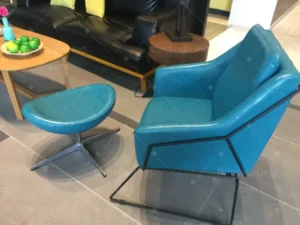
For metal outdoor furniture the workable specifications are marine-grade aluminium with a high-durability coating, or 316 stainless where stainless is required for appearance or structure. The distinction that matters is that 316 contains molybdenum and 304 does not, which is precisely why 304 pits in a chloride atmosphere. Fasteners should be specified in A4 (316) stainless throughout — a 316 frame assembled with A2 screws fails at the screws. For coatings, the relevant specification is a high-durability powder coating class or a marine-qualified system rather than a standard architectural one, and our comparison of powder coating versus anodised aluminium on commercial projects covers where anodising is the better answer.
Textiles and slings
Outdoor upholstery and sling fabrics should be solution-dyed acrylic or solution-dyed olefin, where pigment is in the fibre rather than applied to it, with a stated lightfastness rating. Foam for outdoor cushions should be reticulated quick-dry foam with a drainage-permeable inner cover, and cushion covers should be removable and washable, because a resort’s housekeeping cycle is the real test. Contract-grade requirements for interior soft furnishings are a separate specification again — see contract-grade upholstery fabric for hotel furniture.
Timber and composite
Teak and acacia remain the standard choices for outdoor timber, with certified legal-origin documentation required for most destination markets. The specification should state whether the finish is oiled or left to weather to grey, because that decision drives the resort’s maintenance labour for the next decade. Where a timber look is wanted without the maintenance, WPC is the usual substitute for decking and slats.
Structural adequacy under wind
Umbrellas, pergolas, cabanas and shade structures are wind-loaded elements, not furniture. They need a stated wind rating, a defined base or fixing method, and a documented stow procedure. Our guide to sourcing outdoor pergolas from China covers the specification points for those elements, and where the site is in a hurricane region the requirements escalate sharply — see hurricane impact standards for Caribbean projects.
A second resort-side example, focused on the outdoor package specifically, is set out in our outdoor FF&E and building materials case study.
Sourcing this for a commercial project?
FBM Sourcing works with project owners, developers, main contractors and FF&E contractors on hotel, apartment, school, office and other commercial building projects. Send us your BOQ, drawings or product list — our team will review it and get back to you.
What Building Materials Need a Coastal Specification?
The FF&E gets the attention, but on a resort the building materials package carries most of the long-term risk.
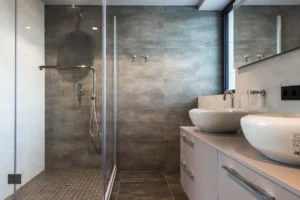
- Pool and wet-area tile: slip resistance has to be specified to the destination market’s method — a wet dynamic coefficient of friction of at least 0.42 under the ANSI A137.1 method for level interior wet areas in the United States, or the DIN 51130 R-classification and the DIN 51097 barefoot A/B/C classification used across Europe and much of Asia for pool surrounds. Barefoot areas need the barefoot classification, not the shod one.
- Grout and adhesive: pool and spa environments call for chemical-resistant grouting, because cementitious grout in a chlorinated or saline environment degrades and becomes the maintenance problem.
- Balustrades and pool fencing: glass and stainless assemblies on a beachfront need 316 componentry and, on many sites, a review of the fixing into the substrate. Specification points are covered in pool fence and railing sourcing from China.
- Doors and windows: beyond the wind and impact requirement, hardware finish and drainage design matter more here than anywhere. Sliding tracks need a drainage path that sand will not block, and hardware should be specified in a marine finish rather than a decorative one.
- Exterior lighting: the ingress protection rating and the housing material both need to suit the zone — poolside, beach walkway and landscape positions are not the same environment. See sourcing outdoor lighting from China.
- Ironmongery throughout: door hardware, locks, hinges and closers in a coastal property fail before the doors do. This is a specification line, not a value-engineering opportunity.
How Does a Resort Package Get Shipped and Sequenced?
Resorts are usually remote, and the logistics are frequently harder than the manufacturing. Three planning points decide whether the programme holds.
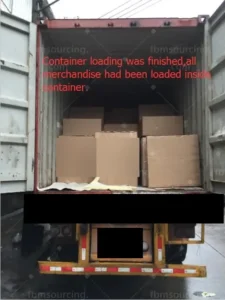
Consolidation and container discipline. A resort package spans outdoor furniture, guest room FF&E, F&B and back-of-house equipment, pool and landscape items and a building materials scope, typically produced across many factories. We always ship by full container: where a category is large enough it becomes its own container run, and where it is not it is consolidated with the other categories for the same project. How that is loaded and documented is set out in consolidating multiple factories into one container.
Transit and transshipment. Island destinations rarely have direct services. Cargo transships at a hub, which adds transit time and adds a handling event where damage and delay occur. On Caribbean routings this is the single biggest scheduling variable — see shipping from China to the Caribbean for project cargo.
Moisture in transit. A long tropical sea voyage produces container rain, and a resort package contains a lot of textile, foam and panel product. Desiccant, ventilation and packing specification are part of the order, and the standard is set out in export packing standards for furniture moving by sea freight.
Sequencing follows the operational opening rather than the construction programme: the areas that must be photograph-ready and revenue-ready first — the beach club, the pool deck, the arrival experience and a show room type — are landed and installed first, and back-of-house follows.
What Should a Resort Package Include That a Hotel Package Does Not?
Four items that are routinely missed when a resort is procured on a city-hotel template:
- An attrition and spares allowance. Outdoor furniture is exposed, moved daily and occasionally lost to weather. A spares allowance in the same production batch — frames, sling sets, cushion covers, umbrella canopies and the specific fixings — is far cheaper now than a matched reorder in two years.
- A stow and storage plan. Stackability and nesting are a specification requirement on a property that clears its deck for storms or for the low season. Twenty stacking loungers occupy a fraction of the store that twenty non-stacking ones do.
- Maintenance documentation. Cleaning agents that are safe on the specified coating, torque values for the fixings, and replacement part references — supplied as a package rather than discovered later.
- Cabana, beach and pool ancillaries. Towel storage, day-bed cushions, service trolleys, planters and signage are usually absent from an FF&E schedule written for a hotel, and they are all long-lead coastal-specification items.
For the broader regional context on Caribbean and island resort procurement, see Caribbean hotel and resort projects: sourcing FF&E and building materials from China, and for the manufacturer landscape our shortlist of outdoor furniture manufacturers in China for hotel and resort projects.
How FBM Sourcing Handles Resort and Beach Club Packages
FBM Sourcing manages the entire China procurement package for overseas construction projects, and on a resort that means the corrosion and UV specification is written into the purchase orders rather than left as a design intent. Before orders are placed we go through the schedule identifying every metallic component, coating system and textile in the package — including the ones inside an item, such as seat frames, fixings and runners — and set the alloy, coating class and lightfastness requirement per line, with a written no-substitution clause on each.
One inspection is carried out by FBM Sourcing’s own team at the factory once bulk production is finished, with photo and video records delivered before shipment. On coastal packages that specifically includes verifying the fastener grade on the finished goods rather than on the drawing, checking coating thickness and cure, confirming the textile supplied is the solution-dyed specification that was approved, and confirming drainage details are open on assembled units. Spares are produced in the same batch as the main order so they match, and the whole package is consolidated and shipped by full container with packing specified for a tropical voyage.
All quotations, invoices and shipping documents are issued by FBM Sourcing — you deal with us, and we carry the responsibility. For suppliers you nominate, we charge a 5% commission; for products we source for you, we quote a direct price. Where a resort is being delivered in phases, decor references, coating codes, fabric batches and fixing specifications are recorded at order stage so phase two matches phase one.
Where a resort or beach club includes a spa or wellness amenity, its FF&E and wet-area finishes run on a different procurement track from guest rooms and pool decking — see our guide to FF&E procurement for spa and wellness center projects.
Woven seating needs the same zone-by-zone thinking. Natural cane belongs under cover, while open pool decks and beach clubs call for a polymer strand on a coated aluminium frame; the reasons, and what to specify for each, are set out in our comparison of PE rattan vs natural rattan for resort outdoor furniture.
FBM Furniture
If you are an FF&E contractor, see furniture sourcing in China for FF&E contractors on fbmfurniture.com, the site of FBM Furniture, the furniture sourcing line of FBM Sourcing Limited.
Get a China Procurement Quote for Your Resort Project
If you are procuring a resort, beach club, pool deck or island hospitality project and need the coastal specification resolved before it is priced, send us the FF&E schedule and BOQ with quantities, the site location and exposure, the destination port and the required-on-site dates. Our team will set the alloy, coating and textile specification line by line, plan the container programme against your opening sequence, and set out the quotation.
Use the quote button above or WhatsApp +86 135 6007 5057 to start the conversation.
Mountain resorts invert several of these requirements — a very dry heated interior instead of humid coastal air, and a summer-only delivery window instead of a continuous programme — as set out in sourcing FF&E and building materials from China for ski resort and mountain lodge projects.