
China runs on a single time zone, China Standard Time (UTC+8), and that one fact determines almost everything about how a project buyer and a China sourcing agent work together. Every overseas project team has a different overlap window with a Chinese working day, and the size of that window decides which decisions can be made live and which have to be made in writing. This guide sets out the real overlap for the main project markets, the Chinese factory calendar that periodically removes the window entirely, and a communication cadence that works on a construction programme rather than on goodwill.
What is the actual working overlap with China?
China does not observe daylight saving. A Chinese factory office typically works roughly 08:30–17:30 CST, and the sourcing agent’s team works to the factory clock because that is when decisions can be executed. Against that:
- Australia and New Zealand (UTC+8 to UTC+13). Effectively a shared working day for the western states and a substantial morning overlap for the eastern seaboard. This is the easiest market to run live.
- Gulf and Middle East (UTC+3 to UTC+4). The Chinese afternoon is the Gulf morning. A reliable three to four hour overlap exists most days, with the complication that the Gulf working week differs from the Chinese one.
- Europe (UTC+1 to UTC+3 in summer, UTC to UTC+2 in winter). The Chinese late afternoon meets the European morning. The window is real but narrow, and it shrinks in European winter.
- United Kingdom and West Africa (UTC to UTC+1). A short window at the start of the UK day and the end of the Chinese day.
- North America east coast (UTC−4 to UTC−5). There is no natural overlap inside normal business hours on the same calendar day. Live calls happen either early morning in China or evening in North America, by arrangement.
- North America west coast and the Caribbean. Similar, with the Chinese morning corresponding to the previous North American evening.
The practical consequence is that for the Americas, the default mode is asynchronous and the exception is a scheduled call; for Australia and the Gulf, the default can be live. Structuring the working method around the wrong assumption is what produces the “we lose a day on every question” complaint.
Why does a one-day turnaround feel like three?
A question sent from North America at the end of the working day arrives in China after the factory has closed. It is read the next Chinese morning, put to the factory, answered by the factory during that Chinese day, and lands back in North America overnight. That is a normal, well-run cycle — and it consumes two calendar days for one question.
Chain three dependent questions together and a week disappears without anyone being slow. This is why the single highest-leverage habit on a China project is asking complete questions: one message containing the question, the drawing reference, the options you would accept, and the decision you will make on each answer. Our note on the five mistakes buyers make before sending a BOQ to China covers the same principle applied to the initial enquiry.
Sourcing this for a commercial project?
FBM Sourcing works with project owners, developers, main contractors and FF&E contractors on hotel, apartment, school, office and other commercial building projects. Send us your BOQ, drawings or product list — our team will review it and get back to you.
What does the Chinese factory calendar do to a programme?
Two annual events remove the overlap window entirely and both have to be in the programme from the start:
- Chinese New Year. The date moves with the lunar calendar, falling between late January and mid-February. The statutory holiday is short, but the practical shutdown is much longer: migrant workers travel home, many factories stop before the official date, and lines restart gradually afterwards as workers return. Capacity in the weeks before the holiday is the tightest of the year, because every exporter is trying to ship before the break.
- National Day, the first week of October. A shorter, more predictable shutdown, but it still removes a working week.
There are shorter public holidays through the year — Qingming, Labour Day, Dragon Boat, Mid-Autumn — that typically cost a few days each. None is individually significant; collectively they matter on a tight programme.
The correct response is not to ask a supplier to “work through the holiday”. It is to place orders so that the holiday falls at a point in the production cycle where it costs least, and to size the schedule buffer accordingly. Our guide to lead-time buffers in a construction schedule covers how to do that.
What communication cadence actually works?
A workable cadence has four layers, each with a different medium and a different response expectation.
- A written weekly report, on a fixed day. Status by line item, what changed since last week, what is blocked, and what decision is needed from the buyer with a date. This is the backbone: it converts a stream of messages into a document the project team can circulate and file.
- A short scheduled call, weekly or fortnightly. Held in the overlap window, with an agenda taken from the open decisions in the report. Calls are for resolving ambiguity, not for status — status belongs in writing.
- Messaging for time-critical items only. Useful and fast, but a decision that exists only in a chat thread is a decision nobody can find in six months. Anything that changes scope, specification, quantity or date should be restated in email.
- A defined escalation path. Name in advance who is called when something cannot wait for the next window — a quality issue found during loading, a material substitution request, a supplier problem. Agreeing this before it is needed removes the worst kind of delay.
Two disciplines make the cadence hold. First, decisions get dates: every open item in the weekly report carries the date by which an answer is needed to protect the programme. Second, photographs replace adjectives: “the finish looks wrong” costs a full cycle; a photograph next to the approved sample resolves it in one.
Who should the buyer actually be talking to?
On a well-structured project the buyer has one counterparty, not several. The agent holds the factory relationships, and the factories do not contact the buyer directly. This is not gatekeeping for its own sake — it exists because a buyer negotiating in parallel with three factories in a language they do not read will get three inconsistent answers and no accountability. Our note on a sourcing agent as your representative in China sets out how that responsibility works, and what a China sourcing agent’s fee covers explains what sits inside that role.
All quotations, invoices and shipping documents are issued by FBM Sourcing — you deal with us, and we carry the responsibility. For suppliers you nominate, we charge a 5% commission; for products we source for you, we quote a direct price.
What about site visits and factory visits?
A visit compresses weeks of asynchronous exchange into a day, and the right time for one is when there is a decision that photographs cannot settle — a finish selection across several suppliers, a mock-up sign-off, or a first-article review on a large repeat item. Our note on visiting Chinese factories with a sourcing agent covers how those trips are structured. Timing them around the two shutdown periods is essential; a visit in the fortnight before Chinese New Year will find factories at their most stretched.
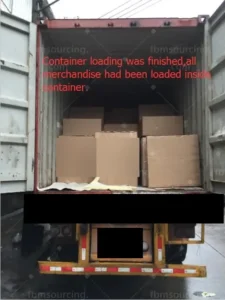
Sometimes, on a large project, one product category alone fill full containers; sometimes the categories share containers with the other product categories of the same project; and sometimes, in one batch, we combine a dozen or more product categories from several projects of the same client into a few containers — always full containers, and for us this is routine, well-practised work. Loading is the last point at which a communication failure is still cheap to fix, which is why a container loading report is issued before the doors close rather than after.
Sourcing this for a commercial project?
FBM Sourcing works with project owners, developers, main contractors and FF&E contractors on hotel, apartment, school, office and other commercial building projects. Send us your BOQ, drawings or product list — our team will review it and get back to you.
About FBM Sourcing
FBM Sourcing manages the entire China procurement package for overseas construction projects. Sourcing since 2014, we have shipped 1,000+ containers to project sites in 20+ countries, working with project owners, developers, main contractors and FF&E contractors on hotels, apartment buildings, schools, offices and other commercial buildings.
If you want to see what a weekly project report looks like on a live package, send us your BOQ or drawings at https://fbmsourcing.com/china-building-materials-ffe-procurement/.
Frequently asked questions
What time zone is China in?
The whole of mainland China uses China Standard Time, UTC+8, and does not observe daylight saving. A factory office day is roughly 08:30–17:30 CST.
How much daily overlap is there between China and the United States?
Effectively none inside normal business hours on the same calendar day. Live calls with North America are scheduled either early in the Chinese morning or in the North American evening, and the default working mode is asynchronous.
How long does Chinese New Year actually stop production?
The statutory holiday is short, but the practical impact is longer because workers travel home before it and lines restart gradually afterwards. The date moves with the lunar calendar, between late January and mid-February, and capacity in the preceding weeks is the tightest of the year. It should be built into the programme rather than negotiated with the factory.
Should decisions be made on messaging apps?
Messaging is useful for time-critical items, but anything that changes scope, specification, quantity or date should be restated in email so it can be found later. A decision that exists only in a chat thread is not traceable on a construction project.
How often should a China sourcing agent report?
A written report on a fixed weekly day, listing status by line item, what changed, what is blocked, and which decisions are needed from the buyer with dates — supported by a short scheduled call in the overlap window for anything ambiguous.