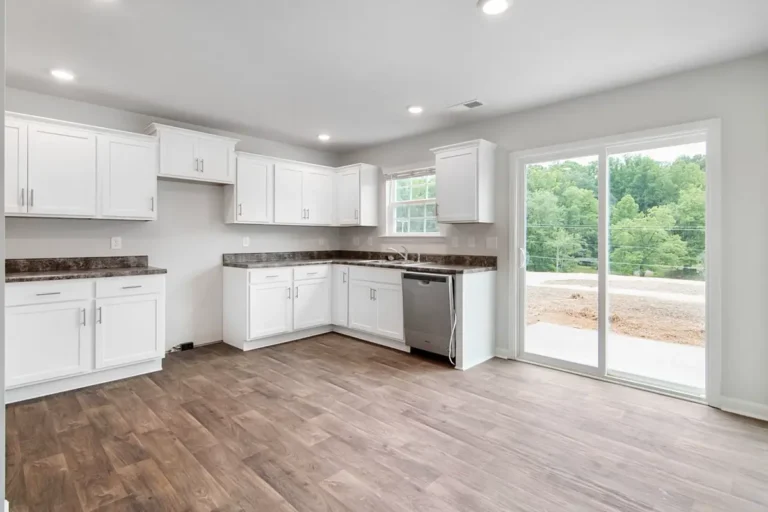
Five of the largest custom kitchen cabinet makers in China are publicly listed companies whose disclosures a UK buyer can read, but every one of them built its business on domestic retail showrooms and franchise stores, not on export project work for UK housing. Beneath that listed tier sits a much larger private tier of export cabinet plants in Guangdong, Zhejiang, Shandong and Jiangsu that no overseas buyer can verify from public records. This guide sets out which companies are actually checkable, how the supplier types differ, and the UK-specific evidence — EN 1116 coordinating sizes, BS 6222 and BS EN 14749 performance testing, moisture-resistant board grades, formaldehyde class and the timber due-diligence trail — that a housing or build-to-rent project team needs in hand before a purchase order for several hundred kitchens is issued.
What are you actually buying when you buy “kitchen cabinets” from China?
The phrase covers at least five different businesses, and the answer to “who makes it” depends on which one is quoting:
- Board mills. They press the particleboard, MDF or plywood and, in many cases, laminate the melamine face. They do not make cabinets. Their quality question is density, internal bond, swelling in humid conditions and formaldehyde emission.
- Door and front makers. Specialists in PVC-wrapped, acrylic, lacquered, PET or veneered doors who sell fronts to cabinet plants. On a project order the door supplier is often a different factory from the carcass supplier, and colour consistency between the two has to be managed.
- Cabinet plants. They cut, edge-band, drill and pack carcasses, fit the hardware and assemble or flat-pack the finished unit. This is the company whose name should be on the purchase order and whose floor the inspection covers.
- Whole-home custom brands. Large retail-driven groups that sell kitchens, wardrobes and wall systems to domestic consumers through franchise showrooms. Several also run a project (“bulk”) channel for developers. This is where the listed companies sit.
- Trading intermediaries. Companies that broker between the buyer and one or more of the above without owning production.
Mixing these up is the most common reason two quotations for the same kitchen schedule are not comparable. A door maker quoting fronts only and a cabinet plant quoting complete units with hinges, runners and plinths are not quoting the same thing. The same discipline applies to the drawings: the schedule has to be turned into a unit-by-unit order sheet before anyone can price it, and the choice between framed and frameless kitchen cabinets for projects has to be settled first, because UK kitchens are almost universally frameless carcasses on a 600 mm module.
Publicly listed companies a UK project buyer can verify
We name only companies whose listing and disclosures are public and checkable, and we state plainly what each one actually does. Everything else in this guide is written as a supplier type.
- Oppein Home Group (欧派家居), Shanghai Stock Exchange: 603833. Guangzhou-based, founded in 1994, and the largest disclosed revenue in the custom-home category. Its business is built on domestic franchise showrooms selling kitchens, wardrobes, bathroom cabinets and wooden doors, with a separately disclosed project channel serving developers. Role note: a retail brand with a project division, not an export cabinet mill. Evidence to request: which subsidiary and which plant would contract with you, whether that entity has shipped complete kitchens to the UK before, and test evidence to British and European standards rather than Chinese ones.
- Suofeiya Home Collection (索菲亚家居), Shenzhen Stock Exchange: 002572. Guangzhou-based, listed in 2011, and historically a wardrobe-led custom furniture group that added kitchens under a separate brand. Role note: strongest in wardrobes and wall systems; kitchens are a second business. Evidence to request: whether the kitchen plant and the wardrobe plant are the same entity, and which one holds the board and hardware certificates you will be relying on.
- Zbom Home Technology (志邦家居), Shanghai Stock Exchange: 603801. Hefei-based, listed in 2017, with kitchens as its original and largest category and a disclosed bulk-project business alongside retail. Role note: one of the few listed groups where kitchens rather than wardrobes are the core. Evidence to request: the project-channel contact rather than the export-trade contact, and completed multi-unit kitchen references outside China.
- Gold Medal Kitchen (金牌厨柜), Shanghai Stock Exchange: 603180. Xiamen-based, listed in 2017, kitchen-led with a disclosed developer channel. Role note: a kitchen specialist by origin, with a smaller overall scale than the two Guangzhou groups. Evidence to request: capacity commitment for a phased delivery across several hundred plots, and how colour-batch consistency is controlled between phases.
- Holike Creative Home (好莱客), Shanghai Stock Exchange: 603898. Guangzhou-based, listed in 2015, wardrobe-led with kitchens added later. Role note: relevant if the same package covers fitted wardrobes and kitchens; less so for kitchen-only orders. Evidence to request: which factory produces which category, and whether a single contract can cover both.
Listed status confirms scale and disclosure obligations. It does not confirm that a company has ever delivered a UK-compliant kitchen package, and it is not a substitute for the test evidence set out below. It is also worth knowing that all five compete hardest for the Chinese domestic developer, so an overseas project of a few hundred units is not automatically a priority for them.
The supplier types that make up the rest of the market
- Export-oriented cabinet plants. Factories whose output is mostly project and wholesale work for overseas markets, most commonly North America and Australia, with the UK a smaller share. Evidence to request: board certificates naming the mill and grade, hinge and runner brand and cycle-test reports, and a UK or European project reference with a completion date.
- Domestic-market plants. Large, capable and tooled for Chinese apartment developers, whose module sizes, appliance housings and worktop conventions differ from the UK. Adapting a domestic line to a 600 mm UK module with UK appliance apertures is an engineering exercise. Evidence to request: a full-size sample kitchen built to your drawings before bulk, not a catalogue.
- Door and front specialists. Where finish quality actually originates. Evidence to request: the wrap or lacquer system, humidity and heat resistance test reports, and colour tolerance across production batches.
- Board and laminate mills. Sell panel by the cubic metre. Evidence to request: EN 312 or EN 622 grade declarations, formaldehyde class test reports, and moisture-resistant grade for sink and appliance units.
- Trading intermediaries. Evidence to request: which factory will produce, whether the intermediary will place its own name on the documents, and who carries responsibility for a colour mismatch discovered on site.
Sourcing this for a commercial project?
FBM Sourcing works with project owners, developers, main contractors and FF&E contractors on hotel, apartment, school, office and other commercial building projects. Send us your BOQ, drawings or product list — our team will review it and get back to you.
Which supplier route fits which UK project?
| Project scenario | Shortlist from this list | Why it fits | What would change the answer |
|---|---|---|---|
| Build-to-rent tower, one or two kitchen types repeated across 200–500 apartments | Export-oriented cabinet plant | Repetition suits a plant already tooled for the 600 mm module and UK appliance apertures | A landlord specification that names a UK hinge or runner brand only one plant is licensed to fit |
| Phased housing scheme, several hundred plots over 18–30 months | Export plant with a written capacity commitment, or a listed group’s project channel | Colour-batch and door-programme continuity across phases matters more than unit price | Phase 2 being tendered separately, which breaks the continuity argument |
| Student accommodation or co-living with communal kitchens | Export plant plus a door specialist for high-wear fronts | Communal use pushes hinge cycle life and impact-resistant fronts to the top of the list | An operator standard that requires stainless or solid-surface worktops from a UK fabricator |
| Kitchens and fitted wardrobes in one package | Listed whole-home group’s project channel, or two specialist plants under one contract | A single supplier removes the colour-match problem between kitchen and bedroom joinery | Wardrobes being site-built by a UK joiner, leaving kitchens only |
| Accessible units to Part M4(2) or M4(3) | Only plants that will build to the accessible layouts from your drawings | Worktop heights, knee spaces and reachable storage cannot be retrofitted from a standard range | Accessible units being fitted out separately by a UK specialist |
Where the finish is the driver, the underlying decision is the door system rather than the carcass supplier, and the trade-offs are set out in melamine vs PVC vs lacquer cabinet finishes.
What UK evidence must be in hand before you order?
This is where a China kitchen purchase for a UK scheme most often goes wrong, because the factory’s own reports are usually to Chinese standards or to the North American standards it exports against, and neither is what a UK employer’s agent or warranty provider will ask for. The following are the documents a UK project team should hold:
- Coordinating sizes to EN 1116. UK kitchens are designed around a 600 mm module with carcasses typically 720 mm high on a 150 mm plinth and 560–570 mm deep under a 600 mm worktop. A plant tooled for another market’s module will produce units that do not meet UK appliances or worktop stock sizes. Ask for the carcass drawings, not a brochure.
- Performance testing to BS 6222-2 and BS EN 14749. These cover the strength, stability and durability of fitted kitchen units and storage units, including shelf loading, door and drawer operation and wall-unit fixing. Ask which laboratory issued the report and which exact carcass construction and hardware were tested — a test on a 16 mm carcass does not cover an 18 mm one, and vice versa.
- Hinge and runner evidence. Hinges to EN 15570 and drawer runners to EN 15338 with the cycle count stated. On a rental scheme the hardware is what the maintenance team replaces first, so the brand and series should be named on the order and matched to what cabinet hardware sourcing from China can actually supply as spares five years later.
- Board grade declarations. Particleboard to EN 312 with P3 grade for sink and appliance units where a moisture-resistant carcass is specified, or moisture-resistant MDF to EN 622-5. Ask for the mill’s declaration, not the cabinet plant’s assurance.
- Formaldehyde class. the emission class the project specification names for carcass and door boards, backed by the board mill’s current test report for that class. The interaction between UK, EU and North American classes is set out in formaldehyde standards for China-sourced cabinets.
- Timber due-diligence trail. Wood-based products, including wooden furniture, fall within the UK Timber Regulations, and the obligation to exercise due diligence on timber origin sits with the first company placing the product on the UK market — normally the importer, not the factory. Ask for species and origin declarations and chain-of-custody certificates so that your own file is complete.
- Independent furniture testing where the specification calls for it. Many UK developer and operator specifications reference FIRA testing or certification for fitted furniture; what that involves for a China-made product is set out in FIRA testing for furniture on UK projects.
- Accessible unit compliance. Where the scheme includes M4(2) or M4(3) dwellings, the kitchen layouts, worktop heights and knee-space units have to be built to the approved drawings, and the factory has to confirm in writing that it has done so.
A note on fire: the Furniture and Furnishings (Fire) (Safety) Regulations apply to upholstered furniture, not to fitted kitchen units, so a factory offering a “UK fire certificate” for a carcass is offering something the regulation does not require. On higher-risk buildings the product information for fitted items may nonetheless be requested for the building’s information record, so keep the specification and supplier file intact.
How do kitchen cabinets ship on a UK project?
Kitchens are a volume cargo. A flat-packed carcass with doors boxed separately uses container space far better than an assembled unit, but flat-pack moves assembly labour to the UK site and puts the responsibility for a square carcass on the fitter; assembled units arrive ready to fix but ship mostly air. The trade-off is set out in flat-packed vs assembled FF&E orders from China, and on housing schemes the answer is usually flat-pack carcasses with pre-fitted hinges and pre-assembled drawers.
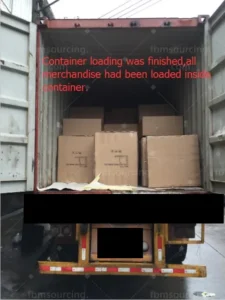
Sometimes, on a large project, the kitchen cabinets alone fill full containers; sometimes the kitchen cabinets share containers with the other product categories of the same project; and sometimes, in one batch, we combine a dozen or more product categories from several projects of the same client into a few containers — always full containers, and for us this is routine, well-practised work.
Three points decide whether the delivery works: the loading sequence has to follow the site’s plot or core sequence, every carton has to carry the plot and unit reference from the kitchen schedule, and the loading has to be documented before the doors close. What that documentation should contain is set out in what a container loading report should show for a commercial project. Where the same developer is also buying doors, sanitaryware or flooring from China, the consolidation decision belongs at package level, and the wider picture for that route is covered in how UK developers source building materials from China.
Why this list has no scores, ratings or supplier links
We publish no score column and no outbound links to the companies named. A score would imply we had audited every company against the same criteria in the same period, which we have not. What we do instead is state what is publicly verifiable, describe the supplier types honestly, and set out the evidence to request — the judgement stays with the project team, its employer’s agent and its warranty provider. That is also why a UK developer often uses a China sourcing partner or sourcing agent for this category: not to be handed a ranked list, but to have the evidence above collected, checked on the factory floor before shipment and tied to one set of documents.
We also publish no prices for kitchens. Unit price moves with carcass grade, door system, hardware brand, worktop scope, the number of unit types and the phasing, and a number published today would mislead a reader next year.
The same listed groups seen through a Gulf compliance lens, where SABER conformity and 45-degree heat specification replace the UK requirements, are covered in top kitchen cabinet manufacturers in China for Middle East and GCC projects.
About FBM Sourcing
FBM Sourcing manages the entire China procurement package for overseas construction projects. Sourcing since 2014, we have shipped 1,000+ containers to project sites in 20+ countries, working with project owners, developers, main contractors and FF&E contractors on hotels, apartment buildings, schools, offices and other commercial buildings. All quotations, invoices and shipping documents are issued by FBM Sourcing — you deal with us, and we carry the responsibility. For suppliers you nominate, we charge a 5% commission; for products we source for you, we quote a direct price.
If you have a kitchen package for a UK housing or build-to-rent scheme, send us the kitchen schedule, the unit-type drawings and the phasing programme at https://fbmsourcing.com/china-building-materials-ffe-procurement/.
Frequently asked questions
Are there listed Chinese companies making kitchen cabinets?
Yes. Oppein Home Group (603833, Shanghai), Suofeiya Home Collection (002572, Shenzhen), Zbom Home Technology (603801, Shanghai), Gold Medal Kitchen (603180, Shanghai) and Holike Creative Home (603898, Shanghai) are all listed custom-furniture groups with kitchen businesses. All five are built on domestic retail showrooms with a project channel alongside; none discloses UK project export as a core business. Most export cabinet plants are private companies without public disclosure.
Which standards apply to kitchen cabinets on a UK project?
Coordinating sizes to EN 1116, unit performance to BS 6222-2 and BS EN 14749, hinges to EN 15570 and runners to EN 15338, board grades to EN 312 or EN 622-5, and the formaldehyde emission class named in the project specification, backed by the board mill’s current test report. Fitted kitchen carcasses are not covered by the Furniture and Furnishings (Fire) (Safety) Regulations, which apply to upholstered furniture.
Does the factory have to comply with the UK Timber Regulations?
The due-diligence obligation sits with the first company placing the wood-based product on the UK market, normally the importer. The factory’s role is to supply species, origin and chain-of-custody evidence so that the importer’s due-diligence file is complete before the goods arrive.
Should kitchens for a UK scheme ship flat-packed or assembled?
Housing and build-to-rent schemes usually ship flat-pack carcasses with pre-fitted hinges and pre-assembled drawers, because container space is used far more efficiently and UK fitters are used to assembling on site. Assembled units suit small unit counts or sites without fitting labour, at the cost of shipping mostly air.
What is the minimum order for kitchen cabinets from China?
We do not handle loose freight. The practical minimum is a full container load consolidated for one client, and kitchen cabinets can share containers with the other product categories of the same project.