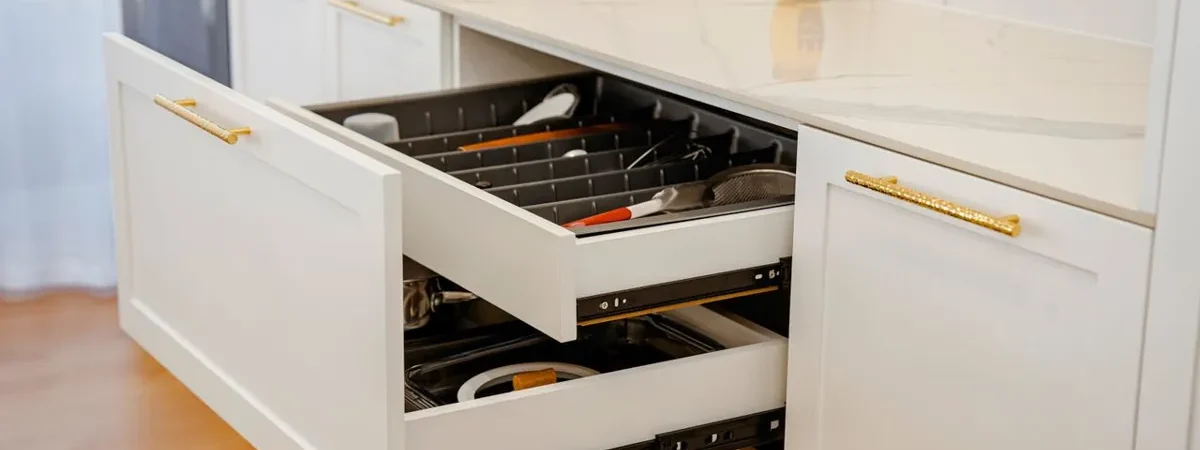
Cabinet hardware is invisible in the renders and decisive in the handover: hinges, slides and dampers are the parts of a kitchen or wardrobe that guests and tenants actually operate, thousands of times, and the first components to be blamed when a door sags or a drawer grinds. On a project buying cabinetry by the apartment block, the hardware count runs into five figures — an average kitchen alone carries 15–25 hinges and 5–10 slide pairs. Cabinet hardware sourcing from China gives commercial projects factory-direct access to the full fitting schedule — concealed hinges, drawer slide systems, lift mechanisms, pull-out baskets and handles — and FBM Sourcing runs the category as a building material sourcing agent and sourcing partner, whether the hardware ships inside finished cabinets or as a bulk fitting order for joinery built elsewhere.
Types of Cabinet Hardware and Specifications for Commercial Projects
A project fitting schedule is built from six repeating families:
- Concealed hinges — 35 mm cup hinges with integrated soft-close, in standard, half-overlay and inset cranks, plus 165° wide-angle and thick-door variants
- Drawer slides — ball-bearing side-mount, full-extension undermount with soft-close, and complete metal-box drawer systems
- Lift systems — gas struts and mechanical stay lifts for overhead flap doors in kitchens and vanities
- Pull-out organisation — wire and flat-wire baskets, corner carousels, larder units and waste pull-outs
- Handles and knobs — aluminum profile pulls, zinc-alloy bar handles and integrated finger-pull channels
- Dampers and accessories — push-to-open catches, shelf supports, plinth clips and levelling feet
The numbers that separate contract-grade from commodity hardware are cycle counts and load ratings. Concealed hinges for hotel and apartment work should be tested to 80,000 open-close cycles with the door loaded; drawer slides to 50,000–80,000 cycles at their rated load, which means 30 kg minimum for standard drawers and 40–45 kg for pot drawers and file storage. Soft-close damping should be hydraulic, not friction, and specified across the whole schedule — mixed damped and undamped hardware in one apartment reads as a defect. Finish testing matters in wet rooms and coastal buildings: nickel-plated steel components should pass 48–96 hour salt-spray testing, and vanity hardware should be specified in stainless or heavily plated variants rather than bare zinc.
How Does Cabinet Hardware Sourcing from China Work?
Most projects meet cabinet hardware in one of two shapes. When FBM Sourcing sources complete cabinetry — the route described in our kitchen cabinet sourcing guide and wardrobe cabinet page — the hardware is specified inside the cabinet order, and the buying decision is about locking the hinge and slide brands and grades in the contract so the factory cannot quietly substitute. When the joinery is being built in the destination country or by a separate fit-out contractor, the hardware ships as its own bulk order: cartoned by fitting type, labelled to the joinery drawings, with 3–5% overage for site loss.
Either way the sequence is the same: fitting schedule from the cabinet drawings, one quotation per hardware family, then a sample kit — one of each hinge, slide, lift and handle — approved before production, the standard golden-sample discipline covered in our sample approval guide. Production runs 15–30 days for a typical project package. Hardware is dense, heavy cargo that never travels alone: it consolidates into the containers carrying cabinets, doors or other building materials, filling the floor space that light cargo wastes.
Quality Standards and Inspection
Hardware substitution is the classic failure in cabinet orders — approved-grade hinges on the sample, lighter ones in the bulk. FBM Sourcing’s own inspection team closes that gap in the factory: batch samples are pulled and compared against the approved kit for markings, gauge and damping behaviour, slides are load-checked and cycled by hand, plating is checked for coverage and burrs, and carton labelling is verified against the fitting schedule before loading. When hardware ships inside finished cabinets, the same team checks the installed fittings during the cabinet inspection — doors aligned, soft-close engaging, drawers running true. The inspection is documented in photos and video for the client’s record.
Why Source Cabinet Hardware Through FBM Sourcing
Fitting schedules cut across every joinery scope on a project — kitchens, wardrobes, vanities and the storage inside a walk-in closet system all draw from the same hinge and slide families. As a building material sourcing agent, FBM Sourcing buys those families once, at one grade, in one finish batch, for the whole project — on a 5% commission for suppliers you nominate (products we source for you are quoted at a direct price) — and answers for the result as part of the wider cabinet and building material package rather than as a bag of parts. For buyers researching the manufacturer landscape first, our guide to China’s top furniture hardware manufacturers maps the brands these grades come from.
Sourcing this for a commercial project?
FBM Sourcing works with project owners, developers, main contractors and FF&E contractors on hotel, apartment, school, office and other commercial building projects. Send us your BOQ, drawings or product list — our team will review it and get back to you.
Get a Quote for Your Project
Send us your cabinet drawings or fitting schedule, unit counts, finish intent, destination port and programme dates. FBM Sourcing will return per-family pricing, a sample kit plan, grade recommendations for wet and coastal areas and a consolidation plan — start on our project inquiry page.