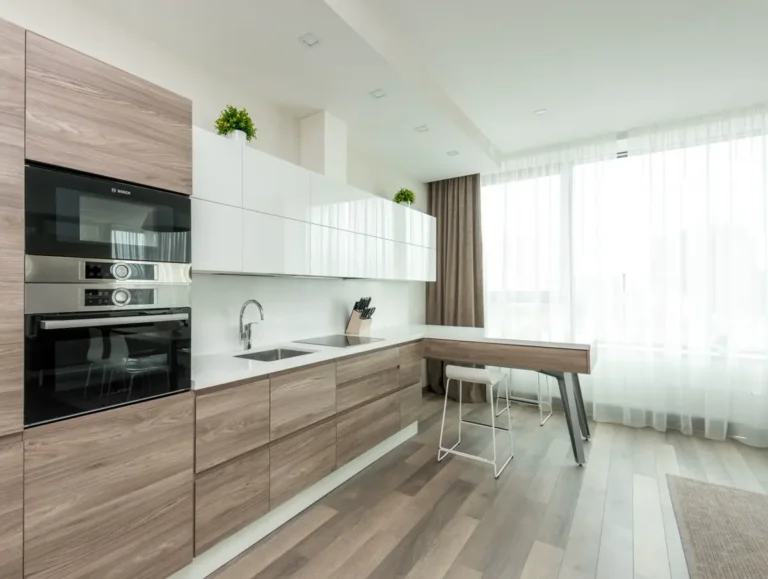
For most US multifamily, build-to-rent and hotel projects, frameless (full-access) cabinets are the better specification: they give noticeably more usable interior volume per box, use standardized 35mm cup hinges and drawer runners that make door and front replacement fast, and match what the majority of export factories in China actually build. Face-frame cabinets earn their place where a traditional American look drives sales value — typically for-sale condos and high-end custom residences — and where site walls are too uneven for the tighter tolerances frameless installation demands. The framed vs frameless kitchen cabinets decision is therefore less about which is “better” and more about matching construction type, tenant profile and factory capability. This is exactly the kind of project FBM Sourcing, your China sourcing partner, is built to handle.
This guide is written for developers, general contractors and FF&E contractors specifying cabinet packages across dozens or hundreds of units, where a structural choice made at design stage ripples through hardware procurement, installation labor and ten years of unit turnovers.
What Is the Structural Difference Between Framed and Frameless Cabinets?
A framed (face-frame) cabinet is the traditional American construction: a hardwood frame — stiles and rails typically 1.5 inches (38mm) wide and 3/4 inch (19mm) thick — is fixed to the front edge of the cabinet box. Doors and drawer fronts mount to this frame, either partially overlaying it, fully overlaying it, or sitting inset within it. The frame stiffens the box, hides raw panel edges, and gives installers something solid to screw through.
A frameless cabinet, also called full-access or European-style, has no face frame at all. The box is built from thicker panels — usually 16-18mm — with front edges finished by edge banding, and doors mount directly to the cabinet sides. Construction follows the “System 32” convention: rows of 5mm holes bored at 32mm centers along the inside of each side panel, which locate hinges, drawer runners, shelf pins and connectors in fixed, repeatable positions. That 32mm grid is why frameless production automates so well: one boring pattern serves every function in the box.
Why the 32mm system matters for procurement
Because hole positions are standardized, frameless cabinets from different factories accept the same hinge plates, runners and shelf supports. On a 300-unit apartment package, that means replacement hardware years later does not depend on the original factory still existing — a genuine lifecycle advantage for asset managers.
How Much More Storage Does a Frameless Cabinet Actually Give You?
The face frame overhangs the cabinet opening on all four sides, and that overhang is dead space. In practical terms:
- A frameless box yields noticeably more usable interior volume than a framed box of identical external dimensions.
- Drawer boxes in a frameless base cabinet can be wider per opening, because runners mount flush to the cabinet sides instead of being blocked out past the frame.
- Full-overlay frameless doors leave only 2-3mm reveals between fronts, so the elevation reads as a continuous surface — the look most current multifamily interior schemes are drawn around.
- Interior shelves in frameless cabinets pull out without catching a frame lip, which matters for ADA-adaptable units where roll-out shelves are specified.
Across a studio or one-bed unit kitchen with limited linear footage, that extra volume is not cosmetic. It is the difference between a renter’s stockpot fitting in the base cabinet or living on the countertop — the kind of detail leasing teams hear about.
Hinges, Runners and the 35mm Hardware Ecosystem
Frameless cabinets run on concealed 35mm cup hinges — the boring diameter standardized by the major European hardware makers such as Blum and Hettich — clipped to mounting plates screwed into the 32mm system holes. Typical commercial-grade specifications are 110-degree opening angle, integrated soft-close, and three-dimensional adjustment (height, depth, side) that lets installers true up door alignment in seconds without re-drilling. Drawer hardware follows the same logic: full-extension concealed undermount runners rated at 30kg or more for kitchen use, again located by the 32mm grid.
Framed cabinets can use adapted versions of the same cup hinges with frame-mount plates, but the hardware pairing is less universal, and inset or partial-overlay framed doors often move to entirely different hinge types. When a project mixes door styles across unit tiers, this is where hardware SKUs multiply — and where consolidated cabinet hardware sourcing under one purchase order protects both budget and spare-parts logic.
One planning number worth locking early: order door hinges and runners with a small overage as attic stock. Hardware is the first thing maintenance teams consume, and matching a discontinued soft-close hinge five years on is harder than storing two boxes of spares.
The door finish decision matters as much as the box format — compare melamine vs PVC vs lacquer cabinet finishes before you lock the spec.
Sourcing this for a commercial project?
FBM Sourcing works with project owners, developers, main contractors and FF&E contractors on hotel, apartment, school, office and other commercial building projects. Send us your BOQ, drawings or product list — our team will review it and get back to you.
Installation Tolerance: Where Face-Frame Construction Is More Forgiving
This is the trade-off frameless advocates tend to skip. The face frame projects slightly proud of the cabinet sides, so framed cabinets can be shimmed and scribed against wavy drywall while the frame keeps sight lines clean; small box-to-box misalignments hide behind it. Frameless runs, by contrast, present a continuous plane of doors with 2-3mm gaps — every deviation in the wall, floor or box alignment telegraphs straight into those reveals.
Practical consequences for a project schedule:
What frameless installation actually requires
Frameless runs need properly leveled bases (adjustable leg levelers are standard on Chinese-made frameless boxes), straighter wall substrates, and installers who work to millimeter reveals rather than “caulk will cover it.” On new build multifamily with decent drywall tolerances this is routine; crews fitting their third identical floor plate move fast, because every kitchen repeats. Where the building design produces lots of out-of-square corners, or where local install labor has only ever hung framed boxes, the framed option de-risks the finish schedule.
Flat-pack versus pre-assembled shipping also enters here: frameless boxes flat-pack efficiently and assemble on site with cam-and-dowel fittings, while face-frame cabinets usually ship assembled and eat container volume. On a full apartment package, that difference changes how many 40ft high-cube containers — about 76 cubic meters of nominal capacity each — the cabinet scope consumes.
Durability and Compliance: KCMA A161.1 and TSCA Title VI
Construction style says nothing about quality by itself; testing does. The US benchmark is ANSI/KCMA A161.1, the Kitchen Cabinet Manufacturers Association performance standard, and it applies equally to framed and frameless product. Its headline tests are concrete enough to write into a purchase order:
- Doors opened and closed through 25,000 cycles, then checked for loose or damaged hinges.
- Drawers operated through 25,000 cycles under load, staying operable and on track.
- Finish surfaces exposed to common substances such as vinegar, coffee, lemon and mustard without blistering or discoloration.
- Structural tests including shelf loading and impacts on doors and fronts.
On board chemistry, every composite wood panel — plywood, particleboard, MDF — entering the US must comply with TSCA Title VI formaldehyde emission limits, which align with CARB Phase 2: 0.05 ppm for hardwood plywood, 0.09 ppm for particleboard and 0.11 ppm for MDF. Compliant Chinese mills produce labeled, certified board as a matter of routine, but the paper trail — mill certificates matched to the actual production batch — is something your purchasing side must collect before shipment, not reconstruct after a customs query.
What Chinese Cabinet Factories Actually Build — and Why It Decides Your Spec
Here is the sourcing fact that should sit in the room during design development: the overwhelming majority of cabinet production lines in China — across both the Foshan/Guangdong cluster and the Shandong export belt — are tooled for the 32mm frameless system. Beam saws, CNC boring centers, edge banders and hardware inventories are all standardized around it. Specify frameless, and nearly the entire capable factory pool can quote your package; the China kitchen cabinet industry is structurally a frameless industry.
True face-frame capability is a different story. Building framed cabinets with mortised or pocket-screwed hardwood frames and five-piece doors requires separate tooling, separate assembly lines and QC habits that most domestic-market factories never developed, because Chinese domestic kitchens are frameless. The factories that do run face-frame lines are concentrated among plants purpose-built for US export — a much shorter list, which makes vetting kitchen cabinet manufacturers for US multifamily the critical path item for a framed specification. A kitchen cabinet sourcing agent in China earns its fee (for suppliers you nominate, a 5% commission; for products we source for you, a direct price) largely here: knowing which plants genuinely run face-frame lines versus which will improvise one for your order.
Timeline reality is similar either way: production starts after shop drawing and finish sample approval, the lead time is confirmed by the factory in writing for each order, and transit time is confirmed by the carrier at booking. Framed packages tend to sit at the longer end of production because assembled boxes move slower through finishing.
Framed vs Frameless Kitchen Cabinets: The Decision Table
| Factor | Framed (face-frame) | Frameless (full-access) |
|---|---|---|
| Front construction | 1.5″ hardwood face frame | Edge-banded box, 32mm system holes |
| Usable interior volume | Baseline | Noticeably more per box |
| Hardware | Frame-mount hinges, more SKU variety | Standard 35mm cup hinges, universal plates |
| Installation tolerance | Forgiving of uneven walls; frame hides misalignment | Needs precise leveling; reveals expose errors |
| Shipping | Usually assembled; more container volume | Flat-packs efficiently; site assembly |
| China factory pool | Small, export-focused plants only | Vast majority of capable factories |
| Best fit | For-sale condos, traditional high-end interiors | BTR, rental multifamily, hotels, student housing |
Why build-to-rent leans frameless
Rental operators optimize for space per unit and cheap, fast turnovers. Frameless delivers both: more storage inside the same kitchen footprint, and slab doors on clip-on hinges that a maintenance tech can swap in minutes when a tenant damages a front — no finish-matching a frame, no re-boring. For apartment development procurement covering hundreds of identical kitchens, that repeatability compounds across the asset’s life.
Why high-end residential still specifies framed
Where units are sold rather than leased, kitchen aesthetics carry sales-price weight, and the shaker-on-face-frame look remains the language of traditional American luxury. Inset doors — the most demanding, most premium expression of it — are only possible with a frame. Buyers at this tier are purchasing the look; the extra interior volume rarely enters the conversation.
Get a China Procurement Quote for Your Project
If you are specifying cabinet packages for a multifamily, hotel or student housing project, we can price both constructions from vetted factories, confirm KCMA test reports and TSCA Title VI board certificates, and manage the order through production — every shipment is inspected before shipment by our own team, with photo and video records. As a building material sourcing agent working only with commercial projects, we handle the package from shop drawings to your destination port. Submit your drawings, unit counts, destination port and timeline through our China building materials and FF&E procurement page, and our team will come back with a factory shortlist and a workable production schedule.