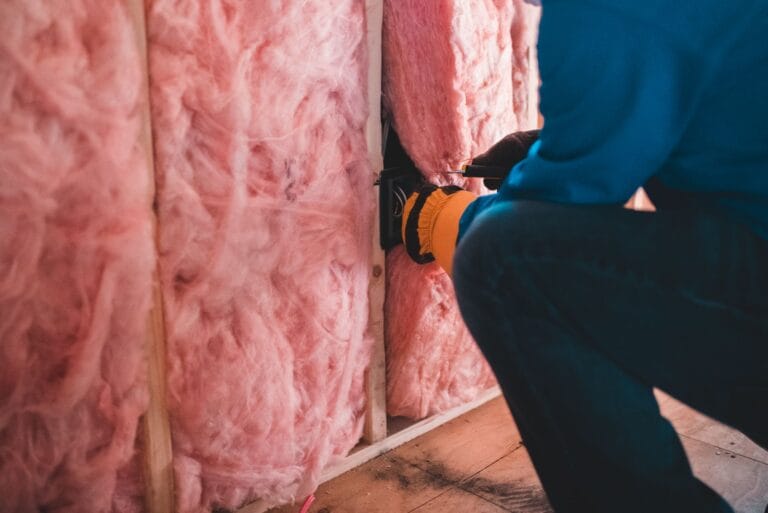
Building insulation for commercial construction is made in China by three kinds of factory: mineral wool and glass wool lines, rigid foam board lines (EPS, XPS, polyurethane and polyisocyanurate), and metal-faced sandwich panel lines that laminate those cores onto steel skins. Only a few of these companies are listed on a Chinese stock exchange with insulation identifiable in their own audited disclosure, so this page names only those we verified against exchange filings and describes every other supplier by manufacturer type, product family and the evidence to ask for. It covers building insulation, not electrical or transformer insulation and not industrial furnace or process pipe lagging.
It is written for developers, general contractors, builders, commercial project owners, interior design and construction companies and FF&E solution providers pricing an insulation package for a commercial, industrial, hospitality or multifamily building who need to know what the Chinese supply base actually looks like before issuing an enquiry.
What Counts as Building Insulation on This Page
The phrase “insulation manufacturers in China” pulls in at least three unrelated industries, and a result mixing them together is worse than useless when a package is being priced. This page covers only thermal and acoustic insulation that becomes part of a building envelope or internal construction. It excludes electrical insulation, transformer paper and cable compounds; high-temperature ceramic fibre for furnace and kiln lining, whatever its makers call themselves; and pre-formed pipe sections for process plant.
The Product Families in a Commercial Insulation Package
Most packages resolve into a handful of families, and the family decides which factory type can quote.
- Stone wool and glass wool. Slabs, rolls and boards for external walls, partitions, roofs and acoustic separation. A genuine producer has its own melting and spinning line, not a cutting and packing operation.
- Expanded polystyrene (EPS). Moulded board for external wall systems and floor build-ups. Low-cost lines, a fragmented supply base, and where relabelled trading stock is most common.
- Extruded polystyrene (XPS). Board where compressive strength and low water absorption matter: inverted roofs, under-slab, perimeter.
- Rigid polyurethane (PU) and polyisocyanurate (PIR). Higher thermal resistance per unit thickness, as board or as a composite panel core.
- Metal-faced sandwich panels. Steel skins bonded to a PUR, PIR, mineral wool or glass wool core, used as wall and roof panels on industrial buildings, logistics sheds and cold stores. A fabrication line rather than a core-material line, and often the format an overseas project actually buys.
Roof insulation has to coordinate with the membrane above it, which is why insulation enquiries often arrive alongside waterproofing membrane and metal roofing sheet enquiries, and why wall insulation is usually priced in the same round as facade cladding.
Which Chinese Insulation Manufacturers Can Be Verified Against Exchange Filings?
The test is deliberately narrow: currently listed on a Chinese stock exchange, no special-treatment prefix, and a 2025 annual report that either shows an insulation line inside the main-business revenue breakdown or discloses an identifiable insulation business whose position in the filing we can describe accurately. Companies are not scored, not ranked and not linked to. Three passed.
Jiangsu Jingxue Insulation Technology Co., Ltd. (Shenzhen Stock Exchange, 301010)
The exchange’s company record gives the registered name as Jiangsu Jingxue Insulation Technology Co., Ltd., registered in Changzhou, Jiangsu, listed 18 June 2021. In its 2025 annual report the main-business product breakdown shows one dominant line, metal-faced energy-saving insulated sandwich panel, at RMB 761,189,100.71, which the same table puts at 88.36 per cent of revenue; cold store and industrial doors form a second line. The product list under that line names PUR and PIR rigid foam sandwich panels, rock wool sandwich panels, rock wool external wall, partition and roof panels, and glass fibre wool wall and roof panels. Role: an envelope panel fabricator whose volume sits in cold storage and industrial building envelopes rather than in board or roll insulation. Evidence to request: core type and density, declared thermal performance at the panel thickness offered, reaction-to-fire classification for the complete panel rather than the core alone, and the tested joint and fixing detail.
Chongqing Zaisheng Technology Corp., Ltd. (Shanghai Stock Exchange, 603601)
The exchange roster records Chongqing Zaisheng Technology Corp., Ltd. as listed since 22 January 2015 with no delisting date. Its 2025 annual report shows two segments, clean air and high-efficiency energy saving, with a high-efficiency energy-saving materials product line at RMB 670,576,379.17. The report’s own glossary defines that line as ultra-fine fibre wool, vacuum insulation panels with their cores and films, lead-acid battery separators, aviation acoustic and thermal wool, and green building insulation materials, and attributes the year’s movement to glass fibre wool and vacuum panel board. Role: a fibre and vacuum panel producer whose energy-saving line is mixed, so building insulation is one part of a line that also carries battery separator and aviation products. Evidence to request: which product code is offered, declared thermal conductivity at the stated mean temperature, and the test report behind any service-life statement.
BBMG Corporation (Shanghai Stock Exchange, 601992)
The exchange roster records BBMG Corporation as listed since 1 March 2011 with no delisting date. Its 2025 annual report shows a green building materials segment and a property segment, and the product-level breakdown is by revenue type rather than by material, so there is no separate insulation revenue line in the main-business product table. The insulation business is identifiable elsewhere in the same report: the subsidiary and acquisition disclosures record that Beijing BBMG Energy-Saving Insulation Technology (Dachang) Co., Ltd. acquired 70 per cent of Shanghai New Building Materials Rock Wool Co., Ltd. for RMB 406,970,529.74, with control transferring on 31 May 2025, and the subsidiary schedule describes that company’s business as new mineral and rock wool insulation materials, decorative materials and other rock wool products with associated materials and installation services. Role: a group whose rock wool capacity sits in named subsidiaries rather than in a reported insulation product line. Evidence to request: which subsidiary and plant a quotation comes from, because the group name alone does not identify the manufacturing entity.
On what is absent: several of the largest listed Chinese waterproofing and gypsum-board groups were checked against their 2025 product tables and report no insulation line at all, so they are not named here; and one large listed producer often returned by searches for “insulation” reports ceramic fibre as its dominant line, which is furnace lining rather than building insulation.
Pricing a building insulation package for a commercial project?
Send the wall and roof build-ups, or the BOQ, and our team in China will turn them into a factory-ready insulation schedule split across the right manufacturer types. Developers, general contractors, builders and FF&E solution providers work with us this way on envelope packages.
The Manufacturer Types Behind the Rest of the Market
Most of the Chinese supply base is privately held, so no filing exists to check, and describing a candidate by type is more useful than ranking names that cannot be verified.
- Integrated mineral wool producers. Own melting and spinning capacity and the ability to produce to a specified nominal density. Evidence to request: density tolerance, thermal conductivity test report at the stated mean temperature, and reaction-to-fire classification in the thickness quoted.
- Foam board extruders and moulders. EPS and XPS lines, often serving a regional market. Evidence to request: compressive strength at the specified deformation, water absorption after immersion, dimensional stability, and the standard the declared values are measured to.
- Sandwich panel fabricators. Buy or make cores and laminate them to coil; a panel can have a compliant core and a facing that fails on coating thickness. Evidence to request: steel grade, coil coating type and film thickness, core density, thickness tolerance, and the fire classification held for the complete panel.
- System houses. Supply an external wall insulation system as a kit: board, adhesive, mesh, base coat and finish. Evidence to request: whether the kit was tested as a system, and which components must stay together for that test to remain valid.
- Trading companies presenting as factories. Common in EPS and board products. Evidence to request: the production licence and the plant address on the test reports, checked against the entity issuing the quotation.
Which Fire and Performance Standards Should the Specification Name?
Insulation is one of the few construction products where the fire rules, not the thermal numbers, decide what can be used. The clauses below were read in the original text on 24 September 2026.
In China, GB 55037-2022, the General Code for Fire Protection of Buildings, was approved by Ministry of Housing and Urban-Rural Development Announcement 2022 No. 189 of 27 December 2022 and took effect on 1 June 2023. The announcement states that it is a mandatory engineering construction code whose provisions must all be strictly enforced, that it prevails over conflicting engineering construction standards, and that it repeals mandatory clauses of other codes including GB 50016-2014 (2018 edition), the Code for Fire Protection Design of Buildings. Section 6.6 governs building insulation: external wall external insulation shall be Class A for crowded-occupancy places and buildings containing them (6.6.5); in a cavity-free external wall system it shall be Class A above 100 m in residential buildings (6.6.6) and above 50 m in other buildings (6.6.7); where the system has a cavity between the substrate wall and the finish layer it shall be Class A above 24 m and not lower than Class B1 at or below 24 m, with the cavity fire-separated and sealed at every floor slab (6.6.8); and internal insulation shall be Class A in crowded-occupancy places, in places with open flame, fuel oil or gas fire risk, in evacuation stair enclosures and their lobbies, in refuge corridors, floors and rooms, and in fire lift lobbies (6.6.9).
The Chinese national standard classifying reaction to fire of building materials and products is GB 8624. On the national standards portal, GB 8624-2012 is shown as current and GB 8624-2025 as a mandatory standard issued 31 December 2025 with an implementation date of 1 January 2027. For the two common foam boards, GB/T 10801.1-2025 and GB/T 10801.2-2025 are both shown as current, issued 31 December 2025 and implemented 1 July 2026, replacing GB/T 10801.1-2021 and GB/T 10801.2-2018. A quotation still citing the superseded editions signals a technical file that has not been refreshed.
| Market | Standard | Edition confirmed on 24 September 2026 |
|---|---|---|
| China | General fire code for buildings | GB 55037-2022, in force 1 June 2023 |
| China | Reaction to fire classification | GB 8624-2012 current; GB 8624-2025 implemented 1 January 2027 |
| China | EPS board | GB/T 10801.1-2025, implemented 1 July 2026 |
| China | XPS board | GB/T 10801.2-2025, implemented 1 July 2026 |
| Europe and UK | Factory made mineral wool | BS EN 13162:2012+A1:2015 |
| Europe and UK | Factory made EPS | BS EN 13163:2012+A2:2016 |
| Europe and UK | Factory made XPS | BS EN 13164:2012+A1:2015 |
| Europe and UK | Factory made rigid polyurethane | BS EN 13165:2012+A2:2016 |
| Europe and UK | Reaction to fire classification | BS EN 13501-1:2018 |
| United States | Rigid cellular polystyrene insulation | ASTM C578-23 |
| United States | Mineral fiber block and board insulation | ASTM C612-25 |
| United States | Surface burning characteristics | ASTM E84-26a |
The European entries are the editions currently published by the British Standards Institution; the mineral wool, EPS and XPS ones are shown as under review and the polyurethane one as current. On United States projects the ASTM E84 result travels with the finish and lining as well as the insulation, covered in our page on flame-spread requirements for wall panels and finishes, and for Australian projects the route from a Chinese test report to acceptance is set out in our overview of NCC and BCA compliance for building materials from China.
How an Insulation Package Is Priced and Shipped
Insulation is bulky and light, so it loads out by volume rather than weight. Sometimes, on a large project, the insulation products alone fill full containers; sometimes the insulation products share containers with the other product categories of the same project; and sometimes, in one batch, we combine a dozen or more product categories from several projects of the same client into a few containers — always full containers, and for us this is routine, well-practised work.
Insulation also rarely arrives as a clean line item: it appears as an area with a thickness note on a wall type or as a layer inside a roof detail, so product family, nominal density, thickness, facing and edge profile have to be fixed first. What a China quotation does and does not contain is set out in our page on what a BOQ-based quotation from China actually includes.
What FBM Sourcing Does on an Insulation Package
FBM Sourcing acts as the sourcing partner in China for the project team. On an insulation package that means turning the wall and roof build-ups into a product schedule a factory can quote, splitting that schedule across the right factory types rather than sending everything to one supplier, collecting the test reports that belong to the exact product and thickness offered, and holding one inspection by our own team at the factory after bulk production is finished, before shipment, with photo and video records. An inspection report goes to the client before the balance is paid.
Pricing a building insulation package for a commercial project?
Send the wall and roof build-ups, or the BOQ, and our team in China will turn them into a factory-ready insulation schedule split across the right manufacturer types. Developers, general contractors, builders and FF&E solution providers work with us this way on envelope packages.
Frequently Asked Questions
Does this list rank Chinese insulation manufacturers?
No. Those companies are named only because their listing status and insulation position could be checked in exchange records and their own 2025 annual reports; they are not scored, not ranked and not linked to, and a company’s absence says nothing about its capability.
What is the difference between building insulation and the industrial insulation that shows up in the same search?
Building insulation becomes part of a wall, roof, floor or internal construction and is judged against building fire classifications and declared thermal performance, while industrial insulation covers furnace lining and process pipework and is judged against continuous service temperature; ceramic fibre is the clearest example, and a supplier whose catalogue is dominated by it is the wrong factory for a construction package.
Which standard decides whether an insulation product can be used on an external wall in China?
GB 55037-2022, the General Code for Fire Protection of Buildings, which took effect on 1 June 2023 and whose provisions the issuing announcement states must all be strictly enforced; its section 6.6 sets the required combustion performance grade for external and internal insulation by building type, height and whether the system has a cavity, and requires cavity systems to be sealed at every floor slab.
Can a Chinese insulation factory supply test data in the format our market expects?
Some can and many cannot: a factory selling mainly into the domestic market holds reports written against Chinese national standards, and converting that into a European, United States or Australian submission normally needs a fresh test at an accredited laboratory, or a conformity assessment body, on the exact product and thickness offered. Settle that before a product is specified.
How should an insulation enquiry be prepared so factories quote the same thing?
Fix six things first: product family, nominal density, thickness, facing or finish, edge profile, and the standard the declared thermal and fire values must be reported against. Without those, quotations come back for different products at levels that cannot be compared, and the differences only surface on site.
About FBM Sourcing
FBM Sourcing manages the entire China procurement package for overseas construction projects. Since 2014 we have worked with developers, general contractors, builders, commercial project owners, interior design and construction companies and FF&E solution providers across more than 20 countries and over 1,000 containers, as their sourcing partner in China — from the schedule or BOQ through factory selection, sampling, inspection by our own team before shipment, consolidation and shipping. All quotations, invoices and shipping documents are issued by FBM Sourcing, and sea freight is quoted to you before shipment. If you have a building insulation package to price, start at China building materials and FF&E procurement.