The fire and life-safety documents you must collect for handover are, for every affected product: a test report or certificate against the standard named in the specification, issued by an accredited laboratory or certification body; evidence that the item delivered is the item tested (label, batch, product description); and the manufacturer’s installation and maintenance instructions. In England and Wales that pack is a legal duty under Regulation 38 of the Building Regulations and the CDM 2015 health and safety file; in the US it is what the authority having jurisdiction inspects before a certificate of occupancy; in Australia it feeds the Form 15/16 and the annual fire safety statement. The mistake that costs money is collecting it at handover. By then the goods are installed, the factory has moved on, and a missing crib 5 report means the sofas come back out. This guide sets out what to collect by product category, what a valid report has to say, and when in the programme to collect it. This is exactly the kind of project FBM Sourcing, your China sourcing partner, is built to handle.
Which Documents Does the Building Authority Actually Ask For?
The legal wrapper differs by market, but the demand underneath it is the same: show that each fire-affected product performs as specified, and show that the thing on site is the thing that was tested.
- England and Wales: Regulation 38 of the Building Regulations requires fire safety information to be given to the responsible person at completion. The Building Safety Act 2022 golden-thread duties make that information set a live record for higher-risk buildings, and CDM 2015 Regulation 12 requires the health and safety file. Product-level test evidence sits inside both.
- United States: the AHJ inspects against the adopted IBC and NFPA 101 editions before issuing the certificate of occupancy. For opening protectives, NFPA 80 requires a written acceptance inspection record at installation and inspection not less than annually thereafter.
- Australia: compliance is demonstrated against the NCC, with certification evidence under NCC A5G2 — CodeMark certificates, accredited test reports or certificates from a professional engineer. In New South Wales the Fire Safety Certificate at completion becomes an Annual Fire Safety Statement thereafter; in Queensland the Form 15 and Form 16 chain carries the same evidence.
- EU: for construction products covered by a harmonised standard, the Declaration of Performance under the Construction Products Regulation is the legal document, and the reaction-to-fire class is one of its declared essential characteristics.
None of these authorities accepts a marketing brochure, a Chinese domestic GB certificate offered in place of a local one, or a report whose sample description does not match what was delivered. Our overview of fire rating standards for building materials and finishes maps which standard governs which surface.
What Do You Collect for Doors, Glazing and Opening Protectives?
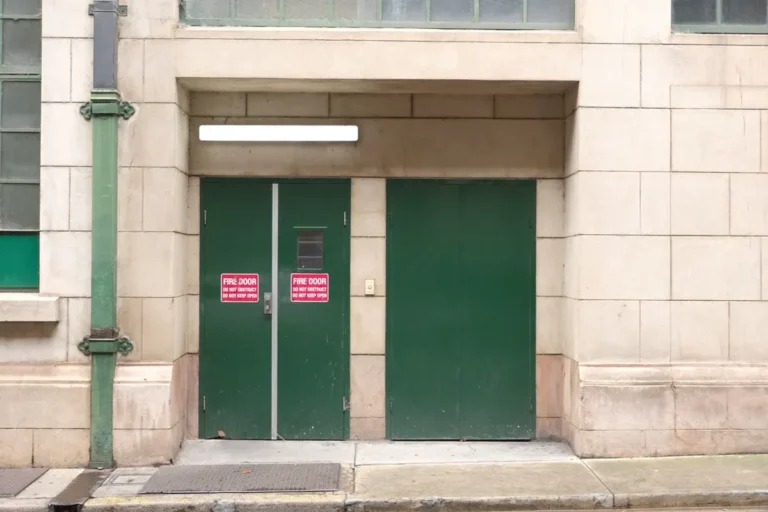
Openings are where the largest handover failures happen, because the rating belongs to the whole assembly — leaf, frame, hardware and glazing — and a single unlisted component voids it.
- Fire doors, US: the listing certificate or file number for each door type tested to UL 10C or NFPA 252 under positive pressure, the hardware schedule showing listing marks for hinges, closers, latches and exit devices, glazing markings such as D-H-90, the manufacturer’s installation and maintenance instructions, and the NFPA 80 acceptance inspection record.
- Fire doors, UK and EU: the FD30 or FD60 evidence to BS 476-22 or EN 1634-1, the third-party certification scheme reference where the specification calls for one, the field of application covering your leaf size and configuration, and the installation instructions. Retain the label or plug identifying each door.
- Fire-rated glazing: the classification report to EN 13501-2 giving the E, EW or EI class and duration, or the US listing mark etched on the glass, plus the framing system it was tested in. Glazing is only rated in the frame it was tested with.
- Smoke seals and intumescent strips: evidence that the seal supplied is the one in the tested assembly, by product reference.
What Do You Collect for Furniture, Fabrics and Soft Furnishings?
Every soft product in a hotel, student residence, hospital or public building has a reaction-to-fire requirement, and the report has to describe the exact build — fabric, interliner, filling and construction — because a compliant fabric over a non-compliant foam fails the composite test.
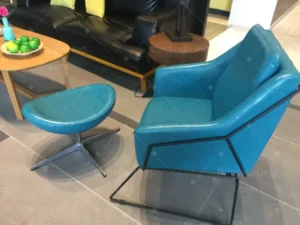
- Upholstered seating, UK: BS 7176 hazard classification with the composite tested to BS 5852; hotels, halls of residence and public buildings normally require medium hazard, ignition source crib 5. Ask for the report on the fabric-and-foam combination you ordered, not on the fabric alone.
- Mattresses and divans, UK: BS 7177 to the matching hazard level, again crib 5 for most contract use.
- Upholstered seating, US: California TB 117-2013 for smoulder resistance, with TB 133 where the local code or the operator’s standard still calls for the full-scale test.
- Upholstered seating, EU: EN 1021-1 (cigarette) and EN 1021-2 (match flame) as the base, with national requirements above it.
- Curtains, drapes and blinds: NFPA 701 in the US; BS 5867 Part 2 Type B for most interiors and Type C where required, in the UK; EN 13773 classes in the EU. Include the after-cleaning declaration where the fabric is durably treated rather than inherently flame-retardant.
- Contract furniture strength and durability is a separate evidence chain from fire — see EN 16139 for contract furniture and FIRA testing for UK projects.
For the equipment itself, see our guide to fire extinguisher and fire hose cabinet manufacturers in China.
Sourcing this for a commercial project?
FBM Sourcing works with project owners, developers, main contractors and FF&E contractors on hotel, apartment, school, office and other commercial building projects. Send us your BOQ, drawings or product list — our team will review it and get back to you.
What Do You Collect for Linings, Floors and Lighting?
Surface linings and floor coverings are judged by classified numbers, and those numbers are the most quotable part of the handover pack — which is also why they are the ones a specifier will check first.
- Wall and ceiling linings, US: ASTM E84 (or UL 723) surface burning characteristics. Class A is a flame spread index of 0–25 with a smoke developed index not exceeding 450; Class B is 26–75; Class C is 76–200. Exit enclosures and corridors in most occupancies demand Class A.
- Wall and ceiling linings, EU and UK: the EN 13501-1 Euroclass with its smoke and droplet sub-classes, for example A2-s1,d0 or B-s1,d0. The sub-classes are not optional detail — a B-s3,d2 product fails a B-s1,d0 specification.
- Wall and ceiling linings, Australia: the Group Number 1 to 3 determined to AS 5637.1, plus the smoke growth rate index where required.
- Floor coverings: ASTM E648 critical radiant flux — Class I is not less than 0.45 W/cm² and Class II not less than 0.22 W/cm² in the EU the Bfl-s1 style classification to EN 13501-1; in Australia AS ISO 9239.1.
- Emergency lighting and exit signage: photometric and duration evidence to BS 5266-1 and EN 1838 in the UK and EU, or UL 924 listing in the US, plus the commissioning record showing the duration test was carried out. Electrical safety approvals are a separate chain again — for Australia see SAA certification for lighting and electrical products.
- Fire-protective coatings on steelwork: the assessment or certificate showing the specified period of fire resistance at the section factor used, plus the applied dry film thickness records.
What Makes a Test Report Valid — and What Makes It Worthless?
Most rejected handover packs contain documents that are technically genuine and practically useless. Six fields decide which one you are holding.
- The issuing laboratory and its accreditation. A report from a laboratory accredited to ISO/IEC 17025 by an ILAC MRA signatory carries weight; an in-house factory report does not, whatever the letterhead. Our comparison of factory test reports and accredited laboratory testing explains the gap.
- The named standard and edition. “Fire tested” is not a standard. “EN 1634-1:2014+A1:2018” is.
- The sample description. It must match what was delivered: species and thickness for a door leaf, fabric reference and foam density for a seat, backing and pile weight for a carpet. This is the field that fails most often.
- The field of application. A door tested at 2,100 mm does not automatically cover 2,400 mm. A classification report states the range it extends to; outside that range the evidence does not apply.
- The date and validity. Certification schemes have expiry and surveillance conditions; a type test report does not expire, but the certification built on it can be withdrawn.
- The link to your goods. Labels, batch or lot numbers, and a packing list that ties the delivered cartons to the tested product. Without this the report is about somebody else’s product.
When Should You Collect the Documents?
Collect at three points, and never leave the first two to the end of the job.
- Before the order is confirmed: the type test report or listing for every specified item, checked for standard, sample description and field of application. If the evidence does not exist, this is the moment when the product can still be changed at no cost.
- During production: photographs of labels and markings as applied, batch numbers, and the coating or thickness records where they are generated. Once cartons are strapped and stacked, label photography becomes a shipment-delaying exercise.
- At shipment: the compiled pack indexed to the packing list, travelling with the shipping and customs document set so that one file arrives with the goods rather than being chased across time zones after installation.
Build the index as a schedule, not a folder of PDFs: one row per specified item, with the standard, the report number, the issuing laboratory, the field of application and the batch it applies to. That schedule is what a building control officer, a fire engineer or an insurer will read, and it is what converts a pile of certificates into an approval.
On a Gulf project the evidence has to exist before the goods are ordered, not only before handover, because Civil Defence approval is issued against a named manufacturing location — see which fire safety approvals a Gulf hotel project needs.
How FBM Sourcing Assembles the Fire and Life-Safety Pack
FBM Sourcing manages the entire China procurement package for overseas construction projects. On a hotel, apartment, school, office or healthcare package we read the fire strategy and the specification first and build a compliance schedule before quoting: every line that carries a reaction-to-fire, fire-resistance or emergency-lighting requirement is listed with the standard it must meet and the evidence that will satisfy it. Factories are shortlisted against existing accredited test evidence for the exact build, not against a promise to test later, and where a specified configuration falls outside a report’s field of application we raise it while the product can still be changed. Before shipment our own FBM Sourcing QC team checks labels, markings and batch numbers at the factory, with photo and video records, so the pack is complete before the container is sealed. All quotations, invoices and shipping documents are issued by FBM Sourcing — you deal with us, and we carry the responsibility. For suppliers you nominate, we charge a 5% commission; for products we source for you, we quote a direct price. Sometimes, on a large project, the doors alone fill full containers; sometimes the doors share containers with the other product categories of the same project; and sometimes, in one batch, we combine a dozen or more product categories from several projects of the same client into a few containers — always full containers, and for us this is routine, well-practised work.
If you are putting together a handover pack for a commercial building, send us the fire strategy, the specification clauses that name a standard, the product list, the destination port and the required-on-site dates. Our team will review it line by line and set out a quotation — use the quote button above or WhatsApp +86 135 6007 5057.