Furniture is protected from moisture and mould in a sea container by controlling three things at the factory before the doors close: the moisture already inside the load (timber, pallets, crates and cardboard, which carry far more water than the air does), the container itself (dry, sound, inspected floor and seals, loaded in dry conditions), and the humidity that will develop during the voyage through daily temperature swings (managed with calcium chloride container desiccants sized to the box, silica gel inside cartons where the product needs it, and barrier packaging for finishes that mark). A 40HQ of casegoods packed with timber kiln-dried to the specified moisture content on dry pallets, with container desiccant hung along the walls and no loading in rain, is far better protected; the same container packed on green pallets, without desiccant, on a monsoon-season sailing across the equator, is where the mould photographs come from. This guide sets out where the water comes from, how much desiccant is needed, and what a project buyer should require and inspect. That is the role FBM Sourcing plays as a sourcing agent and sourcing partner on projects like this.
Where Does the Moisture in a Container Come From?
The instinctive answer is “the sea air”, and it is mostly wrong. A closed 40HQ holds about 76 m³ of air; at 30°C and 80% relative humidity that air contains roughly 1.8–2 kg of water vapour in total. The cargo and its packaging carry many times that:
- Timber in the furniture: 15 tonnes of solid wood, plywood and MDF at 12% moisture content holds about 1.8 tonnes of water. If the wood is at 14% instead of 10%, that is a further 600 kg available to move into the air as the container warms.
- Pallets, crates and dunnage: the largest single risk. Freshly sawn softwood pallets are green timber that has not been kiln-dried; a container load of them carries a large amount of water. ISPM 15 heat treatment kills pests; it does not dry the wood.
- Cardboard cartons and honeycomb: hold moisture and are quick to take up more; a container of carton-packed goods holds a significant amount of water in the packaging alone.
- The container floor: a plywood floor that was rained on before stuffing, or washed and not dried, can release several litres over a voyage.
- Loading conditions: stuffing in rain, high humidity or with wet forklifts brings water in on the goods and the floor.
The mechanism that turns that water into mould is condensation. In sunlight the container roof and the interior air heat up well above the outside temperature; at night, or when the ship moves from the tropics into cooler water, the steel cools below the dew point of the interior air and water condenses on the roof and walls (“container rain”) or on the cargo when the cargo is the coldest surface (“cargo sweat”). Water drips onto cartons, cartons stay wet, and mould can appear first on the packaging and then on the product. Every voyage from South China to North America, Europe or Australia crosses at least one such temperature change; sailings across the equator and through the Red Sea or Panama cross several.
What Moisture Content Should Furniture and Packing Timber Have Before Loading?
Because the wood is the largest reservoir, moisture content at packing is the specification that matters most, and it is measurable with a pin meter at inspection.
- Solid timber and veneered casegoods for temperate destinations (US, UK, Northern Europe): packed at the moisture content stated in the specification, set to match the in-service equilibrium of an air-conditioned building so the product does not shrink and check after installation.
- For tropical and humid destinations (Caribbean, Gulf coast, Southeast Asia, Northern Australia): a specified moisture content closer to the destination’s higher in-service equilibrium.
- Plywood, MDF and particleboard components: at the moisture content they leave the panel mill with; the risk is edge swelling if the panel absorbs water in transit, so sealed edges and carton liners matter more than the starting figure.
- Pallets, crates and dunnage: kiln-dried to the moisture content set in the packing specification; require this and check it. Heat-treated (ISPM 15, HT stamp) is a phytosanitary requirement, not a moisture guarantee.
- Cartons: stored dry, off the floor, and not brought from a humid warehouse straight into a hot container.
How those requirements sit inside a full packing specification — corner protection, carton grades, stretch wrap and crate design — is covered in export packing standards for furniture shipped by sea. Which panel materials are more or less tolerant of a moisture excursion is in plywood vs MDF vs particleboard for casegoods.
How Much Desiccant Does a Container Need?
Container desiccants absorb the vapour that the cargo and the air release, keeping relative humidity below the level at which mould grows on cellulose. Two types are used together on furniture shipments:
- Container desiccants (calcium chloride based): hung from the lashing rings along both side walls, or laid on top of the load. Working dosage is set by the packing specification for the container size, lane and season, following the desiccant supplier’s dosage guidance, and is increased for monsoon-season sailings, equatorial crossings, transhipment with long dwell, and loads with a high proportion of timber or paper. Distribute evenly — units at the door end are worth more than extra units in the nose, because the door end sees the largest temperature swing.
- In-carton desiccants (silica gel or clay): for products that mark, corrode or swell — upholstery with metal frames, lacquered casegoods, leather, mirrors, hardware. Dosage follows DIN 55473 desiccant units, in practice small sachets in each carton rather than one large bag; they protect the microclimate inside the carton, not the container.
Two rules apply to both. Desiccants must be sealed until the moment of loading — a bag opened in a humid warehouse the day before is half spent before the doors close. And desiccant is the third line of defence, not the first: it cannot dry green pallets or a wet floor, and no dosage compensates for loading in the rain.
Sourcing this for a commercial project?
FBM Sourcing works with project owners, developers, main contractors and FF&E contractors on hotel, apartment, school, office and other commercial building projects. Send us your BOQ, drawings or product list — our team will review it and get back to you.
What Should Be Checked on the Container Before Stuffing?
A container is a shipping line’s asset that has just been emptied by someone else, and its condition varies. Before a project load goes in, the box should be checked and photographed:
- Light test: doors closed from inside — any daylight through roof, walls or floor is a leak. Reject the box.
- Floor: dry to the touch, no dark patches, no smell of previous cargo (fertiliser, chemicals, hides and fish are the ones that ruin furniture), no protruding nails or gouges.
- Door seals and locking bars: rubber gaskets intact and closing tight; a container that leaks at the doors wets the last two pallets, which on a project load are usually the ones the site needs first.
- Vents: present and clear; a standard dry box breathes a little, which is desirable.
- Weather at loading: loading stops in rain. Goods do not wait on the apron; forklift tyres are dry.
- Loading order and airflow: a small gap between cargo and side walls where possible, cartons off the floor on dry pallets, and nothing in contact with the roof where container rain forms first.
Weight and space planning for the same load — how many pallets, in what sequence, at what payload — is in 40ft container loading, CBM and weight limits.
Which Products and Routes Are Highest Risk?
Not every project shipment carries the same exposure. Risk rises with the water content of the load, the temperature range of the route, and the sensitivity of the finish:
| Factor | Higher risk | Lower risk |
|---|---|---|
| Product | Solid timber, veneer, leather, natural-fibre upholstery, rattan, MDF with open edges, mirrors and lacquered panels | Powder-coated metal, HPL, porcelain, glass, sealed uPVC and aluminium |
| Packaging | Green pallets, single-wall cartons, cardboard in direct contact with the product | Kiln-dried pallets, double-wall or honeycomb cartons, PE or foam liners between carton and product |
| Season and route | May–September loading in South China (rain and high humidity); equatorial crossings; long transhipment dwell in Singapore, Colombo or Kingston; US Gulf and Caribbean arrivals in summer | Direct services in the dry season; short transits to Australia’s east coast or the US West Coast |
| Dwell time | Container stuffed and left at the factory or terminal for a week before sailing; slow customs at destination; storage in an unconditioned warehouse | Stuffed within a day of the depot pick-up, delivered and unpacked promptly |
The Caribbean is the combination of all four, and it is why island resort projects need a packing specification written for the lane rather than the factory’s default. Our note on shipping project cargo from China to the Caribbean covers the transhipment and dwell issues that make the difference there.
What Should the Buyer Require and Inspect?
A project buyer cannot be at the factory on loading day, so the protection has to be written into the order and verified at inspection. The requirement list FBM Sourcing uses on furniture and joinery packages is short:
- Timber moisture content at packing measured and recorded per line (target range by destination as above), with pin-meter readings in the inspection report.
- Pallets and crates kiln-dried to the moisture content set in the packing specification and ISPM 15 heat-treated, with the HT stamp visible; no green wood.
- Carton grade, liner and internal desiccant per the packing specification for the product type.
- Container desiccant quantity and placement stated in kilograms and positions, sealed until loading, and photographed in place.
- Container inspection checklist completed and photographed before stuffing; loading suspended in rain.
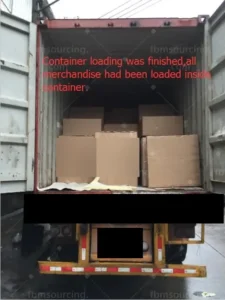
- Loading photographs through the loading sequence and at door-closing, plus the seal number, delivered before the container leaves the factory.
Where the goods are being inspected under a sampling plan, moisture content and packing checks are part of the pre-shipment inspection rather than a separate visit — see pre-shipment inspection and AQL sampling explained. Inspection is carried out once by FBM Sourcing’s own team at the factory when production is finished, with photo and video records delivered before shipment.
What If Mould Is Found on Arrival?
Surface mould on cartons that has not reached the product is common on marginal shipments and is dealt with by unpacking promptly, discarding the packaging outside the building and wiping and airing the goods. Mould on the product is a claim: photograph everything before it is moved, including the desiccants (a spent, swollen desiccant bag is evidence the box ran wet; a dry one is evidence it did not), keep the seal and the container number, and notify the freight forwarder and the cargo insurer within the policy’s notice period, which can be very short. Whether the factory or the buyer bears the loss depends on the packing specification in the purchase order and on which Incoterm passed risk where; under FOB and CIF, risk passes on loading, so the packing must have been right before that point. That is the practical argument for putting the packing and desiccant requirements in the order and inspecting them, rather than arguing about them at the destination.
How FBM Sourcing Handles Moisture Protection on Project Shipments
FBM Sourcing manages the entire China procurement package for overseas construction projects, and packing for the sea voyage is specified as part of the order rather than left to the factory’s default. The packing specification is written for the product, the destination climate and the season of sailing: moisture content targets by line, kiln-dried pallets and crates, carton grades and liners, in-carton desiccant for sensitive finishes, and container desiccant in kilograms with placement. Our own team measures moisture content at inspection, checks the packing against the specification, inspects and photographs the container before stuffing, and records the loading and seal — with photo and video records delivered before shipment.
All quotations, invoices and shipping documents are issued by FBM Sourcing — you deal with us, and we carry the responsibility. For suppliers you nominate, we charge a 5% commission; for products we source for you, we quote a direct price. We always ship by full container, and where a project’s categories come from several factories they are consolidated into one full container under one packing specification, so the desiccant plan covers the whole load rather than each factory’s portion separately. As a furniture sourcing agent for the entire package, we treat a clean arrival as part of the delivery, not as the freight forwarder’s problem.
FBM Furniture
If you are an FF&E contractor, see furniture sourcing in China for FF&E contractors on fbmfurniture.com, the site of FBM Furniture, the furniture sourcing line of FBM Sourcing Limited.
Get a China Procurement Quote for Your Project
If you are procuring furniture, joinery or finishes from China for a hotel, apartment, school, office or resort project — particularly for a humid or tropical destination — send us the BOQ or product schedule, the quantities, the destination port and the required-on-site dates. Our team will review the package, set out a packing and moisture-protection specification for the lane and season, and provide a quotation.
Use the quote button above or WhatsApp +86 135 6007 5057 to start the conversation.