For a commercial project shipment out of China you need an all-risks marine cargo policy written on Institute Cargo Clauses (A), insured for at least 110% of the contract value (the Incoterms 2020 CIP minimum), on warehouse-to-warehouse terms, with general average and salvage charges included and a claims agent in the destination country. Whether you or the factory buys it is decided by the Incoterm: CIF and CIP are the only two Incoterms 2020 rules that oblige the seller to insure, and on every other term the cargo travels uninsured unless you arrange cover yourself. Do not rely on the carrier — its liability is capped by weight or by package, not by what your FF&E is worth. That is the role FBM Sourcing plays as a sourcing agent and sourcing partner on projects like this.
Who Is Actually Required to Buy the Insurance?
Of the eleven Incoterms 2020 rules, only two carry an insurance obligation, and the two are not equivalent. Under CIF the seller need only provide ICC (C), the narrowest of the three standard clause sets. Under CIP, since the 2020 revision, the seller must provide ICC (A), all risks. That change is routinely missed in export contracts written from older templates, and it matters: a CIF hotel FF&E shipment insured to the contractual minimum is not covered for water damage in the container, theft, or handling damage.
Everything else — EXW, FCA, FOB, CFR, DAP, DPU, DDP — is silent on insurance. Risk still transfers at a defined point, but no one is contractually required to insure it. On FOB, the most common term for project cargo out of Chinese ports, risk passes to you once the goods are on board and the factory has no further exposure. If you have not instructed a forwarder or broker to place cover, the container sails bare.
| Incoterm 2020 | Who must insure | Minimum cover required | Where risk transfers |
|---|---|---|---|
| EXW | Neither (buyer should) | None specified | At the factory, goods placed at buyer’s disposal |
| FCA | Neither (buyer should) | None specified | On delivery to the named carrier / place |
| FOB | Neither (buyer should) | None specified | When goods are on board the vessel |
| CFR | Neither (buyer should) | None specified | When goods are on board the vessel |
| CIF | Seller | ICC (C) minimum cover | When goods are on board the vessel |
| CIP | Seller | ICC (A), at least 110% of contract value | On delivery to the first carrier |
| DAP / DPU | Neither (seller carries the risk) | None specified | At the named destination place / after unloading |
| DDP | Neither (seller carries the risk) | None specified | At the named destination, duty paid |
If you are still deciding which term to write into the purchase order, the trade-offs between FOB, CIF and DDP for building materials from China go well beyond insurance and are worth settling before the first deposit.
What Do Institute Cargo Clauses (A), (B) and (C) Actually Cover?
The three standard clause sets are published by the Lloyd’s Market Association and the International Underwriting Association and are used almost universally on marine cargo policies worldwide. They are not tiers of the same wording — (B) and (C) are named-perils covers, (A) is not.
ICC (C) — the narrowest
Covers a short, closed list of major casualties: fire or explosion, the vessel being stranded, grounded, sunk or capsized, overturning or derailment of land conveyance, collision, discharge of cargo at a port of distress, and general average sacrifice and jettison. That is essentially it. If the ship arrives safely and your crates are crushed, soaked or missing, ICC (C) pays nothing.
ICC (B) — named perils, broader
Adds earthquake, volcanic eruption and lightning; washing overboard; entry of sea, lake or river water into the vessel, container or place of storage; and total loss of any package lost overboard or dropped during loading or discharge. It still does not cover theft, pilferage, non-delivery, or ordinary handling damage.
ICC (A) — all risks
Covers all risks of loss or damage to the insured cargo except what the exclusions specifically take out. This is what project cargo should be written on. For a mixed container of casegoods, sanitaryware and light fittings, the realistic loss scenarios — crushed cartons, water ingress through a defective container roof, pilferage of a pallet of tapware — sit outside (B) and (C) almost entirely.
All three sets exclude war and strikes risks in their standard form. Those are bought back separately through the Institute War Clauses (Cargo) and Institute Strikes Clauses (Cargo). For shipments routed through the Red Sea, the Gulf, or any region under active advisory, confirm in writing that both extensions are attached and that no additional exclusion has been endorsed onto the certificate.
How Much Cover Do You Need?
Under Incoterms 2020 CIP the seller must insure for at least 110% of the contract value, unless otherwise agreed; under other terms, state the insured value and the currency in the sales contract. The margin above the goods value is there because a claim costs more than the goods themselves.
For a project buyer that is often still too low. If a damaged batch of corridor casegoods has to be remade and re-shipped to hold an opening date, the exposure is a second production run plus a second container. A higher insured value can be agreed with the underwriter, and manage the timing exposure through FF&E lead times and order sequencing rather than through the cargo policy, because delay itself is not insurable under standard clauses.
Also confirm the deductible (excess) before you accept the certificate. A policy with a deductible applied per package rather than per shipment behaves very differently on a container of 300 cartons than on a single crated reception desk.
Sourcing this for a commercial project?
FBM Sourcing works with project owners, developers, main contractors and FF&E contractors on hotel, apartment, school, office and other commercial building projects. Send us your BOQ, drawings or product list — our team will review it and get back to you.
Why Won’t the Shipping Line Just Pay for the Damage?
Because carrier liability is capped by international convention on a per-package or per-kilogram basis, and the cap bears no relationship to what your cargo is worth.
Under the Hague-Visby Rules, which govern most bills of lading issued for shipments into Europe, the UK, Australia and much of Asia, the carrier’s liability is limited to 666.67 SDR per package or unit, or 2 SDR per kilogram of gross weight, whichever is the higher. SDR is the IMF’s Special Drawing Right, a currency basket whose value is published daily, so the cash figure moves. Under a US bill of lading governed by COGSA, the limit is 500 US dollars per package unless a higher value has been declared on the bill and an ad valorem freight rate paid. The Hamburg Rules and the Rotterdam Rules set higher per-package and per-kilogram figures, but the mechanism is identical: a cap, not an indemnity.
Furniture and joinery are the worst possible cargo under this system. They are light and bulky, so the 2 SDR per kilogram route recovers almost nothing and the per-package limit applies. A crated reception desk worth far more than the package limit recovers the package limit, and the difference is yours. That is before the burden of proving the carrier was at fault, the defences available under the convention, and the one-year time bar under Hague-Visby for bringing suit.
Cargo insurance is a first-party indemnity: the underwriter pays you the insured value, then pursues the carrier itself under subrogation. That difference in position is the reason to buy the policy.
What Is General Average, and Why Does It Catch Project Buyers Out?
General average is the maritime principle, codified in the York-Antwerp Rules, that when a sacrifice or extraordinary expenditure is made to save the common maritime adventure, everyone with property on board contributes in proportion to their value. Engine-room fires, groundings and container fires all routinely trigger a declaration.
Your cargo does not need to be damaged for you to owe money. If general average is declared, an average adjuster is appointed and cargo interests must post security — a general average bond signed by the cargo owner plus either a cash deposit or a general average guarantee — before the container is released. Contributions are assessed on the CIF value of your goods, and adjustments on major casualties can take years to finalise.
If you hold a marine cargo policy, the underwriter issues the general average guarantee and pays the contribution. If you do not, you post a cash deposit out of project funds to get your own undamaged FF&E released from the terminal. This is the single most expensive consequence of shipping uninsured, and it is the one project teams almost never budget for. Confirm on the certificate that general average and salvage charges are covered and that the underwriter will issue the guarantee directly.
What Is Not Covered Even Under ICC (A)?
All risks does not mean all outcomes. The standard exclusions in the Institute Cargo Clauses that bite hardest on building materials and FF&E are:
- Insufficiency or unsuitability of packing or preparation — if the loss happened because the crates were not fit for ocean carriage, the underwriter declines. This exclusion applies where packing was carried out before the insurance attached or by the assured or their servants, which covers the normal factory-packing situation.
- Inherent vice or nature of the subject matter — timber moisture movement, natural stone fissuring along an existing vein, veneer delamination from an unstable substrate.
- Loss, damage or expense caused by delay, even where the delay is caused by an insured peril. Loss of market and consequential loss are excluded outright. A container stuck for six weeks after a casualty does not generate a cargo claim for your programme costs.
- Ordinary leakage, ordinary loss in weight or volume, and ordinary wear and tear.
- Insolvency or financial default of the vessel operator, subject to the clause’s own carve-out where the buyer acted in good faith without knowledge.
- War and strikes risks, unless the separate Institute clauses have been attached.
The packing exclusion is the one you can control, and it is why the export packing specification belongs in the purchase order rather than being left to factory habit. Wood packaging material must also carry an ISPM 15 heat-treatment or fumigation mark to clear most destination markets — a customs issue rather than an insurance one, but it stops the shipment just as effectively; see who clears customs on a project import from China.
How Do You File a Cargo Claim?
Speed and evidence decide claims. The sequence at the destination is unforgiving:
- Inspect at the point of delivery, before signing clean. Note every visible defect on the delivery receipt and the equipment interchange receipt.
- Give written notice to the carrier. Under the Hague-Visby Rules, notice of apparent loss or damage must be given in writing at the time of removal of the goods; where the loss or damage is not apparent, within three days of delivery. Silence creates a presumption that the goods were delivered as described in the bill of lading.
- Notify the underwriter or the named claims agent immediately and let them appoint a surveyor before anything is moved, repaired or discarded.
- Photograph everything in situ — the container seal number intact, the seal after cutting, the stow before unloading, the damaged packages with their shipping marks legible, and the damage itself.
- Keep the original packing. Discarding crates before the survey destroys the evidence that decides whether the packing exclusion applies.
The document pack an underwriter will ask for is consistent across markets:
- Original insurance policy or certificate, endorsed to the claimant
- Original or copy bill of lading and the booking or sea waybill
- Commercial invoice and packing list showing marks, package count and weights
- Independent survey report and the photographic record
- Copies of the written notice to the carrier and the carrier’s reply, plus any repair or replacement quotations
Note also that standard cargo cover runs warehouse to warehouse but terminates on expiry of 60 days after completion of discharge from the vessel at the final port of discharge (Institute Cargo Clauses (A) 1/1/09, clause 8.1.4), or on delivery to the final warehouse, whichever happens first. On projects where containers sit at a bonded yard waiting for the site to be ready, that 60-day tail expires quietly and the goods are uninsured on the final leg. Ask for an extension in writing before it lapses.
Evidence to Request Before the Container Sails
Do not accept “it’s insured” from a freight forwarder. Ask for the certificate and confirm five things on the face of it:
- Clause set and extensions. Is it ICC (A), (B) or (C)? Are the Institute War Clauses (Cargo) and Institute Strikes Clauses (Cargo) attached?
- Insured value and deductible. Is the insured value stated, in the contract currency, and does it meet the contract minimum? What is the deductible, and does it apply per shipment, per package or per conveyance?
- Transit clause. Does it read warehouse to warehouse, and does the named destination match your site or storage address rather than just the port?
- General average and salvage. Are contributions covered, and will the underwriter issue the general average guarantee?
- Claims agent in the destination country. Name, address and telephone number of the settling agent who will appoint the surveyor. A policy with no local claims agent is a policy you will fight from another time zone.
One further point on DDP. It looks like the easy option because the seller handles freight, duty and delivery, but the insurable interest, the policy and the claim all sit with the seller. When a container arrives damaged you are not the claimant — you are a third party asking the seller to pursue their own underwriter, with no visibility of the survey, the adjustment or the settlement. On a fixed project programme, that loss of control usually costs more than the admin it saves.
Where a Sourcing Agent Fits in the Insurance Chain
FBM Sourcing does not sell insurance and does not act as a broker. What we control is everything that decides whether a claim succeeds.
We write the export packing specification into the factory purchase order and enforce it — carton grade, edge and corner protection, internal bracing for casegoods, film and moisture protection, ISPM 15 compliant wood packaging, and shipping marks that survive handling — so that the insufficient-packing exclusion has nothing to work with. Goods are inspected before shipment by our own team at the factory, with photographs and video records, which gives you dated evidence of condition at the point the cargo left China. When a claim is raised, that pre-shipment record is the difference between an argument about whether the damage was pre-existing and a straightforward transit claim.
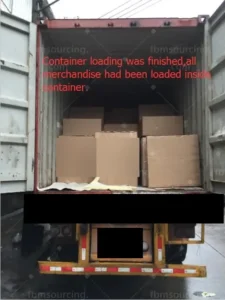
We also plan and supervise container loading and stow, coordinate the booking with your nominated forwarder, and compile the shipping document set — invoice, packing list, bill of lading instructions, certificates — in the form the underwriter will ask for. If you are consolidating multiple factories into one shipment, container planning for hotel FF&E and FF&E procurement for hotels and apartment projects explain how the loading plan is built. If a claim arises, we help assemble the China-side documents and the pre-shipment evidence pack.
Get a China Procurement Quote for Your Project
If you have a hotel, apartment, school, office, clinic or retail project sourcing building materials and FF&E from China, send us the drawings, the BOQ or product list with quantities, the destination port, and the site programme dates. Our team will review the scope with you and come back with a proposal that covers packing standard, consolidation plan, Incoterm and shipping structure alongside the product pricing.
Start on the China building materials and FF&E procurement page, or send the package through directly and we will take it from there.