A 40ft container is loaded from a written loading plan, not improvised at the dock: heavy building materials such as tile, stone and sanitaryware go on the floor and toward the front, casegoods and lighter cartons are stacked above and behind, and every item is placed in a sequence that matches how the goods will be unloaded and installed on site. A 40ft General Purpose (40GP) container offers about 67.7 CBM of theoretical space, while a 40ft High Cube (40HC) offers about 76.3 CBM; how much of that a mixed furniture load actually uses is set in the loading plan. Weight, not volume, is often the real constraint — in the US, road-legal limits usually cap usable cargo weight at roughly 19.5–20 tonnes per container, well below the container’s rated payload. FBM Sourcing works as your sourcing agent and sourcing partner throughout this process.
For project owners and general contractors, understanding 40ft container loading matters for one practical reason: your container count drives your freight budget, your delivery schedule and even your site logistics. This guide walks through the numbers and the process the way a china sourcing agent actually runs it — from CBM math to loading-day supervision.
The loading process for a commercial project order follows five stages:
- Volume and weight calculation — every line item in the order is measured in CBM and kilograms per packed carton or crate.
- Loading plan (container stuffing plan) — a placement map assigning each item a position: heavy and dense goods low and forward, light and fragile goods high and aft.
- Consolidation — goods from multiple factories arrive at one warehouse, are checked against the packing list, and staged in reverse loading order.
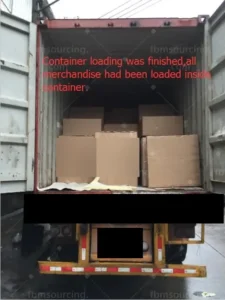
- Supervised loading — the container is stuffed under supervision, with photo and video documentation of the empty container, each loading stage, and the sealed doors.
- Seal and dispatch — the container seal number is recorded, matched to the bill of lading, and the full loading record is delivered to the client before shipment.
What Are the Internal Dimensions and CBM of a 40ft Container?
A 40GP container has internal dimensions of approximately 12.03m long × 2.35m wide × 2.39m high, giving 67.7 CBM of theoretical volume. A 40HC is the same length and width but 2.69m high internally, giving 76.3 CBM — about 13% more space for essentially the same ocean freight cost, which is why nearly all furniture and FF&E shipments move in High Cubes.
Theoretical CBM is never what you actually fit. Mixed furniture orders — beds, wardrobes, sofas, casegoods, mattresses — leave unavoidable air gaps between irregular cartons, so the usable volume is always less than the theoretical figure. Flat-packed casegoods and dense building materials use the space better; assembled upholstery and odd-shaped items use it worse. A good container loading plan is largely the art of closing that gap between theoretical and usable CBM.
How Much Weight Can a 40ft Container Carry?
The container itself is rated far higher than the roads it travels on. A modern 40GP or 40HC has a maximum payload of roughly 26,500–28,500 kg against a maximum gross weight of 30,480–32,500 kg. But the binding limit is almost always the truck leg at destination: in the United States, the 80,000 lb (36,287 kg) gross vehicle weight limit on highways means practical cargo weight in a 40ft container is capped around 19.5–20 tonnes once the tractor, chassis and container tare are deducted. Australia, the UK and most GCC countries have comparable road-transport ceilings.
This is why heavy building materials hit weight limits long before volume. Porcelain tile runs roughly 20–24 kg per square metre for standard 9–10mm thickness, so about 19–20 tonnes of tile fills the road-legal weight allowance while leaving much of the container’s volume empty. Stone slabs, sanitaryware and hardware behave the same way. On mixed project orders, the loading plan deliberately pairs these dense materials with light, bulky furniture so each container maxes out on both weight and volume instead of shipping half-empty by one measure. Quantity planning for tile and stone should also build in a cutting allowance — see our guide to tile and stone wastage percentages for project orders.
20GP vs 40GP vs 40HC: Which Container Fits Your Order?
The three standard dry containers used for project cargo compare as follows:
| Container | Theoretical CBM | Rated payload | Practical road-legal cargo weight (US) | Best use for project cargo |
|---|---|---|---|---|
| 20GP | 33.2 CBM | ~28,200 kg | ~19–20 t | Dense, heavy loads: tile, stone, hardware, sanitaryware |
| 40GP | 67.7 CBM | ~26,500–27,700 kg | ~19.5–20 t | Mixed loads where height clearance at destination is limited |
| 40HC | 76.3 CBM | ~26,500–28,500 kg | ~19.5–20 t | Furniture and FF&E — the default for volume-driven cargo |
The rule of thumb: volume-driven cargo (furniture, mattresses, joinery) ships in 40HCs; weight-driven cargo (tile, stone) often ships in 20GPs because a 20GP reaches its road-legal weight limit well before its volume is used, and a smaller box is easier to handle at site. A typical hotel or apartment project ends up with a mix of both. These per-container numbers feed directly into your freight line when you calculate the landed cost of a China project order.
Sourcing this for a commercial project?
FBM Sourcing works with project owners, developers, main contractors and FF&E contractors on hotel, apartment, school, office and other commercial building projects. Send us your BOQ, drawings or product list — our team will review it and get back to you.
How Is a Container Loading Plan Actually Built?
A container loading plan (also called a stuffing plan) starts from the packing list: every SKU with its packed dimensions, carton count, gross weight and stacking limit. From there, three rules govern placement. First, weight distribution — heavy items sit on the container floor, positioned and spread evenly along the length so neither half of the box carries a disproportionate share of the cargo weight; a badly balanced container can be rejected at the terminal or fined at destination weighbridges. Second, crush hierarchy — crated stone and tile on the bottom, rigid flat-pack casegoods in the middle, upholstered goods and lightweight cartons on top, nothing fragile under anything heavy. Third, unload sequence — items needed first on site are loaded last, so they come off first.
That third rule is where project experience shows. If your installation sequence runs flooring first, then joinery, then loose furniture, the containers should be planned so materials arrive and unload in that order rather than forcing the site team to dig through a container of mixed cartons. On phased projects, this extends to the shipping schedule itself — some clients have factories hold stock for staggered delivery so containers land floor by floor rather than all at once.
Export Packing: What Protects Goods for Weeks at Sea
Sea freight from China to the US, the UK, the Middle East and the Caribbean takes weeks, with transit time confirmed by the carrier at booking — and the container will be lifted, trucked and rolled through swells the entire way. Export packing for furniture typically means five-layer corrugated cartons with EPE foam lining and corner protectors, stretch film on upholstered goods, and honeycomb or plywood face protection on glass and mirrors. Stone, tile and glass ship in fumigated plywood crates or on pallets with edge protection and strapping.
Inside the container, void spaces are filled with dunnage bags, and the final tier at the doors is braced with lashing straps or a wooden gate so nothing shifts against the doors in transit. Moisture is the quiet enemy on long sailings: desiccant strips in the container are standard for casegoods to prevent condensation damage inside sealed cartons. Even with good packing, ocean transit carries irreducible risk, which is why project cargo should move under marine cargo insurance rather than bare carrier liability.
Loading Mixed Orders from Multiple Factories
A commercial project order rarely comes from one factory. A 100-room hotel package might involve eight to twelve factories — casegoods from one, seating from another, tile, lighting, sanitaryware, mattresses and curtains from others — often spread across two or three provinces. Rather than shipping many under-filled boxes, goods are trucked to a consolidation warehouse near the port, received against the master packing list, inspected, and combined into full containers according to the loading plan.
Consolidation is one of the core functions a building material sourcing agent performs, because it converts a dozen factory deliveries into a clean set of full containers with one document package. FBM Sourcing manages the entire China procurement package for overseas construction projects. The consolidation stage is also the last realistic checkpoint to catch shortages or carton damage before goods disappear into a sealed box for weeks at sea — and it is where the sourcing agent’s fee — a 5% commission for suppliers you nominate (products we source for you are quoted at a direct price) — visibly earns its keep on multi-factory orders.
What Happens on Loading Day?
On loading day, FBM Sourcing’s own team supervises the stuffing from empty box to sealed doors. The container is inspected before loading — floor condition, holes, odours, door seals — and photographed empty. As loading proceeds, the team checks carton counts against the packing list tier by tier, verifies placement follows the loading plan, and photographs each stage. A supervised loading of a 40HC produces photos plus video covering the empty container, the loading sequence, the final door tier with bracing, and the applied seal with its number legible.
That complete photo and video record is delivered to the client before shipment, together with the final packing list and container/seal numbers, as part of the pre-shipment inspection documentation. For the project owner, this record does double duty: proof of what physically left China, and the evidence base if a marine insurance claim is ever needed. The seal number on the photos must match the bill of lading — a detail that also matters when your broker handles customs clearance at the destination port.
How Many Containers Does Your Project Need?
CBM planning translates directly into project scale. How many hotel guest rooms of full FF&E — bed set, casegoods, seating, lighting, soft goods — fit in one 40HC depends on room size and specification level; heavier custom joinery takes more space, lean select-service specs take less. The same applies per apartment unit on the residential side, so the container count is worked out from the packing list, not from a per-room figure.
Building materials add containers on the weight side: flooring for the same building adds tile containers that weigh out long before they cube out. Running this math early — at BOQ stage, not booking stage — lets you budget freight accurately and decide whether to trim specs or consolidate phases. For a fuller worked example, see our breakdown of what it takes to furnish a 50-unit apartment building from China. Your actual count depends on your spec and packing factors and is set in the load plan.
Related reading: export packing standards for furniture shipped by sea freight.
What goes into the box matters as much as how much fits: how furniture is protected from moisture and mould in sea containers covers moisture content targets, desiccant dosage per box and the pre-stuffing container checks.
Get a China Procurement Quote for Your Project
If you are planning container counts for a hotel, apartment building, school, office or other commercial project, the fastest route to a reliable number is a real packing-list-level estimate, not a rule of thumb. Send us your drawings or BOQ, product list, quantities, destination port and project timeline, and our team will map your order into containers — CBM, weights, loading plan logic and shipping schedule included.
As a furniture sourcing agent working exclusively on commercial construction projects, we handle the whole chain behind the container: factory pricing, production follow-up, our own pre-shipment inspection with photo and video records delivered before shipment, consolidation, supervised loading and export documentation. Use the quote button above or message us on WhatsApp with your project brief to get started.