
Procurement for an apartment development works differently from any other project type because of one property: repetition. A 40-unit block specifies the same kitchen, the same wardrobes, the same doors, tiles and sanitary ware dozens of times over — which means a single apartment project clears Chinese factory minimums in almost every category, buys at volume-tier factory pricing, and can ship on a floor-by-floor delivery programme. The workable model is one consolidated China package: cabinets, wardrobes, interior doors, flooring, tiles, sanitary ware and lighting sourced as a coordinated programme through a building material sourcing agent and sourcing partner, rather than as separate purchases.
What the numbers look like on a typical multi-unit package:
- Unit repetition clears MOQs: 40 kitchens in one finish programme is comfortably above the typical 30–50-set cabinet MOQ
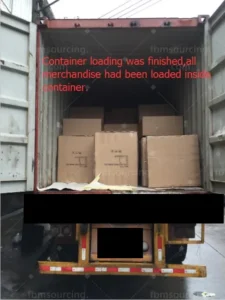
- Container maths: flat-packed kitchen cabinet programmes typically load 40–50 apartment kitchens per 40HQ
- Production window: 45–60 days for the cabinet/wardrobe/door package once samples are approved
- Delivery staging: containers packed by building/floor so goods arrive in installation order
- Spares: 2–3% attic stock on finishes (tiles, flooring) ordered with the main run — matching a batch later is the expensive way
What Does an Apartment Procurement Package from China Include?
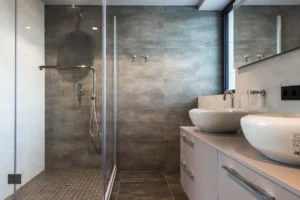
The core interior package for multi-unit residential is remarkably consistent across markets: kitchen cabinets with benchtops, built-in wardrobes, interior doors and frames with hardware, floor coverings (engineered timber, SPC or tiles), wall tiles for wet areas, sanitary ware and tapware, mirrors and vanities, and unit lighting. Common areas add lobby furniture, corridor lighting and carpet, mailboxes and signage — smaller in value, but the lines most likely to fall below custom MOQs, which is exactly the fragmentation problem covered in our guide to Chinese factory MOQs.
Developers rarely send all of it to China. The rational split is: high-labour, high-customisation joinery and finish categories from China (cabinets, wardrobes, doors, stone, tiles, lighting); structural, code-critical and service items locally (framing, fire doors where local certification requires domestic testing, electrical switchgear). The China share of an interior fit-out BOQ commonly lands at 50–70% of line items by value — enough to move the project budget materially.
How Does Unit Repetition Change Factory Pricing and MOQ?
Factories price custom work by run length: one setup amortised over more identical units. Forty identical kitchens is a fundamentally better order than forty different ones, and the factory quote reflects it. This is why specification discipline at design stage is worth real money on multi-unit projects — every additional finish programme or non-standard carcass dimension splits the run and re-prices the package upward.
The same logic applies across categories: one door leaf design in three sizes beats five designs; two tile SKUs across all wet areas beat six. For the cabinet category specifically, our review of kitchen cabinet manufacturers for US multifamily projects shows how factory capability aligns to exactly this kind of repeated-programme order.
How Should Developers Stage Deliveries Across the Construction Programme?
An apartment project doesn’t want all its goods at once — it wants them in installation order. The practical method is to split the package into container waves mapped to the construction sequence: wet-area tiles and sanitary ware ahead of the fit-out trades that fix them, cabinet and wardrobe containers timed to each building’s joinery installation window, and light fittings with the final wave. Each container is packed by building and floor, cartons coded to unit numbers, so distribution on site is a logistics exercise instead of a sorting exercise.
That staging is created upstream, at purchase-order time — issuing POs so each factory’s completion lands in the right consolidation window, exactly the reverse-scheduling method described in how multi-factory consolidation works. Get it right and site storage, double handling and damage all drop together.
Sourcing this for a commercial project?
FBM Sourcing works with project owners, developers, main contractors and FF&E contractors on hotel, apartment, school, office and other commercial building projects. Send us your BOQ, drawings or product list — our team will review it and get back to you.
Which Compliance Standards Apply to Apartment Packages?
Compliance is destination-specific and must be locked into the specification before sampling, not discovered at customs:
- United States: composite wood (cabinets, wardrobes, engineered flooring) must be CARB Phase 2 / TSCA Title VI compliant with certificates per shipment; plumbing fixtures need cUPC listing in most jurisdictions
- Australia: windows and external glazed doors to AS 2047 with WERS ratings; tapware and sanitary fixtures require WaterMark certification; engineered timber to formaldehyde class E0/E1
- Europe/UK: CE/UKCA marking on construction products, EN 14351 for windows and doors, and, for EU projects, the REACH limit of 0.062 mg/m³ for furniture and wood-based articles placed on the EU market after 6 August 2026
Chinese factories serving export project markets hold these certifications routinely — the failure mode is not availability but specification: the certificate has to be named in the purchase order and verified against the actual production batch during QC, which FBM Sourcing’s own inspection team does as part of standard factory QC inspection.
Do You Need a Sourcing Agent for a Multi-Unit Project?
A multi-unit package is eight to twelve factories, three to six container waves, a compliance matrix per destination and a construction programme that penalises both early and late delivery. A developer’s team can manage one factory relationship; managing twelve from another time zone during construction is where packages go wrong. A china sourcing agent with a team on the ground compresses that into one contract, one QC standard and one delivery calendar — the same model we run for student housing packages, documented in our student accommodation procurement guide, and for hotel and apartment developers through our hotels & apartments procurement service. FBM Sourcing works on a 5% commission for suppliers you nominate (products we source for you are quoted at a direct price) across the consolidated package.
Where the apartment levels sit above a hotel, retail podium or office floors, the packaging logic changes again — see how procurement for mixed-use development projects handles multiple specification sources and staggered completion dates on one supply chain.
Related guide: see our walkthrough of cost to furnish an apartment building from China for how this applies at project level.
For the package-by-package view of the same work — what to send to start, what comes back, and the eight trade blocks an apartment scheme splits into — see apartment project procurement from China, package by package.
Repetition works differently when the apartments are cut into an existing office building rather than a new frame: unit types multiply and windows are made to measured openings. See this guide to office to residential conversion packages sourced from China.
Get a China Procurement Quote for Your Apartment Project
Send us your unit schedule, drawings or BOQ with unit counts, destination port and construction timeline. We will return a category-by-category sourcing plan — factory programme, container waves, compliance matrix and budget estimate: China building materials & FF&E procurement.
Related reading: serviced apartment FF&E procurement.
For institutionally owned rental schemes, see our dedicated guide to build-to-rent (BTR) building materials procurement, which covers durability specs, phased handovers and operational spare stock.