China’s store fixture supply for chain rollouts is spread across several distinct manufacturer types: metal shelving and gondola makers, wood and panel-product cabinet and counter makers, glass and acrylic showcase makers, lightbox and illuminated display makers, and refrigerated display cabinet makers. Only one manufacturer in these types can be named here with a verifiable public record: Shuhua Sports Co., Ltd. (Shanghai Stock Exchange: 605299), whose 2025 annual report lists display racks as a separate revenue line. The rest of this list is organised by manufacturer type, with the product evidence each type should supply.
This guide is written for retail developers, general contractors, builders, commercial project owners, interior design and construction companies and FF&E solution providers pricing store interiors for a chain: a prototype store followed by a rollout of many sites that all need to look the same.
What Counts as a Store Fixture in a Chain Rollout Package?
A chain store fixture package usually mixes several fixture families, each made by a different kind of factory:
- Wall systems and shelving: slatwall or slotted-upright wall bays, metal gondola runs, adjustable shelves, brackets and hang bars.
- Floor fixtures: island tables, mid-floor units, nesting tables, podiums and display platforms.
- Counters and cabinets: cash wraps, service counters, back-of-counter storage and lockable display cabinets.
- Glass and acrylic displays: showcases, glass shelving, acrylic risers, product holders and sign holders.
- Illuminated displays: lightboxes, backlit graphic frames and fixtures with built-in LED lighting.
- Refrigerated displays: chilled and frozen display cabinets for food and beverage formats, plus the joinery built around them.
A plant that powder-coats gondola uprights is not the plant that builds a veneered cash wrap, and neither makes refrigerated cabinets. A chain package is therefore a multi-factory package, and the procurement work is in keeping those factories building to one drawing set, one finish schedule and one packing plan.
How This List Is Built
We name a manufacturer only when two things can be checked in a primary public source: that the company is currently listed on a stock exchange, and that its own annual report shows the product category as a line in its revenue breakdown by industry or by product. A mention in a business description or a search summary is not enough. The entry below was checked against the Shanghai Stock Exchange company list and the company’s 2025 annual report on the exchange’s disclosure system, as of September 2026. Other fixture types are described by manufacturer type, with the evidence to request. We do not score or rank manufacturers.
The Named Listed Manufacturer
Shuhua Sports Co., Ltd. (Shanghai Stock Exchange: 605299)
- Listing: listed on the Shanghai Stock Exchange since December 2020, with its registered location in Fujian province.
- Main business: fitness equipment. The company’s 2025 annual report describes it as a sports and fitness services company whose products are mainly fitness equipment, and fitness equipment is by far its larger revenue line.
- Role in store fixtures: the 2025 annual report states that the company’s products are divided into fitness equipment and display racks. Display racks appear as their own line in the revenue breakdown by industry, and as “display products” in the breakdown by product. The report describes this line as merchandise display props supplied to sportswear and footwear brands for their physical retail stores, covering wall units, hanging fixtures, island units, display platforms and related items.
- How the display line is run: the report states that display racks are made to order, with production planned from sales orders by a dedicated display business centre, and it lists a wholly owned subsidiary in Quanzhou, Fujian, whose name refers to commercial display props.
- What the report does not say: its export commentary concerns fitness equipment; it does not state that the display line is exported.
- Evidence to request: shop drawings and a finish schedule for the specific wall and floor units quoted; material and coating specifications for metal parts; a load assumption per shelf or hang bar confirmed on the drawings; a packed sample bay with its assembly instructions.
Naming a listed company here is a statement about what its public filings say, not a recommendation and not a statement about any working relationship.
Why We Have Not Published a List of Named Factories Here
For the other fixture types below, we have not published company names. For metal shelving, joinery counters, glass and acrylic displays and lightboxes, we did not find a currently listed Chinese company whose annual report shows the category as its own revenue line. Without that, a name would rest on a company’s own marketing, a directory listing or a search summary, and publishing it would present unchecked claims as facts. What a project team can use instead is what each manufacturer type makes, where it fits, and what evidence it should produce before a purchase order.
Manufacturer Types for Shelving and Joinery
1. Metal shelving and gondola manufacturers
- What they make: gondola runs, wall bays with slotted uprights, shelves, brackets, hang bars, checkout lane frames and wire accessories, usually in powder-coated steel.
- What to settle in the specification: upright pitch and slot pattern, shelf depths, the load each shelf is designed to carry (stated on the drawing by the project team, not assumed by the factory), powder coat colour references and gloss level, and whether bays arrive knocked down or pre-assembled.
- Evidence to request: dimensioned shop drawings per bay type; the coating specification and colour reference for each finish; a load statement for shelves and brackets matching the project’s stated load; a sample bay built from production parts.
2. Wood and panel-product cabinet and counter makers
- What they make: cash wraps, service counters, mid-floor tables, display cabinets, wall panels and back-of-house storage, built from MDF, particleboard or plywood with laminate, veneer or paint finishes.
- Where they fit: the most brand-visible part of a store, where loose finish references show up as colour drift between batches.
- Market requirement example: for the United States, 40 CFR Part 770, the federal formaldehyde standard for composite wood products under TSCA Title VI, applies to composite wood products and to finished goods containing them that are sold, supplied or imported in the United States. Fabricators of finished goods must label each finished good, or each box or bundle, with at least the fabricator’s name, the month and year of production, and a statement that the goods are TSCA Title VI compliant.
- Evidence to request: shop drawings with edge, joint and hardware details; the board type and emission class for each panel; for United States projects, the TSCA Title VI panel certification and a draft of the finished-goods label; a finish sample board for every laminate, veneer and paint reference, kept as the master for later batches.
Pricing store fixtures for a chain rollout from China?
Send us your fixture schedule and drawings. We match each fixture family to the right factory type and coordinate the package from prototype store to rollout.
Manufacturer Types for Glass, Illuminated and Refrigerated Displays
3. Glass and acrylic showcase makers
- What they make: glass showcases and counters, glass shelves, acrylic risers, product holders, sign holders and display boxes.
- Standard reference: where glass shelves or showcase panels are to be thermally toughened, a European reference is EN 12150-1, the standard for thermally toughened soda lime silicate safety glass; BSI lists BS EN 12150-1:2015+A1:2019 as under review as of September 2026. Our guide to glass safety standards for glass from China covers how that standard relates to the other markets’ requirements.
- Evidence to request: glass type and thickness per component; the toughening standard the glass is made to and the marking on each pane; acrylic sheet grade and thickness; edge finish and drilling details; a sample of each showcase with its locks and hinges.
4. Lightbox and illuminated display makers
- What they make: backlit fabric or film graphic frames, lightboxes, illuminated shelf edges and fixtures with integrated LED strips and drivers.
- What to settle in the specification: destination voltage and plug type, graphic sizes and change method, and who supplies the graphics.
- Evidence to request: a wiring diagram for each illuminated fixture; the certification documents for the drivers and LED components required in the destination market; the light colour temperature and output stated on the drawing; a working sample lit and photographed before bulk production begins.
5. Refrigerated display cabinet makers
- What they make: chilled and frozen display cabinets, open multideck cases and service counters for food and beverage retail formats.
- Where they fit: convenience, grocery, cafe and pharmacy formats. The cabinet usually comes from a refrigeration factory, while the counter or surround around it comes from a joinery factory, so the two drawings have to be coordinated.
- Standard reference: EN ISO 23953-2 specifies requirements for the performance of refrigerated display cabinets used in the sale and display of foodstuffs; BSI lists BS EN ISO 23953-2:2023 as current as of September 2026, having replaced the 2015 edition. Our list of commercial refrigeration manufacturers in China covers this category in more depth.
- Evidence to request: the test report for the cabinet model against the standard the project specifies, with the edition stated; electrical certification for the destination market; refrigerant type; external dimensions and clearance drawings for the joinery around the cabinet.
What Should Be in the Fixture Specification Before Factories Quote?
Fixture quotations are hard to compare when each factory quotes its own interpretation of a design-intent drawing. The specification that goes out for quotation should settle, as a minimum:
- A fixture schedule with a unique code for every fixture type, the quantity per store format, and the number of stores in each rollout phase.
- Dimensioned drawings for each fixture code. Factories will produce their own shop drawings, and approving them before production is the control point; our note on shop drawings versus design drawings for Chinese factories explains the difference.
- A finish schedule with a code and a physical sample for every laminate, veneer, paint, powder coat and metal finish, shared by every factory in the package.
- Load and use assumptions for shelves, hang bars and counters, set by the project team and written on the drawings.
- Destination-market requirements for panel emissions, glass and electrical components, stated per fixture code.
- Packing and labelling rules, including the store code on every carton so that each store’s fixtures can be identified on site.
With that in place, quotations from different factories can be compared against the same fixture codes.
How Does a Chain Rollout Change the Way Fixtures Are Ordered?
For a rollout, the prototype store fixes the drawings and finish samples, and every later phase is ordered against those masters:
- Freeze the masters. After the prototype is approved, the finish sample boards and shop drawings become the reference for every later batch; changes are issued as numbered drawing revisions.
- Order by phase, pack by store. Fixtures are produced in phase quantities, then packed and labelled store by store so that each site receives a complete, identifiable set.
- Plan spares. A small spares allowance of shelves, brackets, hooks and glass parts per store avoids a separate reorder for a handful of parts.
Our article on procurement for convenience store and retail chain rollouts covers the rollout process itself, and our guide for pharmacy and health retail chains covers a format where regulated items such as refrigeration sit alongside the standard fixtures.
How Are Store Fixtures Packed and Shipped?
Whether each fixture ships knocked down or assembled is decided per fixture code in the specification: shelves, uprights and panels can usually be flat-packed, while counters and showcases may be crated assembled where assembly on site would put the finish or glass at risk. Carton labels carry the fixture code and store code.
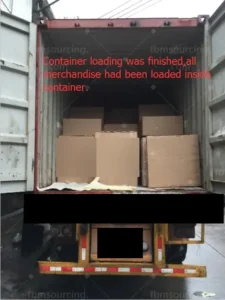
Sometimes, on a large project, the store fixtures alone fill full containers; sometimes the store fixtures share containers with the other product categories of the same project; and sometimes, in one batch, we combine a dozen or more product categories from several projects of the same client into a few containers — always full containers, and for us this is routine, well-practised work.
How Does Quality Control Work on a Fixture Order?
As the client’s sourcing partner, FBM Sourcing carries out one inspection by our own team at the factory once bulk production is finished, before shipment, with photo and video records. For store fixtures, that inspection checks the finished fixtures against the approved shop drawings and the master finish samples: dimensions, finish colour and texture, edge and joint quality, glass marking, hardware, function of locks and lights, and packing and store labelling. The inspection report goes to the client before the balance is paid. Your own project team is welcome to attend the inspection with us.
How Is This Different from Museum Display Cases?
Retail fixtures are specified for repeatability across many stores and frequent handling; museum and exhibition cases are specified around conservation, security and loan conditions for individual objects. If your project is a gallery or exhibition rather than a store, our guide to museum display cases and exhibition fixtures from China is the relevant one.
Pricing store fixtures for a chain rollout from China?
Send us your fixture schedule and drawings. We match each fixture family to the right factory type and coordinate the package from prototype store to rollout.
Frequently Asked Questions
Are there listed Chinese companies that make retail store fixtures?
Yes, at least one. Shuhua Sports Co., Ltd. (Shanghai Stock Exchange: 605299) is mainly a fitness equipment company, but its 2025 annual report lists display racks as a separate revenue line and describes them as display props for sportswear and footwear brands’ retail stores. For the other fixture types we found no listed company whose annual report breaks out the category, so we describe them by manufacturer type.
Can one factory in China supply a whole store fixture package?
It is uncommon. Metal shelving, joinery counters, glass and acrylic showcases, illuminated displays and refrigerated cabinets usually come from different kinds of factories, so a chain package is normally a multi-factory package coordinated around one drawing set, one finish schedule and one packing plan.
What evidence should a store fixture factory provide before production?
At a minimum: shop drawings and finish samples for every fixture code, a load statement matching the project’s shelf loads, emission details for panel products, the toughening standard for glass, destination-market certification for electrical parts, and a sample built from production parts.
What standard applies to refrigerated display cabinets?
EN ISO 23953-2 specifies performance requirements for refrigerated display cabinets used in the sale and display of foodstuffs, and BSI lists BS EN ISO 23953-2:2023 as the current edition as of September 2026. The project specification should state which edition the cabinet test report must follow.
How are fixtures for many stores kept consistent?
By freezing approved shop drawings and physical finish samples after the prototype store, issuing any change as a numbered drawing revision, ordering later phases against those masters, and checking finished fixtures against them in one inspection by our own team once bulk production is finished, before shipment.
About FBM Sourcing
FBM Sourcing manages the entire China procurement package for overseas construction projects. Since 2014 we have worked with developers, general contractors, builders, commercial project owners, interior design and construction companies and FF&E solution providers across more than 20 countries and over 1,000 containers, as their sourcing partner in China — from the schedule or BOQ through factory selection, sampling, one inspection by our own team once bulk production is finished and before shipment, consolidation and shipping. All quotations, invoices and shipping documents are issued by FBM Sourcing, and sea freight is quoted to you before shipment. If you have a store fixture package to price, start at China building materials and FF&E procurement.
For grocery and retail projects, compare supermarket shelving and the documents buyers should compare.