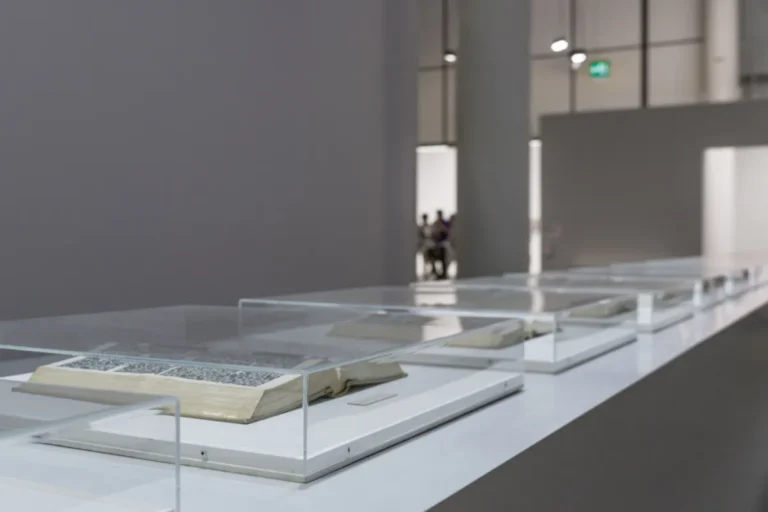
Yes, museum display cases and the rest of a gallery or visitor centre interior can be made in China, but only if the conservation, security and loan requirements are written into the drawings and the materials schedule before factories price the work. What changes the order is not the look of a case but what happens inside it: the sealed air volume, every material exposed to that air, the security glazing and locks, and a lighting compartment kept apart from the objects. Those decisions add a material testing and approval period ahead of production, so they must be settled before any two quotations can be compared.
This guide is written for general contractors, interior design and construction companies and exhibition construction contractors that deliver museums, galleries, visitor centres and exhibition halls, and for the developers and commercial project owners, including public bodies and trusts, that own and develop them. It covers procurement only; environmental targets, object safety and security grading remain decisions for the museum’s own conservation, security and structural advisers.
What Is in a Museum or Visitor Centre Package, and Which Parts Change the Order?
Most of the package is commercial interiors work built to drawings, much like a cinema or entertainment venue package. The display cases are the exception, and they set the programme for everything else.
| Package | Typical items | What changes the order | From China? |
|---|---|---|---|
| Display cases | Vitrines, wall cases, table cases | Air-tightness, tested materials, security glazing, locks, separate lighting compartment | Yes, to approved drawings and a frozen materials schedule |
| Exhibition fixtures | Plinths, platforms, exhibition walls, graphic panels | Fire classification, object loads, fixing, accessible heights | Yes |
| Display lighting | Track spotlights, case lighting, wall washers | Low UV and heat, deep dimming, destination certification | Yes for fittings; control programming local |
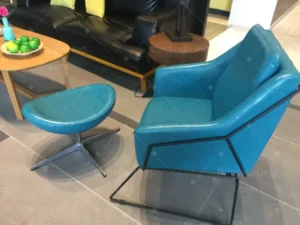
| Finishes and furniture | Flooring, wall and acoustic panels, gallery benches, reception and shop counters | Fire classification, accessible seat and counter heights | Yes |
| Systems and specialist work | Intruder and case alarms, environmental monitoring, AV, object mounts, installation | Integration with site systems and with the objects | Usually local |
Why Is a Museum Showcase a Different Product from a Shop Display Case?
A shop case protects stock from hands. A museum showcase also protects objects from the room: dust, humidity swings and pollutants. The tighter the case, the better it resists what comes from outside, and the more its own boards, paints, fabrics, adhesives and seals matter, because whatever they release has nowhere to go.
- The showcase standards were revised in 2025. CEN Technical Committee 346, Conservation of cultural heritage, published EN 15999-1:2025, Guidelines for design of showcases for exhibition and preservation of objects, Part 1: General requirements, replacing the 2014 edition, and EN 15999-2:2025, Part 2: Technical aspects. Part 1 focuses on passive showcases, those without powered climate control, and ties the role of a case to a site-specific risk assessment; Part 2 classifies the technical properties of passive showcases and how their performance can be assessed. A specification still quoting the 2014 edition should be updated before factories price it.
- Air-tightness is a number, and it is measured. Conservation scientists at English Heritage report that many recent showcases have been built to an air exchange rate specification of 0.10 per day, and they measured showcase air exchange using carbon dioxide tracer gas decay. The target belongs to the museum; the contract should state the figure, the method, and whether it is measured on a prototype, on site, or both.
Two documents often appear in museum specifications without governing the case contract. ISO 11799:2024 covers repositories for archive and library materials and states that it does not specify exhibition or display guidelines. PAS 198:2012 has been withdrawn and superseded by BS EN 16893:2018, which deals with buildings or rooms for the storage or use of heritage collections.
Which Materials Inside the Case Need Testing, and How Long Does It Take?
The most widely used screen is the Oddy test, developed by Andrew Oddy, a conservation scientist at the British Museum, and first described in 1973. As set out by English Heritage researchers, 2 grams of material are enclosed with silver, copper and lead coupons at 60 degrees Celsius and close to 100 percent relative humidity for twenty-eight days, then the corrosion is assessed visually. A common rating scheme is suitable for permanent use, suitable for temporary use, or unsuitable.
It is not one fixed procedure. The American Institute for Conservation records that a 2014 survey of 43 conservators found at least 20 different Oddy testing procedures in use in the United States, and describes the results as subjective. So the museum names the protocol and the laboratory, and the factory supplies samples of exactly the materials it will build with. Where photographs are displayed, ISO 18916:2025, the Photographic Activity Test for enclosure materials, recommends testing by batch or lot and requires re-testing when the formulation or the supplier changes, so a material that has passed should keep its supplier.
Technical Bulletin 32 from the Canadian Conservation Institute, Products Used in Preventive Conservation, shows why ordinary commercial specifications are not enough:
| Material | What the guidance says | What to write into the order |
|---|---|---|
| Solid timber | Oak and cedar are the most acidic species and, in general, should not be used to make enclosures | Species named; no substitution |
| MDF, particleboard, plywood | The main problem is the acidic emission of the wood components; formaldehyde-free products benefit human health but not usually objects | Board type, barrier layer and supplier fixed before testing |
| Paints and coatings | A drying period of four weeks is recommended before objects go into a newly painted enclosure | Coating type and application date in the programme |
| Rigid PVC foam board | Not recommended in contact with objects or in a fairly airtight enclosure long term | Kept out of the display volume |
| Silicone sealants | Acetoxy-cure types release acetic acid; some neutral-cure types may release ammonia, acetone or alcohol | Sealant named and tested |
Graphics are easy to forget. In the English Heritage study, all the vinyls tested, which are used to hold graphics in showcases, generated acetic acid concentrations that pose a risk to lead under some circumstances. Graphic films, fabric liners and gaskets belong on the same materials schedule as the carcass.
Emission certificates written for people do not answer this question either. A board meeting a formaldehyde limit, or furniture carrying a GREENGUARD or low-VOC certification, has been assessed for occupant exposure, not for the acidic and sulfur-bearing emissions museum tests look for inside a sealed case.
Pricing museum display cases or gallery interiors from China?
Send your case schedule, drawings and materials requirements. Our team will review them with you and source factories that can build and document the cases to that specification.
What Security Glazing and Locks Should a Museum Display Case Have?
Security grading is a risk decision for the museum. Arts Council England’s Security Specification: Attack resistant display cases, reviewed in May 2024, is one of the clearest published references:
| Grade | Construction | Glazing | Locking |
|---|---|---|---|
| Very high security | Welded steel or other approved metal framework | EN 356 P6B or equivalent, normally glass and polycarbonate laminate, in a rebate of at least 30 mm on all sides, bonded with neutral curing adhesive | Twin high-quality locks on registered keys |
| High security | Aluminium or heavy hardwood framework | Minimum for UK Government Indemnity Scheme objects: EN 356 P4A, 11.5 mm 5-ply laminated | As above, or two BS 3621 locks |
| Low security | Hardwood | 6.4 mm 3-ply laminated | Twin locks |
The same document makes two points that change what a factory builds. Bonded frameless glass cases have only modest security value, because the adhesive will shear if the case is attacked near the bonded edge. Case lighting should sit in a separate light box compartment secured by different locks, so it can be maintained without opening the display section.
Security glazing is a separate question from the safety glass standards used in buildings; a case may need both, and glass make-up, rebate depth, hinge loads and locks all belong on the shop drawings.
What Will a Lending Museum Ask About the Cases?
Before a loan, the lender assesses the venue. The UK Registrars Group Display Case Supplement to its Facilities Report, re-issued in December 2015, asks for:
- The case manufacturer’s specification and every material in the case and its linings, including whether MDF is coated with an inert material and whether linings were tested, for example by the Oddy test.
- Coating type and how far in advance it is applied; shelf fixing; how the case is made stable.
- Glazing material and thickness, whether the case is air-tight, and whether humidity inside can be monitored.
- Lock type, age and number per case with the lock manufacturer’s specification, and whether the case can be individually alarmed.
- How the case is lit, whether fittings can be altered without disturbing the objects, and whether there is a barrier between lamps and objects.
If the museum plans to borrow, these answers are contract deliverables: materials schedule with test records, glazing and lock data, fixing details and as-built drawings. On public projects they sit alongside the submittal and handover documents public buildings require.
How Should Display Lighting Be Specified?
The Canadian Conservation Institute describes the traditional museum lighting rules as 50 lux for textiles, works on paper, watercolours and photographs, 150 lux for oil and acrylic paint surfaces and furniture, and 300 lux for stone and metal, with UV below 75 microwatts per lumen, and notes that this policy underlies most current lending and borrowing requirements. The lighting technical report CIE 157:2004, Control of damage to museum objects by optical radiation, gives a practical procedure for setting up and monitoring display lighting. For the order, that means:
- Dimming at the low end. Fittings chosen for shop or office brightness may not dim smoothly to gallery levels; test a sample on the site’s control protocol.
- Heat and UV. The Canadian Conservation Institute lists incandescent lamps as having the highest heat output of any lamps and as not suitable inside cases; ask for spectral data on every LED fitting and keep drivers in the light box.
- Certification. Museum use does not exempt fittings from destination electrical certification; shortlist LED and architectural lighting manufacturers in China that can document it for the exact models.
Walls, Plinths, Floors and Seismic Fixing
Wall panels, flooring and plinth cladding need the reaction-to-fire classification of the destination market, such as EN 13501-1 in Europe or ASTM E84 in the United States, and the fire rating standards for finishes are not interchangeable. The paint drying period for open walls is less critical than inside a case, since normal room ventilation prevents high levels of pollutants from accumulating.
State the object load on every plinth and deck, and how each case is fixed. In earthquake regions this is an engineering task: at the J. Paul Getty Museum, mountmakers and conservators evaluate every object that goes on display for seismic protection, with methods ranging up to base isolation systems, one of them hidden beneath the display furniture of a marble statue. The factory builds in the anchor points and space for isolation hardware that the engineer specifies, before production starts.
Visitor Seating, Reception and Shop Furniture: Which Dimensions Matter?
In the United States, the 2010 ADA Standards and the Smithsonian Guidelines for Accessible Exhibition Design give figures for the drawings; other markets apply their own codes.
| Item | Dimension | Source |
|---|---|---|
| Case for objects flat on a deck | Top at most 915 mm (36 in) above the floor | Smithsonian Guidelines |
| Wall-mounted case | Lower edge at or below 685 mm (27 in) | Smithsonian Guidelines |
| Gallery seating | Firm seats 430 to 510 mm (17 to 19 in) high with arm and back support; 50 percent of seats accessible | Smithsonian Guidelines |
| Ticket and shop counters | A portion no higher than 36 in (915 mm), at least 36 in long for a parallel approach | 2010 ADA Standards, 904.4 |
How Should the Order Be Sequenced and Shipped?
- Freeze the case schedule: security grade, glazing, locks, air exchange target and heights per case type.
- Freeze the materials schedule with named suppliers and send samples to the museum’s nominated laboratory; allow the twenty-eight days of an Oddy test, plus reading and re-tests, before releasing production.
- Build and measure a prototype of the main case type.
- Produce without substitutions; any change of board, fabric, adhesive, sealant or gasket goes back through approval.
- Inspect against the approved documents: inspection by our own team at the factory before shipment, with photo and video records.
- Plan packing around the glass, checking crate sizes against container doors and site access, and allow the four-week coating drying period before objects go in.
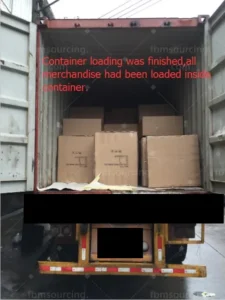
Sometimes, on a large project, the display cases and exhibition fixtures alone fill full containers; sometimes the display cases and exhibition fixtures share containers with the other product categories of the same project; and sometimes, in one batch, we combine a dozen or more product categories from several projects of the same client into a few containers — always full containers, and for us this is routine, well-practised work.
Pricing museum display cases or gallery interiors from China?
Send your case schedule, drawings and materials requirements. Our team will review them with you and source factories that can build and document the cases to that specification.
Frequently Asked Questions
Can museum display cases made in China comply with EN 15999?
EN 15999-1:2025 and EN 15999-2:2025 are design guidelines that tie a showcase to a site-specific risk assessment and classify the technical properties of passive showcases. A case made in China can be built to the properties a museum specifies, provided drawings, materials and the air exchange target are fixed first and performance is measured.
What is an Oddy test, and who carries it out?
It is an accelerated corrosion test first described by Andrew Oddy of the British Museum in 1973: material is sealed with silver, copper and lead coupons at 60 degrees Celsius and high humidity, typically for twenty-eight days. Procedures vary, so the museum’s conservation team or a laboratory it nominates should run it on the exact materials the factory will use.
Is formaldehyde-free or low-VOC board safe inside a museum showcase?
Not automatically. The Canadian Conservation Institute notes that the main problem with wood products is acidic emission from the wood itself, and that formaldehyde-free products benefit human health but not usually objects. Board, barrier layer and supplier should be fixed and tested.
What glass should a museum display case use?
The museum’s security risk assessment decides. Arts Council England sets EN 356 P4A, 11.5 mm 5-ply laminated glass, as the minimum for cases holding UK Government Indemnity Scheme objects, P6B or equivalent for very high security, and warns that bonded frameless cases have only modest security value.
What documents should a showcase manufacturer provide for loan requests?
Enough to complete the lender’s facilities report: case specification, construction and lining materials with test details, coatings, glazing, air-tightness, locks, fixing and lighting. As a sourcing partner in China, FBM Sourcing writes that documentation set into the order.
About FBM Sourcing
FBM Sourcing manages the entire China procurement package for overseas construction projects. Since 2014 we have worked with developers, general contractors, builders, commercial project owners, interior design and construction companies and FF&E solution providers across more than 20 countries and over 1,000 containers, as their sourcing partner in China — from the schedule or BOQ through factory selection, sampling, inspection by our own team before shipment, consolidation and shipping. All quotations, invoices and shipping documents are issued by FBM Sourcing, and sea freight is quoted to you before shipment. If you have a museum display case and exhibition interiors package to price, start at China building materials and FF&E procurement.