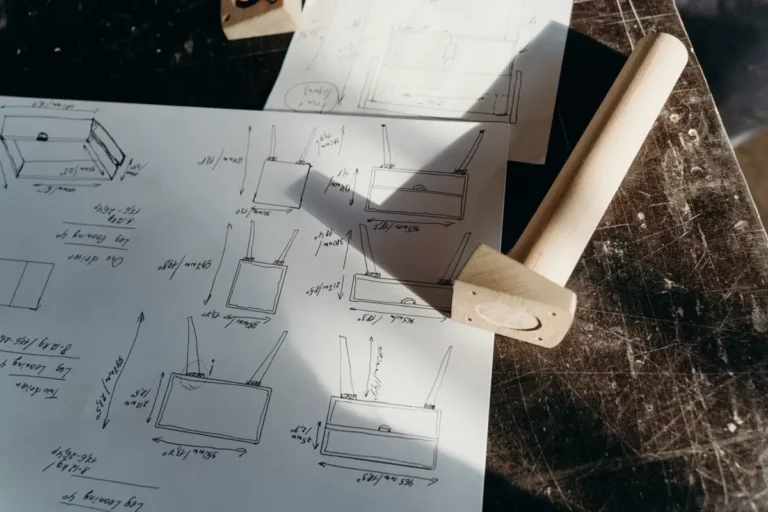
Design drawings communicate intent; Chinese factories manufacture from shop drawings — and confusing the two is one of the most common causes of dimensional and material disputes on a China-sourced project. For custom millwork, joinery, doors and windows, the factory produces its own shop drawings against your design set, and the approval loop on those shop drawings, not the original design file, is what actually fixes dimensions, materials and finishes for production. This article sets out the difference, who produces each drawing type, and what the approval process should look like before production starts.
What Is a Design Drawing?
- Produced by: the project’s architect, interior designer or FF&E consultant.
- Shows: design intent — overall form, layout, materials palette, finish selections and approximate dimensions, usually as part of a broader design package rather than a manufacturing-ready document.
- What it doesn’t show: exact joinery methods, hardware placement tolerances, panel seam locations, structural reinforcement, or the specific fabrication approach a given factory’s equipment and process actually requires.
- Purpose: to communicate what the finished piece should look like and how it fits the space — not how to build it.
What Is a Shop Drawing?
- Produced by: the manufacturing factory, working from the design drawing and specification.
- Shows: exact fabrication dimensions, material thickness and grain/finish direction, joinery and construction method, hardware placement and specification, panel breaks and seam locations, and any structural detail needed to actually build the piece.
- Purpose: to be the document the factory floor works from — every measurement on it is a manufacturing instruction, not a design suggestion.
- Who approves it: the shop drawing goes back to the designer or project owner for review and sign-off before production starts — this is the actual approval gate, not the original design drawing.
Why the Difference Matters for a China-Sourced Project
A design drawing alone is not a manufacturing instruction, and a factory that starts cutting material against a design drawing — rather than waiting for an approved shop drawing — is filling in every unspecified detail with its own default assumption. Those assumptions may not match what the designer intended, and by the time the discrepancy is discovered the material has already been cut. The shop drawing approval loop exists specifically to catch this before production, not after.
- Dimensional tolerance gaps: a design drawing might show a cabinet as “1200mm wide” without specifying whether that includes or excludes an overlay door reveal — the shop drawing has to resolve this exactly.
- Material and finish specificity: “walnut veneer” on a design drawing becomes a specific veneer cut, grain direction and finish sheen on the shop drawing — details that materially affect both cost and appearance.
- Hardware coordination: hinge, slide and lock hardware placement needs exact dimensioning on the shop drawing to avoid clashes with panel seams or structural members that the design drawing never addressed.
Have design drawings that need factory-ready shop drawings?
FBM Sourcing works with project owners, developers, main contractors and FF&E contractors on commercial building projects. Send us your design drawings or specification — our team will coordinate shop drawing production and approval with the factory.
What Should the Shop Drawing Approval Process Look Like?
- Factory produces the shop drawing from the design drawing and written specification, typically within a stated turnaround after the order is confirmed.
- Shop drawing is reviewed against design intent by the designer or project owner — checking dimensions, materials, hardware and any details the design drawing left open.
- Revisions are tracked and re-submitted until signed off — and it is normal for a complex custom piece to go through more than one revision round.
- Production only begins after written sign-off on the shop drawing — not on a verbal go-ahead, and not on the original design drawing.
- Signed-off shop drawings are kept on file as the reference document if there is any dispute later about what was actually approved.
This approval discipline is what connects the drawing takeoff process covered in window and door drawing takeoff, from schedule to order sheet to the actual factory production floor.
How FBM Sourcing Manages the Shop Drawing Process
FBM Sourcing manages the entire China procurement package for overseas construction projects, and for any custom millwork, joinery, door or window scope, we coordinate the shop drawing cycle between your designer and the factory — reviewing the factory’s shop drawing against your design intent before it goes back to you for sign-off, and confirming written approval is on file before production starts. Before shipment our own FBM Sourcing QC team checks the finished goods against the approved shop drawing, not the original design file — dimensions, material, finish and hardware — with photo and video records before shipment. All quotations, invoices and shipping documents are issued by FBM Sourcing — you deal with us, and we carry the responsibility. For suppliers you nominate, we charge a 5% commission; for products we source for you, we quote a direct price.
If you have design drawings ready for a custom scope, send them to us along with your specification. Our team will coordinate shop drawing production and approval before anything goes into production — use the quote button above or WhatsApp +86 135 6007 5057.
Where Shop Drawings Sit in the Document Chain
Shop-drawing approval is the stage between a priced quotation and a factory production order. The full chain — takeoff, RFQs, comparable quotation, shop drawings and production orders — is mapped in how to send a BOQ or drawings to a China sourcing agent and runs as one service, the BOQ & drawing takeoff service. Upstream of this stage, the bill is split into factory-level RFQs and priced as a BOQ-based quotation with a stated inclusion and exclusion list. Most drawing problems that surface here started earlier, in the 5 mistakes to avoid before sending a BOQ to China.