
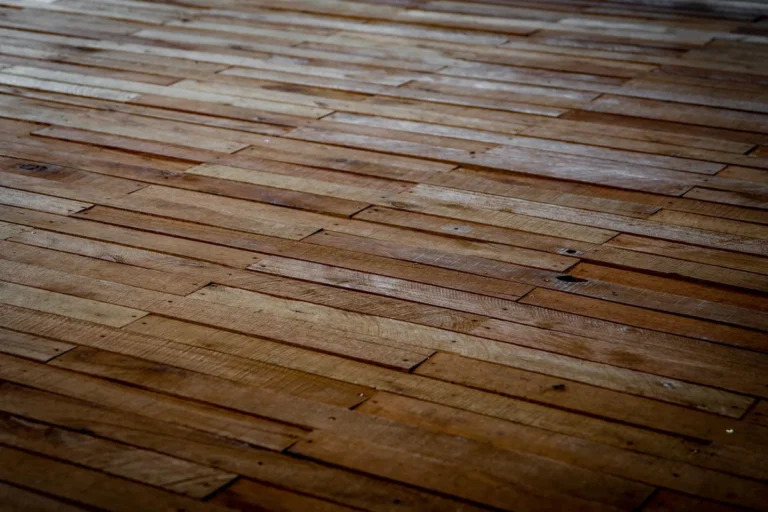
A flooring, stair-tread or tabletop specification can state how hard the timber must be, and the number it uses is Janka hardness. The figure is easy to quote and easy to misread. It belongs to one species at one moisture content, it was measured on clear wood, and a trade name such as “oak” or “maple” can cover species whose values are far apart. This article explains what the figure measures, sets out side hardness values for common species from the US Forest Service Wood Handbook, and lists what a procurement team should ask for when a quotation says “Janka 1,300” or names a species only by its trade name.
Our source is Chapter 5, “Mechanical Properties of Wood”, of the Wood Handbook—Wood as an Engineering Material (General Technical Report FPL-GTR-282, Forest Products Laboratory, US Department of Agriculture, 2021). We downloaded the chapter on 24 October 2026 and copy the table values exactly as printed there. We did not read ASTM D 143, the standard the Handbook names as the basis of its test methods, and we did not read any manufacturer’s test report. Nothing below recommends a species for a particular job; it is a reading of a public reference for procurement planning.
What the Wood Handbook says Janka hardness measures
The Handbook treats hardness as one of the additional measurements made alongside modulus of rupture and compression and shear strength. Its definition reads: “Generally defined as resistance to indentation using a modified Janka hardness test, measured by the load required to embed a 11.28-mm (0.444-in.) ball to one-half its diameter. Values presented are the average of radial and tangential penetrations.”
Two details in that sentence matter for a specification. The result is a load, so a bigger number means more force was needed to push the ball in. And the value is an average of penetrations on the radial and tangential faces, not a reading from one face of one board.
The Handbook’s tables call the property side hardness, and the note to Table 5–3a defines it plainly: “side hardness is hardness measured when load is perpendicular to grain.” When a flooring brochure quotes a Janka figure, side hardness is therefore the quantity to look for. The Handbook tables we read do not print a figure for the end of the board.
The Handbook gives each property twice, once for green wood and once for wood at 12% moisture content, and it warns that “the mechanical properties reported in the tables are significantly affected by specimen moisture content at time of test”. The tables indicate which dry values were “adjusted to a common moisture content base of 12%”. A Janka number without a stated moisture content is therefore not a complete number. For Tables 5–3 and 5–4, which cover species grown in the United States and Canada, it says the test methods “are based on standard procedures (ASTM D 143)”.
Units are the other trap. Table 5–3b prints side hardness in pounds-force (lbf) and Table 5–3a prints the same data in newtons, “converted to metric units directly from Table 5–3b”. Sugar maple at 12% moisture content is 1,450 lbf in the first and 6,400 N in the second; white oak is 1,360 lbf and 6,000 N; shagbark hickory is 1,880 lbf and 8,400 N. In these three pairs the newton value is the converted lbf value rounded to the nearest 100 N, so converting a quoted lbf figure with a calculator will not reproduce the printed value exactly. A quotation that gives “1,300” with no unit could mean either system, and the two differ by a factor of more than four.
Side hardness for common US-grown species
The table below copies side hardness at 12% moisture content for a selection of species from Table 5–3b, “Strength properties of some commercially important woods grown in the United States (inch–pound)”. We ordered the rows from highest to lowest within the table, which the Handbook does not do, and we picked species that appear in flooring, stair and furniture specifications. The Handbook lists many more.
| Species as named in the Handbook | Type | Side hardness at 12% moisture content (lbf) |
|---|---|---|
| Hickory, shagbark | Hardwood | 1,880 |
| Maple, sugar | Hardwood | 1,450 |
| Oak, white (White) | Hardwood | 1,360 |
| Ash, white | Hardwood | 1,320 |
| Beech, American | Hardwood | 1,300 |
| Oak, red (Northern red) | Hardwood | 1,290 |
| Birch, yellow | Hardwood | 1,260 |
| Walnut, black | Hardwood | 1,010 |
| Cherry, black | Hardwood | 950 |
| Maple, red | Hardwood | 950 |
| Pine, longleaf | Softwood | 870 |
| Larch, western | Softwood | 830 |
| Douglas-fir, Coast | Softwood | 710 |
| Pine, loblolly | Softwood | 690 |
| Yellow-poplar | Hardwood | 540 |
| Basswood, American | Hardwood | 410 |
| Pine, eastern white | Softwood | 380 |
| Cedar, Western redcedar | Softwood | 350 |
The Handbook’s note to the hickory rows adds that the side hardness values for the true hickories come from Bendtsen and Ethington (1975). That is a reminder that a table is a compilation: values reach it from different studies, and the footnotes say where.
Side hardness for imported species
Tropical species used in decking, stair treads and tables are in Table 5–5b, “Mechanical properties of some woods imported into the United States other than Canadian imports (inch–pound)”. The Handbook treats this table differently from the US one. Its footnote says the property values “were taken from world literature (not obtained from experiments conducted at the Forest Products Laboratory)”, and the text that follows adds: “Values reported in Table 5–5 were collected from the world literature; thus, the appropriateness of these properties to represent a species is not known.” Treat these figures as reference points, not as guarantees.
| Species as named in the Handbook | Side hardness (lbf) | Moisture content of the printed value |
|---|---|---|
| Ipe (Tabebuia spp., lapacho group) | 3,680 | 12% |
| Courbaril (Hymenaea courbaril) | 2,350 | 12% |
| Sapele (Entandrophragma cylindricum) | 1,510 | 12% |
| Merbau (Intsia spp.) | 1,500 | 15% |
| Keruing (Dipterocarpus spp.) | 1,270 | 12% |
| Teak (Tectona grandis) | 1,000 | 12% |
| Mahogany, African (Khaya spp.) | 830 | 12% |
Merbau is printed at 15% moisture content, not 12%, so it is not strictly comparable with the other rows. We kept it in the list because the Handbook prints no 12% value for it, and we flag the difference rather than adjust the number ourselves.
Three things the numbers show
A trade name is not a hardness. The Handbook states that “one common name may be applied to groups of species for marketing”. The table shows what that can mean. The red oaks in Table 5–3b range from 1,060 lbf (southern red) to 1,510 lbf (pin); the white oaks from 1,130 lbf (chestnut) to 1,620 lbf (swamp white); the maples from 700 lbf (silver) to 1,450 lbf (sugar). A tabletop quoted as “maple” could sit at either end of that range. Only the species name, in Latin or at least in the Handbook’s common-name form, settles which row applies.
Hardwood does not mean hard. The Handbook groups its strength tables into hardwood and softwood and states that this grouping is “not correlated with hardness or softness”. The table bears it out: longleaf pine, a softwood, is listed at 870 lbf, above the hardwoods yellow-poplar (540 lbf) and basswood (410 lbf). Western larch, also a softwood, is at 830 lbf, within 120 lbf of black cherry at 950 lbf. Whether a tree is classed as a hardwood or a softwood does not predict how a surface dents.
The top of the scale is a long way from the middle. Ipe at 3,680 lbf is about 2.7 times white oak at 1,360 lbf (3,680 divided by 1,360). Teak at 1,000 lbf is lower than sugar maple at 1,450 lbf and white oak at 1,360 lbf. Resistance to decay or weathering is a different property and is not what this table measures.
As a worked illustration of how a threshold reads against the tables, suppose a specification asked for at least 1,200 lbf at 12% moisture content. From the rows above, shagbark hickory, sugar maple, white oak, white ash, American beech, northern red oak and yellow birch clear that figure, and so do ipe, courbaril, sapele and keruing. Merbau’s 1,500 lbf is printed at 15% moisture content, so it needs the caveat above. Black walnut, black cherry, red maple, teak, African mahogany and all the softwoods in the table fall below it. This is an arithmetic reading of the printed numbers, not a recommendation to specify 1,200 lbf.
Sourcing this for a commercial project?
FBM Sourcing manages the entire China procurement package for overseas construction projects. We work with Developers · General Contractors · Builders · Commercial Project Owners · Interior Design & Construction Companies · FF&E Solution Providers. Send your BOQ, drawings or product schedule for review.
What these tables do not tell you
Read the footnotes before relying on a figure. The notes to the tables state that the results are from tests “on clear, straight-grained specimens”. A board with knots, a finger-jointed lamella or a heavily figured face is not what was tested. The Handbook also cautions that the properties reported in some of its tables, Table 5–5 on imported species among them, “may not necessarily represent average species characteristics because of inadequate sampling”, while still suggesting the relative influence of species and specimen parameters. For the imported species, as quoted above, it says the appropriateness of the values to represent a species is not known.
The tables report solid wood. A lacquer, an oil, a veneer over a core, or a laminated top is not what was tested, so a species figure is a starting point for a conversation about the product, not a performance claim for it. If a quotation lists an engineered board with a Janka figure, ask which layer the number belongs to.
Finally, harder is not automatically better. In discussing variability, the Handbook says that a piece being stronger, harder or stiffer than the average tends to matter less to the user than a weaker piece, and adds that this may not be true “if harder or tougher material is difficult to work”. For joinery and for site fitting, the hardest species also has to be cut, fixed and finished.
What to request when a quotation quotes Janka hardness
For a project that will specify timber by hardness, ask each bidder to put the following in writing. These are evidence requests, not thresholds.
- The species by botanical name (genus and species) next to the trade name, because the trade name can cover several species.
- The side hardness figure with its unit (lbf or N), the moisture content at which it applies, and the test method named.
- Whether the figure is a published reference value for the species, with the table and edition named, or a result measured on the bidder’s own material. If it is a measurement, ask for the report with the laboratory, the specimen description and the date.
- For veneered or engineered products, the species of the wear layer or top face, and a statement of what the number refers to.
- A sample of the actual face, so the architect can check species and appearance against the quoted data.
Timber legality documents are a separate set from hardness data; our guide to FSC, EUTR/EUDR and Lacey Act paperwork covers them. For how solid and engineered constructions differ in joinery, see solid wood vs engineered wood for project joinery; for engineered flooring supply routes, see our engineered wood flooring guide; and for a timber used outdoors, aluminum vs teak vs rope outdoor furniture compares materials on other grounds than hardness.
Frequently asked questions about Janka hardness
What is Janka hardness?
In the US Forest Service Wood Handbook it is hardness “generally defined as resistance to indentation using a modified Janka hardness test, measured by the load required to embed a 11.28-mm (0.444-in.) ball to one-half its diameter”, averaged over radial and tangential penetrations. The Handbook’s tables report it as side hardness, the load measured perpendicular to the grain.
Is the Janka figure in pounds-force or newtons?
Either. The Wood Handbook prints side hardness in pounds-force (lbf) in Table 5–3b and in newtons in Table 5–3a; in the pairs we checked, the newton figure is the converted value rounded to the nearest 100 N. Sugar maple at 12% moisture content is 1,450 lbf or 6,400 N. A figure with no unit cannot be compared with another until the unit is known.
Does hardwood always mean harder than softwood?
No. The Wood Handbook says its hardwood and softwood groupings are not correlated with hardness or softness. In its Table 5–3b, longleaf pine, a softwood, is listed at 870 lbf at 12% moisture content, above yellow-poplar at 540 lbf, a hardwood.
Is a higher Janka number always better?
Not necessarily. The figure measures resistance to indentation of the wood itself. The Wood Handbook says that being harder than average tends to matter less to the user than being weaker, but that this may not be true “if harder or tougher material is difficult to work”. Choose the figure that the project specification requires and ask for evidence that the quoted product meets it.
Does the Janka figure describe a finished floor or an engineered board?
The Wood Handbook tables report tests on clear, straight-grained specimens of solid wood. A finish, a veneer over a core or a laminated construction was not tested there, so ask which layer of the product a quoted figure belongs to and how it was measured.
How does FBM Sourcing support this kind of project?
We review the brief, collect comparable quotations and manage the package for the project. For suppliers you nominate, we charge a 5% commission; for products we source for you, we quote a direct price. Our own team performs one inspection after bulk production is complete and before shipment, and the client’s project team is welcome to attend.
FBM Sourcing manages the entire China procurement package for overseas construction projects. We work with Developers · General Contractors · Builders · Commercial Project Owners · Interior Design & Construction Companies · FF&E Solution Providers.





