
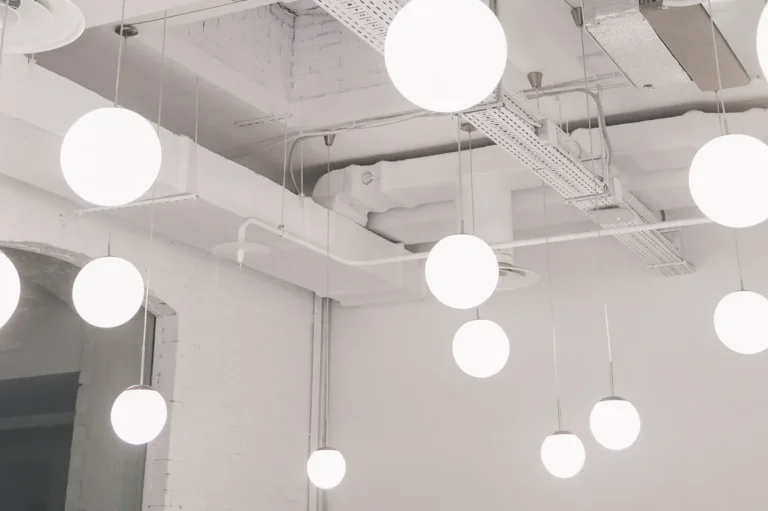
A luminaire quotation that says “L70 50,000 hours” is quoting the end of a chain: a laboratory test of LED light sources, a mathematical projection from that test, and a rule that limits how far the projection may go. Each link has its own document and its own limits, and a lifetime figure that cannot name them is a marketing number. This article explains the chain using two public reports prepared for the US Department of Energy (DOE) by RTI International, and ends with a list of what a lighting specifier or procurement team can ask for before accepting an L70 claim.
Our sources are the DOE Solid-State Lighting report Lumen and Chromaticity Maintenance Behavior of LED Packages Based on LM-80 Data (March 2020) and the RTI presentation New Considerations for SSL System Reliability – Recent Test Results (2020), both downloaded on 24 October 2026. The standards themselves, published by the Illuminating Engineering Society (IES), were not available to us, so everything below about LM-80 and TM-21 is what the DOE documents say about them. We did not read any manufacturer’s test report, and nothing here is a statement about a particular product.
The three layers behind an L70 claim
The DOE report defines L70 as “the time for the luminous flux to decay to 70% of the initial value”, and L80 and L90 the same way for 80% and 90%. It calls the general form Lx, “the luminous flux maintenance value”. The three layers are these:
- A measurement. IES LM-80 is the method for measuring how the light output of LED light sources falls over time under stated conditions. It produces a data set.
- A projection. IES TM-21 takes that data set and fits an exponential decay curve to it, so that the hours at which the output would reach 70%, 80% or 90% can be stated even though the test stopped earlier.
- A cap. TM-21 limits how far the projection may reach, in terms of the length of the test. The DOE documents call this the 6X rule.
The DOE report puts the arrangement in one sentence: “Together, LM-80 and TM-21 have become the accepted methods for reporting the luminous flux maintenance performance of LEDs used in lighting applications, especially for white LEDs.”
Layer one: what LM-80 produces
The DOE presentation says IES LM-80-08 “was first adopted in 2008 as a method to take data on the luminous flux maintenance of LED light sources.” The DOE report adds the content of that first version: it provides procedures for collecting luminous flux maintenance data and the magnitude of chromaticity shift, written as Δu’v’, and it requires measurements at three LED case temperatures, 55°C, 85°C and a third temperature chosen by the manufacturer.
The report explains why the method was revised. As the industry grew, reporting only the size of a chromaticity shift was judged inadequate, so ANSI/IES LM-80-15 added reporting requirements. For each working device under test at each test interval, LM-80-15 requires initial and subsequent flux values; chromaticity coordinates expressed in CIE u’ and v’; statistical information for all devices at each measurement interval; the electrical drive level; the measurement point temperature and location; and a description of the photometric measurement method. In the report’s words, Δu’v’ “provides the chromaticity shift magnitude but not the direction”, while the new coordinates also show the direction.
Two practical points follow. First, the data are tied to test conditions. The DOE analysis calculates its decay constants “at each test condition”, such as temperature and forward current, and notes that higher-stress conditions, such as higher temperatures and higher forward current, tend to show lower luminous flux maintenance values. Second, the version matters: an LM-80-08 report and an LM-80-15 report do not contain the same information, and only the later one carries the u’ and v’ coordinates.
Layer two: what TM-21 projects
According to the DOE report, LM-80 data sets are fitted with an exponential decay model using the method in IES TM-21-11 and the ANSI/IES TM-21-19 revision. The model is Φ(t) = B·e−αt, where Φ(t) is the averaged normalized luminous flux at time t, B is a projected initial constant that is approximately 1.0 when the flux is normalized, and α is the exponential decay rate constant. A smaller α means slower decay. The report also states that TM-21-19 has a minimum α of 2 × 10⁻⁶: calculated values below that are set to that figure.
Because the model is an exponential, the time to reach a given fraction follows directly. With B = 1, the time to fall to 70% is the natural logarithm of 1/0.7 divided by α, which is about 0.357 divided by α. That is our arithmetic from the DOE formula, and it reproduces the DOE’s own figures: the report says that an L70 of 50,000 hours corresponds to α = 7.13 × 10⁻⁶ and an L70 of 100,000 hours to α = 3.56 × 10⁻⁶, assuming B = 1.
Layer three: the 6X rule
The projection is not allowed to run as far as the maths would let it. The DOE report says that both TM-21-11 and TM-21-19 “mandate that rated flux maintenance life (Lp) times cannot be greater than 6 times the actual LM-80 test duration, and only when specific test conditions, such as the number of samples, have been met.” Its example: if an LM-80 test ran for 10,000 hours, “the maximum value of L70 is 60,000 hours, although the L70 time could be less.”
The DOE presentation shows the effect with two worked cases, reproduced here with the sums behind them.
| Decay rate α | LM-80 test duration | L70 | L80 | L90 |
|---|---|---|---|---|
| 2 × 10⁻⁶ | 10,000 hours | > 60,000 hours | > 60,000 hours | 53,000 hours |
| 1 × 10⁻⁵ | 6,000 hours | 36,000 hours | 22,000 hours | 11,000 hours |
In the first row the maths would give an L70 of about 178,000 hours (0.357 divided by 2 × 10⁻⁶), but a 10,000-hour test caps the claim at 60,000 hours, which is why the table prints “> 60,000”. L90 for the same α comes out near 52,700 hours (0.105 divided by 2 × 10⁻⁶), below the cap, so it is printed as a value. In the second row the 6,000-hour test caps the claim at 36,000 hours; the L70 sum gives about 35,700 hours, and the printed 36,000 is the same number rounded.
The consequence for a buyer is simple arithmetic. A claim of L70 = 50,000 hours cannot rest on a test shorter than about 8,300 hours (50,000 divided by 6), and a claim of 60,000 hours needs a test of at least 10,000 hours. The DOE report mentions that some of the data sets it analysed had measurements only to 6,000 hours, which “limit projection times to 36,000 hrs by the 6X-rule”. The test duration is therefore a required part of the claim, not a footnote.
Sourcing this for a commercial project?
FBM Sourcing manages the entire China procurement package for overseas construction projects. We work with Developers · General Contractors · Builders · Commercial Project Owners · Interior Design & Construction Companies · FF&E Solution Providers. Send your BOQ, drawings or product schedule for review.
What an L70 figure does not cover
It is about the LED light source, not the whole luminaire. The DOE report’s focus is the “L1” LED package, the packaged die, and the data sets come from LM-80 testing of such packages. The DOE presentation separately mentions luminaire and lamp testing. In its slide on OLED lighting products it says luminous flux maintenance data “can be modeled using IES LM-84 and IES TM-28-14. These are the luminaire and lamp equivalent of LM-80/TM-21.” The same slide says LM-84 tests tend to use smaller sample sizes than LM-80, so the maximum projection time is 3 to 6 times the test duration. When a quotation says “TM-21” for a finished fixture, ask whether the data are for the LED package or for the fixture.
It does not include the driver. The DOE presentation lists drivers as “a potential failure point in the lighting system”, and reports that degradation of the surge-suppression and electromagnetic-interference filter components in multichannel drivers can lead to failures throughout the device. A light source with a long L70 can still sit behind a driver with a shorter life, so the driver’s own life and replaceability are separate questions.
It says nothing about colour. L70 is a statement about light output. Colour change is reported separately, as chromaticity shift. The DOE report describes TM-35-19, a method approved jointly by ANSI and IES for projecting long-term chromaticity shifts, and states that it can only be applied to LM-80-15 data sets that report u’ and v’ at regular intervals; intervals shorter than 600 hours are preferred and intervals longer than 1,000 hours are not allowed. A project that cares whether a corridor of luminaires stays visually matched needs chromaticity data, not only a lumen maintenance figure.
It is tied to conditions. Because α is calculated at each test condition, an L70 figure belongs to a case temperature and a drive current. Whether the luminaire runs the LED at the conditions that were tested is a question for the luminaire design, and the DOE documents do not answer it for any product.
What the DOE data shows about LED packages, and its limits
The DOE report analysed 223 LM-80 data sets from testing of representative products from many Tier 1 LED manufacturers, 84% of them from testing completed in 2018 and 2019. It found that 96% of the α values were below 6 × 10⁻⁶, “which corresponds to an L70 time of nearly 60,000 hours”. It also reports that polymer-based packages had improved to nearly the same performance as ceramic-based ones at forward currents of 200 mA and below.
Read that finding for what it is. It describes data sets that manufacturers supplied to the study, at the conditions they were tested, for LED packages. It is not a lifetime for any luminaire, and the report does not say that every product on the market reaches these values. It does show that a published package-level L70 in the tens of thousands of hours is a measurable, documentable thing, which is why asking for the documents is reasonable.
What to ask a lighting bidder to put in writing
For a project where fixture life matters, request the following with the quotation. These are evidence requests, not thresholds.
- The LM-80 report for the LED package used in the fixture: which edition (LM-80-08 or LM-80-15), the test laboratory, the package model, the test duration, the case temperatures, the drive currents and the number of samples.
- The TM-21 calculation: which edition (TM-21-11 or TM-21-19), the α and B values, the projected L70 or L80, and whether the stated figure sits at the 6X limit.
- A statement of whether the lifetime figure belongs to the LED package or to the finished fixture, and, if the latter, the LM-84 and TM-28 documents.
- The operating conditions inside the fixture (drive current and the temperature at the LED) set against the conditions in the LM-80 report.
- The driver’s own rated life, brand and model, and whether it can be replaced in the field.
- Chromaticity data in u’ and v’ from an LM-80-15 report where colour stability over time is part of the specification.
Related guides on this site cover the rest of a lighting package: our commercial lighting brief lists the other items a quotation should carry; UL listing for lighting from China and voltage and electrical standards for lighting cover safety and supply; and CRI and R9 in lighting specifications covers colour rendering, which is a different property from the colour stability discussed above.
Frequently asked questions about LM-80, TM-21 and L70
What does L70 mean for an LED?
In the US Department of Energy report, L70 is the time for the luminous flux to decay to 70% of its initial value. L80 and L90 are the same measure for 80% and 90%. An L70 figure describes light output only; it does not describe colour change or the life of the driver.
What are LM-80 and TM-21?
LM-80 is the IES method for collecting luminous flux maintenance data on LED light sources. TM-21 is the method for fitting an exponential decay curve to that data and projecting L70, L80 or L90 beyond the test period. The DOE report calls them together the accepted methods for reporting the luminous flux maintenance of LEDs used in lighting.
What is the 6X rule?
It limits a TM-21 projection to six times the length of the LM-80 test, provided the required test conditions such as the number of samples are met. In the DOE report’s example, a 10,000-hour test gives a maximum L70 of 60,000 hours.
Does an L70 figure include the driver?
No. The DOE presentation describes drivers as a potential failure point in the lighting system, so ask for the driver’s own life and whether it can be replaced.
What are LM-84 and TM-28?
The DOE presentation describes IES LM-84 and TM-28-14 as the luminaire and lamp equivalent of LM-80 and TM-21. If a lifetime figure is claimed for the finished fixture, ask which of the two sets of documents it rests on.
How does FBM Sourcing support this kind of project?
We review the brief, collect comparable quotations and manage the package for the project. For suppliers you nominate, we charge a 5% commission; for products we source for you, we quote a direct price. Our own team performs one inspection after bulk production is complete and before shipment, and the client’s project team is welcome to attend.
FBM Sourcing manages the entire China procurement package for overseas construction projects. We work with Developers · General Contractors · Builders · Commercial Project Owners · Interior Design & Construction Companies · FF&E Solution Providers.





