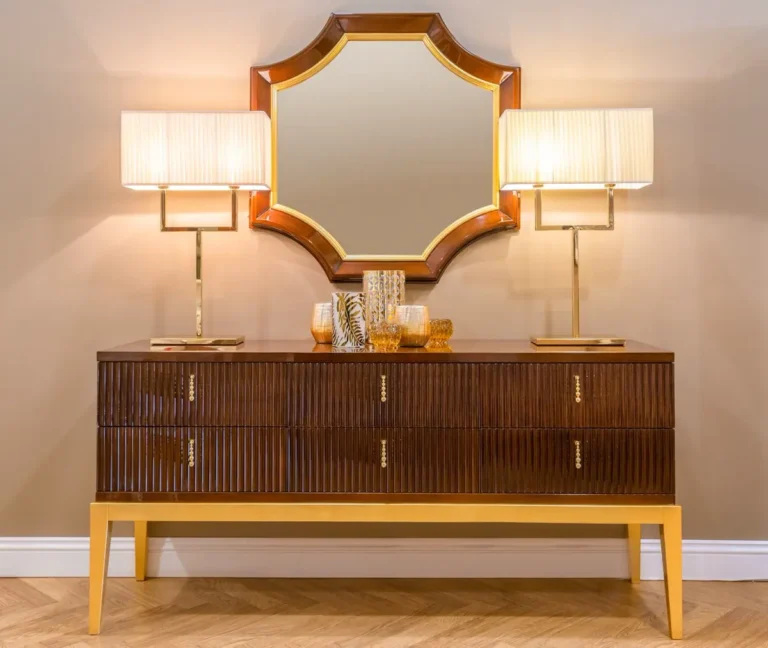
For hotel casegoods, high pressure laminate is the right specification when repeatability, damage resistance and phased reordering matter more than material authenticity; wood veneer is the right specification when the design depends on real grain, and the property has the budget and the maintenance regime to support it. HPL is a manufactured surface tested to EN 438 or NEMA LD 3, so a panel produced next year matches one produced today; veneer is a natural product cut from a log, so consistency depends on flitch sequencing and the finish is applied and cured in the factory. The decision is usually settled by two questions that have nothing to do with appearance: how many phases will this property order in, and who repairs a damaged panel in year three. FBM Sourcing is your sourcing partner in China: it holds no inventory and has no product range of its own.
What Is the Real Difference Between HPL and Veneer?
Both are thin surfaces bonded to a panel substrate, and both are specified by the same drawing. What differs is how the surface is made and therefore how it behaves.
- HPL is layers of kraft paper impregnated with phenolic resin plus a decorative sheet and an overlay, consolidated under heat and pressure into a rigid sheet, then bonded to MDF or particleboard. Typical decorative thicknesses are around 0.7 mm for vertical applications and around 1.2 mm for horizontal, working surfaces.
- CPL (continuous pressure laminate) is the thinner relative, commonly in the 0.2–0.5 mm range, used where cost matters more than impact resistance and often confused with HPL in submittals.
- Wood veneer is a sliced sheet of real timber, usually around 0.5–0.6 mm for sliced decorative veneer, bonded to the substrate and then sanded, sealed and lacquered in the factory as a multi-coat operation.
- Melamine faced board is a different product again — a decor paper fused directly to the board with no separate laminate sheet — and is covered in our comparison of melamine, PVC and lacquer cabinet finishes.
The substrate matters as much as the face on hotel work. Both HPL and veneer are normally applied to MDF for flat faces and to particleboard or MDF for carcases, with moisture-resistant grades where the unit meets a wet area. Our breakdown of plywood, MDF and particleboard for casegoods covers which substrate to call up for which element.
Which Performs Better in a Hotel Guest Room?
A guest room is a light-commercial abuse environment: suitcases against the wardrobe base, wet glasses on the desk, housekeeping chemicals daily, and a cleaning cycle that does not adjust itself for a delicate finish.
Abrasion, impact and staining
HPL wins on all three at the surface level. Abrasion resistance is a graded, tested property under EN 438-2 and the NEMA LD 3 grades, which is why HPL is specified for desktops, luggage benches and wardrobe interiors. Lacquered veneer is a coating over a soft substrate: it is repairable, but it marks. A veneered desk in a busy property will show ring marks and edge wear years before an HPL one does.
Moisture and edges
Edges are where casegoods actually fail, not faces. HPL panels are edged with 1–2 mm PVC or ABS edgebanding, or post-formed around a radius so there is no edge joint at all on the working front. Veneer is normally edged with solid timber lipping, sanded flush and finished with the face — a better-looking detail that is also the first place moisture gets in if the lacquer is breached. Around minibar counters, vanity units and anywhere a kettle sits, this difference is decisive.
Repair and lifecycle
Here veneer wins, and it is the strongest argument for it. A veneered panel can be sanded back locally, re-stained and re-lacquered by a competent French polisher, which is why upscale properties can run a refurbishment cycle rather than a replacement cycle. A damaged HPL panel cannot be repaired invisibly — the surface is the sheet, so the element is replaced. On a property with an in-house maintenance capability, veneer’s repairability can outlast HPL’s toughness; on a property that has none, it cannot.
Fire performance
Neither material is inherently compliant. Reaction-to-fire classification for wall-adjacent and built-in elements is a property of the assembly — face, adhesive and substrate together — and both HPL and veneer are available in constructions that achieve the classifications commercial interiors need. What matters is that the classification is evidenced for the assembly you are buying, not for the face material in isolation; see fire rating standards for building materials and finishes.
Sourcing this for a commercial project?
FBM Sourcing works with project owners, developers, main contractors and FF&E contractors on hotel, apartment, school, office and other commercial building projects. Send us your BOQ, drawings or product list — our team will review it and get back to you.
How Does the Choice Affect Production Time and Consistency?
This is the part of the decision that is invisible on a finish board and decisive on a programme.
Finishing is the factory bottleneck. A veneered casegood goes through veneer laying, pressing, sanding, sealing, denibbing and two or three topcoats with curing time between each, in a booth whose throughput is fixed. An HPL casegood is pressed, edged and assembled — no finishing line at all. On a package of several hundred rooms, that difference is not a small percentage; it is the constraint that sets how many rooms per month a factory can actually deliver, which is exactly what a pre-order capability check should be measuring.
Consistency across a run. HPL is a manufactured decor with a batch reference, so a colour and pattern are reproducible. Veneer is cut from logs, and a log runs out: colour, figure and grain vary between flitches, which is why veneered packages need flitch sequencing, book-matching or slip-matching specified, and why approved control samples have to be signed off with a tolerance range rather than a single reference.
Reorders and later phases. This is where projects get hurt. A phase-two order of HPL panels can usually be matched by calling up the same decor code. A phase-two order in veneer will not match phase one unless veneer was reserved at the outset, because the original flitch is gone. Our guide to matching existing finishes on a phase-two FF&E order from China covers what to reserve and document if a property is being built out in stages, or is one of several under the same brand standard.
For panel-based casegoods the composite wood core also carries an emissions requirement in most destination markets — CARB Phase 2 and TSCA Title VI for the United States, and equivalent emission classes elsewhere — and that applies to both HPL and veneered construction because it is a property of the board, not the face. See CARB Phase 2 and TSCA Title VI compliance for furniture from China.
Which Should You Specify? A Decision Framework
Rather than a general preference, the answer follows from the property and the programme.
- Specify HPL for economy, midscale and extended-stay properties; for student accommodation and staff housing; for any working horizontal surface regardless of segment; for wardrobe and cupboard interiors; for multi-property rollouts under one brand standard; and for any property that will order in phases.
- Specify veneer for upscale and luxury guest rooms and suites where the design depends on real grain; for feature elements such as headboard walls and bar fronts; and where the operator has a maintenance capability that can refinish rather than replace.
- Specify both, deliberately. The common and usually correct answer on a four-star property is veneer on the visible vertical faces and HPL on the desk top, the luggage bench and every interior — giving the room the material read the design wants and the durability the operation needs.
Two specification details are worth insisting on either way. First, name the grade, not just the material: for HPL that means the applicable EN 438 or NEMA LD 3 grade and thickness per application, and for veneer it means species, cut, match, thickness and finish system with a sheen level. Second, approve a physical control sample and keep a retained counter-sample, because “walnut veneer” and “wood-effect HPL” describe hundreds of products. Our overview of the types of hotel furniture in an FF&E package shows where each element normally sits, and hospitality casegoods manufacturing hubs in China covers where each construction is genuinely well supported.
How FBM Sourcing Specifies and Controls Casegood Surfaces
FBM Sourcing manages the entire China procurement package for overseas construction projects, and on a casegoods package the surface decision is taken with the client before purchase orders are issued, line by line, against the property segment, the maintenance regime and the phasing plan — not left as a material name in a schedule for each factory to interpret.
In practice that means: grade and thickness written into the order rather than a material name; substrate and edge treatment specified per element, with moisture-resistant board called up where the unit meets a wet area; a signed physical control sample with a retained counter-sample held against the production run; flitch sequencing and match specified where veneer is used, and decor batch references recorded where HPL is used so a later phase can be matched; and emissions class evidence collected for the board at order stage rather than requested at submittal. One inspection is carried out by FBM Sourcing’s own team at the factory once bulk production is finished, with photo and video records delivered before shipment, and surface checks are made against the retained sample rather than against a photograph.
Because finishing is the capacity constraint on veneered work, the production programme is planned around the finishing line rather than the machining shop, and where a package spans several factories the slowest finishing operation is identified before the container dates are committed. All quotations, invoices and shipping documents are issued by FBM Sourcing — you deal with us, and we carry the responsibility. For suppliers you nominate, we charge a 5% commission; for products we source for you, we quote a direct price.
FBM Furniture
If your package is mainly hotel guestroom furniture, see hotel guestroom furniture on fbmfurniture.com, the site of FBM Furniture, the furniture sourcing line of FBM Sourcing Limited.
Get a China Procurement Quote for Your Casegoods Package
If you are specifying casegoods for a hotel, apartment, student accommodation or extended-stay property and need the surface decision resolved before it is priced, send us the FF&E schedule and drawings with quantities, the property segment and brand standard, the destination port and the required-on-site dates. Our team will mark the surface specification element by element, flag anything that will not match in a later phase, and set out the quotation.
Use the quote button above or WhatsApp +86 135 6007 5057 to start the conversation.