
CARB Phase 2 and TSCA Title VI are the two formaldehyde emission regulations that govern composite wood products sold in the United States, and since June 1, 2018 every panel of hardwood plywood, MDF and particleboard — and every cabinet or piece of furniture made from them — must comply with TSCA Title VI (40 CFR Part 770) to legally enter the US market. The two standards share identical emission limits, so a Chinese factory that produces to TSCA Title VI automatically satisfies CARB Phase 2 for California. For a commercial building project — multifamily cabinets, hotel casegoods, student housing furniture — the practical job is verifying that your factory buys certified panels, holds the right documents and labels the finished goods correctly, which is exactly the kind of paperwork an experienced china sourcing agent and sourcing partner for building materials and FF&E checks before your deposit is paid.
- TSCA Title VI emission limits: hardwood plywood 0.05 ppm, MDF 0.11 ppm (thin MDF 0.13 ppm), particleboard 0.09 ppm formaldehyde.
- Effective dates: CARB Phase 2 fully in force since 2012 (California); TSCA Title VI federally since June 1, 2018; imported articles must carry a compliance label since March 22, 2019.
- Who certifies: panel mills must be certified by an EPA-recognized Third-Party Certifier (TPC); CARB-approved TPCs are automatically EPA-recognized.
- What you collect from the factory: TPC certificate number, panel mill compliance declarations, current test reports, and a correct label on the finished goods.
- Not covered: solid wood, structural plywood (PS 1/PS 2), OSB and hardboard are outside the scope.
2026 Documentation Figures for a CARB / TSCA Purchase Order
The emission limits above are only half the requirement. The other half is the paper chain, and these are the figures to write into the order.
- Certification route: panel producers must be certified by an EPA-recognised TSCA Title VI Third-Party Certifier, and the TPC number is what makes a claim checkable rather than assertable.
- Label content: compliant panels and finished goods carry the panel producer identification, the lot or production date, the TPC number and a statement of compliance with TSCA Title VI.
- Record retention: importers must keep records demonstrating compliance for three years, which means the certificates have to be collected at shipment, not requested later.
- Exemption routes: NAF (no-added-formaldehyde) and ULEF (ultra-low-emitting formaldehyde) resins carry reduced testing obligations once approved, and are worth specifying where a project has a green-building documentation requirement.
- Scope trap: the limits apply to the panel, so a laminated component made from a compliant core stays compliant only if the lamination process itself is covered by the applicable provision.
What Is the Difference Between CARB Phase 2 and TSCA Title VI?
CARB Phase 2 is a California regulation (17 CCR 93120), enforced by the California Air Resources Board since it fully phased in during 2012. TSCA Title VI is the federal version: the EPA took CARB’s Phase 2 emission limits and applied them nationwide under the Formaldehyde Standards for Composite Wood Products Act, codified at 40 CFR Part 770, with mandatory compliance from June 1, 2018.
The emission limits in the two rules are numerically identical. The differences that matter to an importer are administrative: TSCA Title VI applies in all 50 states, adds its own labeling language (“TSCA Title VI compliant”), and defines its own recordkeeping chain from panel mill to importer. Because EPA recognizes CARB-approved Third-Party Certifiers, a Chinese mill holding a CARB TPC certificate is in practice certified for both regimes. When US buyers say “CARB 2 board,” Chinese cabinet factories understand it as shorthand for TSCA Title VI compliant panels — but your purchase order should cite TSCA Title VI explicitly, because that is the rule US Customs and the EPA actually enforce at import.
Which Furniture and Cabinet Products Are Covered?
The regulation targets composite wood panels — hardwood plywood, MDF and particleboard — and every finished or component article that contains them. On a commercial building project, that captures most of the joinery and casegoods package:
- Kitchen cabinets and wardrobe/closet systems (typically plywood or particleboard carcasses with MDF doors — see our kitchen cabinet sourcing guide for construction options);
- Bathroom vanities and laundry cabinets;
- Hotel and apartment casegoods: bed bases, headboards, desks, nightstands, TV panels, minibar units;
- Office furniture with MDF or particleboard worktops and panels;
- Wall paneling, decorative veneered boards and MDF skirting/trim.
Exempt categories include solid wood furniture with no composite panels, structural softwood plywood and OSB made to PS 1/PS 2 (these follow HUD rules instead), hardboard, and panels produced with no-added-formaldehyde (NAF) or ultra-low-emitting (ULEF) resins — NAF panels can earn a two-year exemption from routine quarterly testing, and ULEF panels a reduced testing regime, once approved by a TPC. If you are unsure which core material your casegoods actually use, our comparison of plywood vs MDF vs particle board in project furniture breaks down where each panel typically appears.
What Are the Exact Formaldehyde Emission Limits?
Both CARB Phase 2 and TSCA Title VI set the same ceilings, measured by the ASTM E1333 large chamber method (or ASTM D6007 with an established correlation):
- Hardwood plywood (veneer core or composite core): 0.05 ppm formaldehyde;
- Particleboard: 0.09 ppm;
- MDF: 0.11 ppm;
- Thin MDF (≤8 mm): 0.13 ppm.
Two points trip up buyers comparing quotations. First, the limits apply to the panel, not the finished cabinet — a factory cannot “test the cabinet” into compliance; it must buy certified panels and preserve the paper trail. Second, China’s domestic grades do not map one-to-one: the Chinese national standard GB/T 39600 grades boards in mg/m³ (E0 at 0.050 mg/m³ or less, ENF at 0.025 mg/m³ or less), while US limits are set in ppm against ASTM E1333, so an “E0” or “E1 board” claim is not evidence of TSCA compliance. We cover the Chinese grading system separately in our guide to formaldehyde standards for cabinets made in China. And keep the scope straight: this page is about formaldehyde emissions only — fire performance of finishes and materials is a different compliance track covered in our fire rating standards guide (ASTM E84, EN 13501, BS 476).
Sourcing this for a commercial project?
FBM Sourcing works with project owners, developers, main contractors and FF&E contractors on hotel, apartment, school, office and other commercial building projects. Send us your BOQ, drawings or product list — our team will review it and get back to you.
What Documents Should a Chinese Factory Provide to Prove Compliance?
Compliance is a document chain, not a single certificate. Before production starts — ideally before the deposit — a US-bound cabinet or furniture order should have these four items on file:
- The panel mill’s TPC certificate number. The mill (not the cabinet factory) must be certified by an EPA-recognized Third-Party Certifier. Ask for the certificate copy showing the TPC’s EPA/CARB recognition number, the mill name, product type and validity dates, and cross-check the mill name against the panels actually being purchased for your order.
- Chain-of-custody declarations. A written statement from the panel mill or panel distributor to your fabricator confirming the specific batch/grade supplied is TSCA Title VI certified. Certified mills undergo quarterly TPC testing plus routine in-house quality control testing, so current paperwork should never be more than a few months old.
- Recent third-party lab test reports issued under the TPC program for the panel type used in your goods, showing results against the 0.05/0.09/0.11 ppm limits.
- The fabricator’s own TSCA Title VI compliance statement for the finished goods, which becomes part of your import records — US importers are required to keep these records for three years.
On FBM Sourcing projects, all incoming panel paperwork is checked against the physical goods before shipment: all inspections are carried out by FBM Sourcing’s own team on the factory floor, with photo and video records delivered to the client before shipment, so the boards going into your carcasses match the certificates in your file. This is a routine step for any competent Foshan sourcing agent working the cabinet factories around Foshan and Guangzhou, where most export joinery for US projects is produced.
How Do You Put TSCA Title VI on Your Purchase Order and Labels?
Write compliance into the PO as a specification, not a hope. Three clauses do most of the work:
- Material clause: “All hardwood plywood, MDF and particleboard used in this order shall be certified compliant with TSCA Title VI (40 CFR Part 770) and CARB Phase 2 (17 CCR 93120). Seller shall provide the panel mill TPC certificate and batch declarations before shipment.”
- Labeling clause: finished goods (or, for boxed products, the smallest saleable package) must be labeled with the fabricator’s name, the date of manufacture (month/year), and the statement that the product is “TSCA Title VI compliant” — mandatory on imported articles since March 22, 2019. A stamp, sticker or printed mark inside a cabinet carcass is acceptable; loose paper certificates alone are not.
- Documents clause: list the compliance file (TPC certificate, mill declaration, test report, fabricator statement) as a required shipping document alongside the packing list and bill of lading, with balance payment tied to a complete document set.
Also brief your customs broker: importers of regulated composite wood articles must exercise “reasonable care” under TSCA import certification rules, and a missing label or declaration can hold containers at port. Getting the label text and placement photographed during FBM Sourcing’s in-factory inspection — before cartons are sealed — is far cheaper than re-working goods at a US warehouse.
Does CARB/TSCA Compliance Change Cost or Lead Time?
For mainstream cabinet and casegoods factories serving the US market, certified board is the default purchasing route, so compliance normally adds little or nothing to the production schedule of a typical 30–45 day cabinet production run. Where budgets move is panel upgrade decisions: NAF-resin plywood or E0-grade board specified above the minimum legal requirement costs more than standard certified panels, which matters on a multifamily job running dozens of apartment kitchen sets per 40HQ container. The right sequence is to fix the compliance floor (TSCA Title VI certified panels, correct labels, full document chain) in the RFQ, then let a furniture sourcing agent price optional upgrades — NAF cores, moisture-resistant board for vanities, plywood in lieu of particleboard — as separate line items so you can see exactly what each specification decision costs. Factories quoting suspiciously low against a US-bound spec are often quoting uncertified domestic-grade board; treat the TPC certificate request as your first filter, not a formality at shipment time.
What Should Be Checked Before Shipment?
Paperwork collected at quotation stage only proves the factory can comply; the inspection of the finished goods proves your specific order does. Four checkpoints close the loop:
- Incoming material check: panel stamps or edge markings on the boards in the cutting area matched against the TPC certificate and batch declaration — certified mills mark bundles, and an unmarked stack of bargain board on the shop floor is the single most common failure point.
- Pre-shipment check: finished goods labeling photographed — fabricator name, month/year of manufacture, and the “TSCA Title VI compliant” statement in place on the article or smallest package.
- Document check: the complete compliance file (TPC certificate, mill declaration, test report, fabricator statement) assembled and cross-referenced to the packing list before the container doors close.
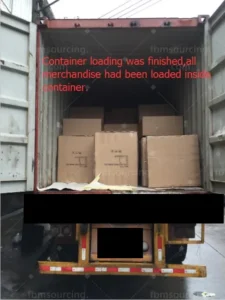
On FBM Sourcing orders, our own team carries out a full inspection on-site at the factory once production is finished, with photo and video records delivered to the client before shipment — so by the time the goods sail, the importer’s three-year record file is already complete. For US multifamily developers running repeat container programs, this same file becomes a template: once a factory’s panel chain is verified on the first order, subsequent orders only need batch-level updates, which is one reason repeat cabinet programs move faster than first orders (see our guide to kitchen cabinet manufacturers serving US multifamily projects).
2026 Emission Limits and Evidence Checklist
The compliance question on a project order is not whether a factory says it is compliant, but whether the specific panel in your product carries evidence against these limits.
- Hardwood plywood: 0.05 ppm formaldehyde emission limit.
- Particleboard: 0.09 ppm.
- Medium density fibreboard (MDF): 0.11 ppm.
- Thin MDF (8 mm or less): 0.13 ppm.
- Certification route: panel producers are certified by a third-party certifier recognised under the programme, and the panel carries a mill and certifier identification; the finished furniture maker is a fabricator relying on that certification, so the evidence chain runs panel mill → certifier → fabricator → importer.
- Labelling: finished goods must be labelled as compliant, and the importer is the party responsible for holding the records, which is why the label wording and the panel certificates should be agreed before production rather than requested at the port.
Emission limits reviewed for the 2026 procurement season.
If the project is chasing LEED or WELL credits, CARB/TSCA compliance is only the baseline: our guide to LEED and WELL documentation from Chinese factories (EPDs, HPDs and low-VOC certificates) covers the rest of the submittal.
Get a China Procurement Quote for Your Project
If your project includes cabinets, casegoods or joinery bound for the US market, send us your drawings, BOQ or product schedule together with quantities, destination port and target timeline. FBM Sourcing works on a 5% commission for suppliers you nominate (products we source for you are quoted at a direct price), and our team will review your requirements and get back to you.
Related reading: plywood vs MDF vs particleboard for project casegoods.
Formaldehyde compliance is only half of the wood paperwork — the other half is legality of the timber itself: see timber legality documents for wood products from China (Lacey Act, EUDR, FSC).