Hospitality procurement services in China cover the sourcing, production management, quality control and shipping of everything a hotel, resort or serviced apartment project needs to open — guest room and public area FF&E, OS&E, and the fit-out building materials that surround them — run by a team on the ground in China, typically for a 5% commission for suppliers you nominate (products we source for you are quoted at a direct price). For a 100–200 room property, that package spans hundreds of SKUs across several factory categories, fills a number of 40HQ containers set in the load plan, and needs around four months from deposit to shipment (around two months for drawings and around two months for production), before sea freight — which is why procurement starts while the building is still in structural fit-out, not when rooms are ready to furnish. FBM Sourcing is your sourcing partner in China: it holds no inventory and has no product range of its own.
This guide explains what the service includes, how it compares to the alternatives, how the workflow runs week by week, and where hospitality packages most often go wrong. It is written for hospitality developers, owners, operators, main contractors and FF&E contractors sourcing from China for commercial building projects — the delivery model behind it is FBM Sourcing’s work as a China procurement agent for hotels and apartment developments.


What Do Hospitality Procurement Services in China Include?
A hospitality package is not one order — it is a coordinated set of orders across product categories that come from entirely different manufacturing bases, each with its own lead time:
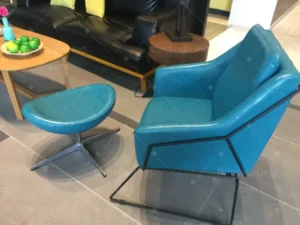
- Guest room FF&E — casegoods, beds and headboards, seating, desks, wardrobes and lighting; the factory confirms the production lead time in writing after sample approval.
- Public area FF&E — lobby seating, reception desks, restaurant tables and chairs, outdoor furniture; these are the most design-sensitive items with the longest approval loops, so they are sampled first and usually ship last.
- OS&E — linen, towels, crockery, glassware, guest amenities and housekeeping equipment, sourced from textile mills and ceramics factories rather than furniture producers, and ordered closer to opening.
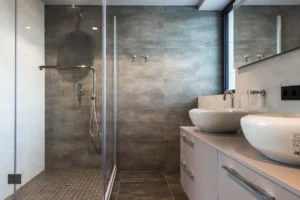
- Fit-out building materials — doors (including fire-rated sets), tiles and stone, sanitary ware, wall panels and railing systems; production lead times vary by category and are confirmed by each factory in writing.
The category-by-category contents of a full package — and who typically buys which scope on a hotel project — are broken down in what a complete hotel FF&E package from China includes.
Purchasing Group, Buying Direct, or a China Sourcing Agent — Which Fits Your Project?
Three routes exist, and the right one depends on brand constraints and how much custom manufacturing the design requires:
- Hospitality purchasing group — strongest when a brand standard dictates approved product lines; weakest on custom items.
- Buying direct from factories — viable only if you have staff in China; a single hotel package routinely involves five to eight factories, and someone must hold them to one specification system, one carton labelling scheme and one loading plan.
- Independent China sourcing agent — a 5% commission for suppliers you nominate (products we source for you are quoted at a direct price) with sampling, inspection before shipment and consolidation managed on the ground.
The structural comparison is covered in hospitality purchasing group vs independent China sourcing agent, and what to look for when appointing the agent itself — scale capability, hospitality specification knowledge, delivery coordination — in our Chinese sourcing agent guide for hotel developers and contractors. The short version: the more custom the design and the tighter the budget, the more the agent model pays for itself.
Sourcing this for a commercial project?
FBM Sourcing works with project owners, developers, main contractors and FF&E contractors on hotel, apartment, school, office and other commercial building projects. Send us your BOQ, drawings or product list — our team will review it and get back to you.
How Does the Procurement Workflow Run, Step by Step?
The workflow below assumes a mid-size hospitality project with custom guest room FF&E. Every stage gates the next, and the timing of each stage is confirmed in writing for the project:
| Stage | Control point |
|---|---|
| 1. Scope and BOQ review | Split items by factory category and risk; flag specification gaps before quoting |
| 2. Factory matching and quotation | Like-for-like comparison on material grade, hardware, packing and lead time — not unit price alone |
| 3. Samples and approvals | First samples, revision rounds as needed, written sign-off before production |
| 4. Mass production | Schedule tracking across all factories so goods converge on one consolidation window |
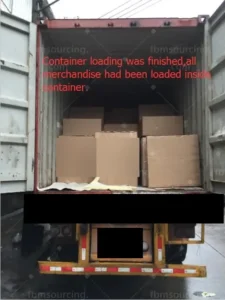
| 5. Final inspection and loading | One inspection by our own team once production is finished, against the approved sample, then supervised container loading |
| 6. Ocean freight and delivery | Tracking, documents and arrival coordination with the site programme |
Two scheduling rules carry most of the value. First, factories with different production lengths start at different dates so everything is ready for consolidation in the same window — a long casegoods run and a shorter tile run should not start on the same day. Second, containers are loaded by building zone, so the floors that finish fit-out first receive furniture first. The furnishing sequence itself is in how to furnish an entire hotel from China.
If your project needs the full engagement model rather than a single category, our guide to FF&E procurement China for hotels and apartment developments explains how FBM Sourcing runs a multi-category package from BOQ to shipment.
How Is Quality Controlled Across Five or More Factories?
On a multi-factory package, quality control only works if every factory is held to the same reference system. That system is built at the sample stage: a signed-off pre-production sample of each custom item, held to a common ±2mm dimensional tolerance for casegoods and specified foam densities (35–40 kg/m³ seat foam for contract seating), plus retained material and finish references. For guest room packages, the sample stage often culminates in one complete mock-up room assembled before bulk production — a round that typically surfaces 10–20 correction points, each of which would otherwise be multiplied across every room in the building.
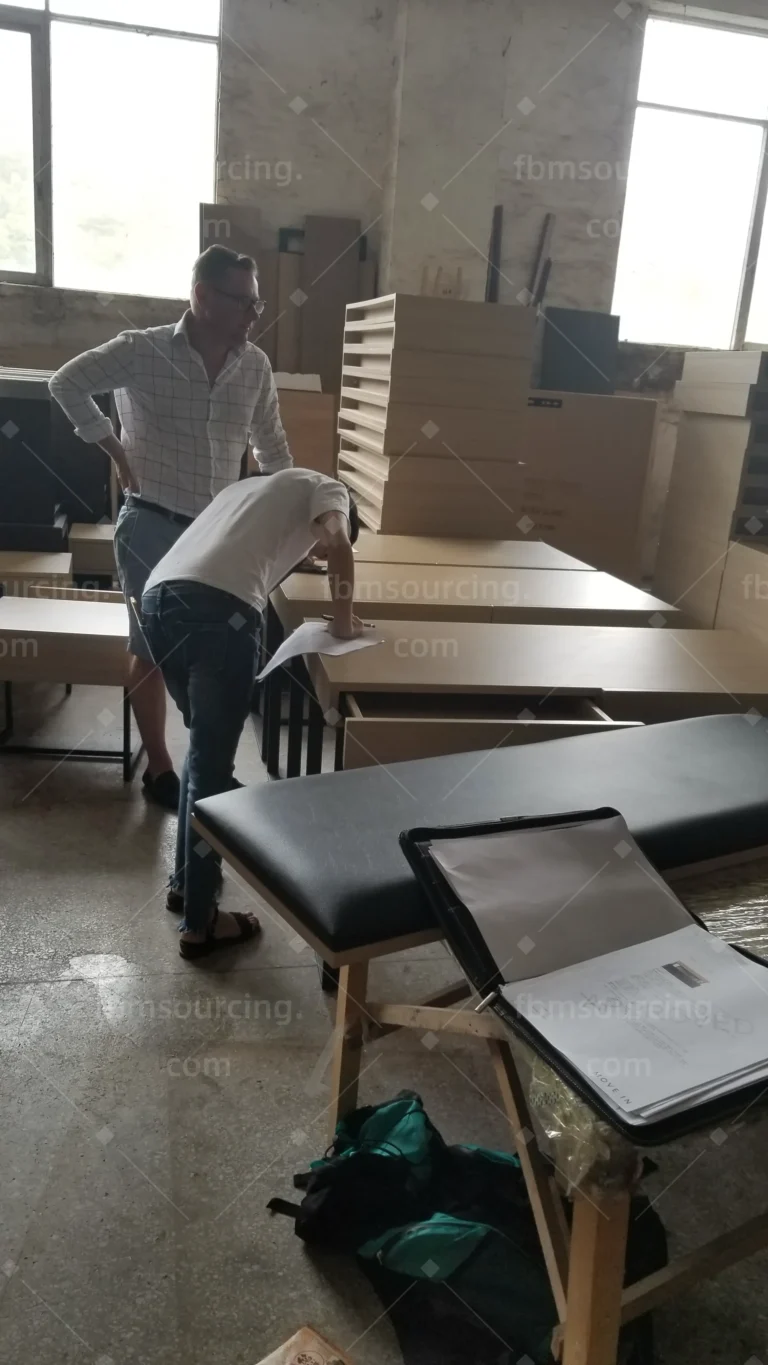
Pre-shipment inspection is carried out once, before loading— materials, workmanship, dimensions and finish are checked against the approved sample. On FBM Sourcing projects the inspection is carried out by our own team inside each factory, with photo and video records delivered to the client, so the owner’s team can verify quality against the approved sample without flying in. The mechanics are detailed in how factory QC and inspection works when sourcing from China.
What Are the Most Common Mistakes on Hospitality Packages?
- Starting procurement too late — a package that needs around four months from deposit to shipment (around two months for drawings and around two months for production) cannot be compressed by negotiation; late starts end in air freight premiums or a delayed opening.
- Comparing quotations that describe different products — one factory quotes a different board grade, another excludes hardware or spare parts, a third uses lighter cartons; scope must be equalised before price means anything.
- Approving production from photographs — catalogue images answer nothing about batch consistency; only a physical approved sample does.
- Forgetting OS&E and attrition stock — furniture arrives on time but the property cannot open because linen and amenities are weeks out; experienced operators also order a small allowance of spare units on high-wear FF&E items in the original run, agreed at order stage.
- Paying the balance before inspection — the inspection report should reach you before the balance is paid.
For how the purchasing-agent, buying-group and China-sourcing-partner models differ on who contracts, who is paid by whom, who inspects and who answers for the goods, see hospitality procurement companies compared.
Get a Hospitality Procurement Plan for Your Project
If you are planning a hotel, resort or serviced apartment project, send FBM Sourcing your room count, FF&E schedule or BOQ, drawings, destination port and target opening window. Our team will review it and get back to you. See our China building materials and FF&E procurement service.