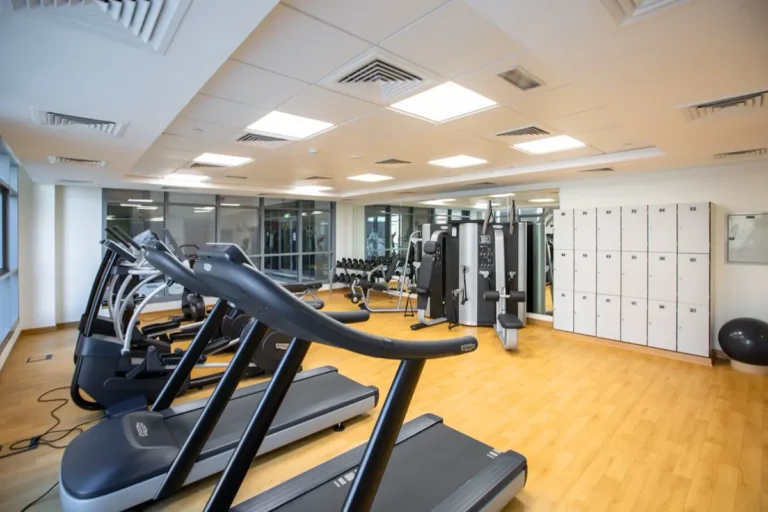
Gym and fitness chains handle gym fit-out sourcing from China by locking one standard specification — sports flooring, mirror walls, lockers, reception furniture, sanitary ware, lighting and acoustic panels — and then ordering it in batches timed to each club’s opening. The materials come from different factory clusters, so chains either manage six to eight separate suppliers themselves or run the whole package through a china sourcing agent and sourcing partner who consolidates production, inspection and container loading. The container plan is decided per site, not per product: flooring, lockers and mirrors for one club share containers.
For expanded categories, see how padel, tennis and sports club FF&E procurement works.
This guide is written for gym chain owners, developers, main contractors and fit-out contractors running multi-site programs — not for single-club buyers picking items one at a time. The economics below only work when you are opening clubs in sequence and can repeat a specification.
What Can a Gym Chain Actually Source from China?
A fitness club is closer to a materials project than a furniture project. By value and by volume, the fit-out package is dominated by flooring, wall finishes and changing-room fit-out rather than loose furniture. Here is how the package usually breaks down for fitness center FF&E procurement:
| Category | Typical specification | Procurement notes |
|---|---|---|
| Rubber sports flooring | 8 mm general zones; 10-15 mm free weights; 20 mm+ drop zones | Heavy — drives container weight, not volume |
| Vinyl sports flooring | 4-8 mm rolls for cardio, studios, stretching | Order per site with cutting-waste allowance |
| Mirror walls | 5-6 mm silvered glass with safety backing film | Crating quality decides breakage rate |
| Lockers & benches | Cold-rolled steel or 12 mm compact HPL | HPL for wet areas; steel for dry zones |
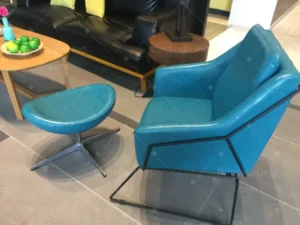
| Reception & lounge FF&E | Reception counter, seating, retail shelving | Same factories as hotel/office furniture |
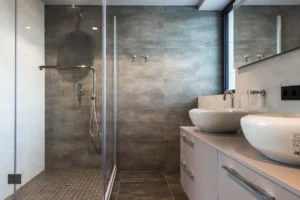
| Showers & sanitary ware | Shower panels, partitions, vanities, mixers | Match valve specs to destination plumbing codes |
| LED lighting | Linear and track fixtures, typically 100-130 lm/W | Confirm certification for destination market |
| Acoustic panels | 9 mm PET felt panels, wood slat panels | Light and stackable — fills spare container space |
Notice what is not on the list as a core category: cardio and strength machines. They can be co-loaded — more on that below — but the sourcing case for a chain rests on the materials and fit-out package, where products are bought from the factories that run the production lines — a direct price for products we source, a 5% commission for suppliers you nominate.
Rubber and Vinyl Sports Flooring: The Specification Decisions That Matter
Flooring is usually the single largest line in a gym package, and it is where buying commercial gym flooring from china rewards precision. Rubber flooring is zoned by impact: 8 mm tiles or rolls handle general training and machine zones, 10-15 mm covers free-weight areas, and dumbbell drop zones and lifting platforms step up to 20 mm or more. Specifying one uniform thickness across the club either wastes money in cardio zones or under-protects the slab under the racks.
Order quantities and attic stock
Flooring orders should carry a cutting-waste allowance per site, confirmed from the layout, and chains typically add attic stock in the club’s exact batch so future repairs match in colour. Rubber is dense — a full flooring order can max out a container’s payload weight before its volume — so your forwarder needs flooring weights per square metre, not just cubic metres, before booking.
Interlocking tiles vs rolls
Interlocking tiles install faster and tolerate imperfect slabs, which matters when a fit-out contractor is working a compressed opening schedule. Rolls give cleaner seams in cardio rows. Most chains standardise one system across all sites so installation crews stop re-learning the floor at every opening.
Lockers, Benches and Wet-Area Fit-Out
Changing rooms decide how a club feels at the price point it charges, and they are also where material selection fails first. Steel lockers for dry zones are typically fabricated from cold-rolled sheet in the 0.6-0.8 mm range — thinner gauges dent and rattle in daily commercial use. For wet and humid zones, 12 mm compact HPL (solid phenolic) is the standard board for lockers, benches and cubicle partitions because it tolerates direct moisture that would swell melamine-faced MDF within months.
Benches, vanities and shower partitions should come from the same specification conversation, because mixing suppliers freestyle produces mismatched colours and edge details across sites. This is the same discipline chains apply in restaurant chain furniture procurement for China rollouts: freeze the finishes schedule once, then repeat it.
Sourcing this for a commercial project?
FBM Sourcing works with project owners, developers, main contractors and FF&E contractors on hotel, apartment, school, office and other commercial building projects. Send us your BOQ, drawings or product list — our team will review it and get back to you.
How Should a Chain Time Gym Fit-Out Sourcing from China Across a Rollout?
The rollout calendar, not the product list, is what separates gym chain rollout procurement from one-off buying. Factory production for a typical gym package — flooring, lockers, mirrors, reception joinery — runs on the factories’ written lead times, and sea freight adds the carrier’s transit time, which depends on whether the destination is Southeast Asia, the Gulf, Australia or North America. Working backwards from each site’s fit-out schedule, a batch is placed early enough to cover production, inspection and the sea leg before materials must be on the floor.
A typical batch cycle for a chain opening clubs in sequence looks like this:
- Week 0: batch PO issued against the frozen chain specification, keyed to confirmed site handover dates
- Weeks 1-5: factory production across flooring, locker, glass and joinery factories in parallel
- Week 5: goods inspected before shipment by our own team, with photo and video records shared for sign-off
- Weeks 5-6: consolidation at one warehouse, container loading and export clearance
- Weeks 6-11: sea freight, destination clearance and delivery to site or local warehouse
Container math per club
Whether a dedicated container beats shared shipping is a comparison your forwarder quotes for the actual volume. The container count per club is set in the load plan. If a batch covers three clubs opening within the same quarter, per-site sea freight and clearance costs drop because the fixed costs spread across the batch — the same logic covered in full container consolidation for building material projects.
Treat the first club as the pilot batch
The first site in a rollout should deliberately over-invest in sampling: physical samples of every flooring thickness, a locker prototype, mirror edge and film samples, and finish plates for the reception joinery. Approving these once against the design intent means every later batch is measured against a physical golden sample rather than a PDF, which is what keeps club five looking like club one. Chains that skip the pilot step end up re-approving finishes site by site and lose the speed advantage that made China sourcing attractive in the first place.
One container, six factories
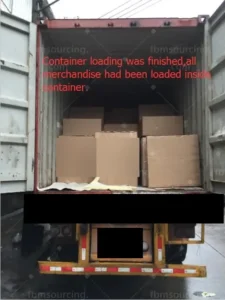
Flooring, lockers, mirrors, sanitary ware, lighting and acoustic panels come from different factories, often in different cities. Chains that ship each category separately pay loose-freight rates and receive six deliveries per site. The alternative is to consolidate multiple factories into one container: everything routes to a single warehouse, gets checked and loaded together, and arrives at each site as one delivery the fit-out contractor can program around.
Mirrors, Lighting and Acoustics: The Details That Separate Clubs
Mirror walls are specified as 5-6 mm silvered glass with a safety backing film so a broken panel holds together instead of shedding shards into a training zone — a requirement most commercial building codes impose for glazing in activity areas. Panels are cut to the elevation drawings before shipping, and the crating specification matters more than the glass itself: mirrors are the highest-breakage item in a gym container, so a small overage on panel count is cheaper than an air-freighted replacement.
LED lighting for training floors typically delivers 100-130 lumens per watt, which is why chains replacing older fluorescent schemes see meaningful power savings across a 24-hour club. Certification must match the destination market — CE for Europe, UL-listed fixtures for North America, RCM for Australia — and that requirement belongs in the PO, not in a conversation after arrival.
Acoustics is the most under-specified category in gym fit-outs. Music zones, spin studios and free-weight areas generate complaints in mixed-use buildings, and 9 mm PET felt panels or slat systems on walls and ceilings are the standard treatment. They are light and stack flat, so they ride in the spare volume of the main container. Specification options are covered in our guide to PET fabric and wood slat acoustic panels for commercial projects.
Where Do Cardio and Strength Machines Fit In?
Fitness equipment is a different procurement animal from fit-out materials. Chains usually hold separate agreements with equipment brands for warranty, servicing and member-facing branding reasons, and equipment carries its own standards track — EN ISO 20957, which replaced most of the EN 957 series, is the reference standard set for stationary training equipment in many markets. FBM Sourcing’s core scope for gym projects is the building materials and FF&E package; where a chain does buy Chinese-made racks, benches or plate-loaded pieces, we can co-load them in the same consolidated containers as the fit-out goods, but we position that as freight efficiency, not as an equipment supply program. Deep equipment selection stays with the chain’s fitness team.
How the Buying Model Works for a Chain
Most chains that source well from China do not run it with in-house staff flying between factory cities. They appoint a building material sourcing agent working on FBM Sourcing’s model — a 5% commission for suppliers you nominate, a direct price for products we source for you: the agent quotes the frozen specification across vetted factories, manages production against the rollout calendar, and every batch is inspected before shipment by our own team, with photo and video records tied to the PO so the chain signs off remotely before containers are sealed.
For a chain, the compounding benefit is repetition. The second club’s batch reuses the first club’s approved samples, packing method and container plan, so procurement effort per site drops while consistency across sites rises — the exact pattern we run for gas station chain building materials and fixtures, where identical branded sites open on a rolling schedule. The mechanics of scoping, quoting and managing a full package are laid out by our china sourcing agent for building materials and FF&E service page.
Get a China Procurement Quote for Your Project
If you are opening or expanding a gym or fitness chain and want one accountable partner for the flooring, lockers, mirrors, sanitary ware, lighting and acoustic package, send us your drawings, quantities, destination port and rollout timeline. FBM Sourcing will map your specification to vetted factories, structure the batches around your opening dates, and give you a consolidated quotation on a 5% commission for suppliers you nominate (products we source for you are quoted at a direct price) model — with every shipment inspected before shipment by our own team, with photo and video records, before it leaves China.