Padel, tennis and multi-sport club projects source most of their physical scope from China as one procurement package: sports surface systems (padel artificial turf, acrylic court coatings, timber sports floors), tempered glass court enclosures, galvanised steel structures, LED court lighting, spectator seating, changing-room lockers and benches, sanitary ware, and the reception, café and outdoor furniture that make up the front of house. A China sourcing partner consolidates these categories — each made by a different type of factory — into one quotation set, one quality-control process and one container plan to your destination port. That is the practical answer to how sports club FF&E sourcing from China works: not one factory for everything, but one accountable partner across many source production lines.
FBM Sourcing manages the entire China procurement package for overseas construction projects. For club operators — especially the padel chains now expanding across Europe, the Middle East and Australia — that means you send drawings or a BOQ and receive priced, inspected, consolidated containers, instead of managing eight or ten separate factories yourself.
The process, in five steps:
- Drawings / BOQ review — the project is split into product categories: surfaces, glass and structure, lighting, FF&E.
- Each category is quoted by factories on the matching source production line — a turf factory never quotes glass, and a glass factory never quotes lockers.
- Specifications, samples and finishes are confirmed against your drawings before production.
- FBM Sourcing’s own team inspects at the factory before shipment, with photo and video records.
- The full scope is consolidated into full containers and shipped to your destination port.
What Do Padel, Tennis and Sports Club Projects Source from China?
A club is really five or six procurement packages wearing one logo. The categories below cover a typical padel or racket-sport club; larger multi-sport venues add courts and halls but follow the same structure, and the mix overlaps heavily with what gym and fitness center chains source from China.
Court and playing surface systems
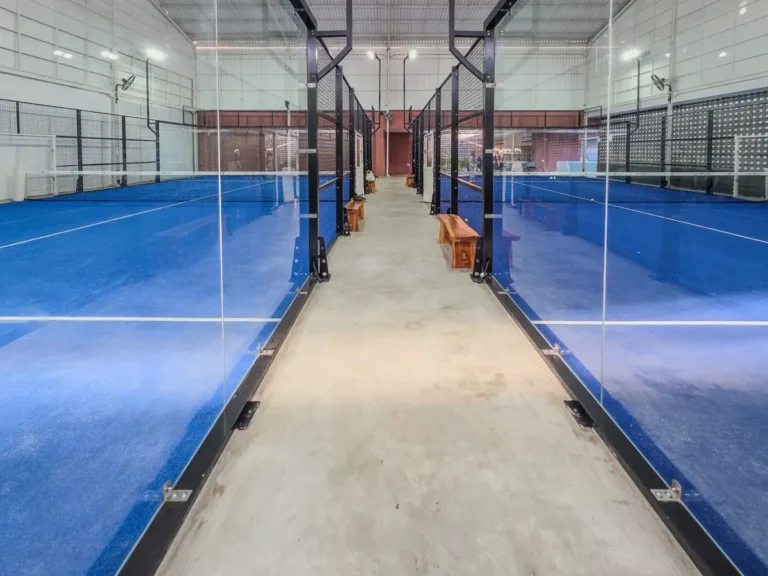
A standard padel court has an interior playing area of 20 m × 10 m, which fixes the quantities for turf, glass and structure before any design work starts. Padel courts use sand-dressed artificial turf made on dedicated sports-grass production lines; tennis projects specify acrylic hard-court coating systems or cushioned surfaces; indoor halls add timber or vinyl sports flooring. The International Padel Federation (FIP) operates an approval process for competition courts and surfaces, so clubs planning sanctioned events should specify turf that has been through FIP-recognised testing rather than generic landscape grass. China produces the large majority of the world’s hard-surface flooring exports, and the China flooring market spans every one of these systems from distinct manufacturing clusters.
Glass court enclosures and steel structure
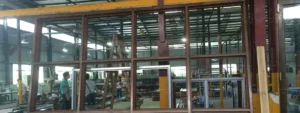
The signature element of a padel court is its glass. Under FIP court rules, the back walls run 4 m high across the full 10 m width — a 3 m lower section of tempered glass or solid material, topped by 1 m of metal mesh. The glass itself is 10–12 mm thermally toughened safety glass produced to EN 12150, pre-drilled with countersunk holes to suit the fixing system, and shipped with the hot-dip galvanised steel frame it bolts into. Because glass, steel and mesh come from different factories, this is exactly the kind of category where a single accountable procurement package earns its keep.
LED court lighting
Sports lighting is specified in lux on the playing surface, not in watts. Competition-class padel courts are lit to a minimum of roughly 500 lux with high uniformity, and television-broadcast events push towards 1,000 lux; fixtures are typically mounted on poles at 6–8 m to control glare. Club-level courts can run lower levels, but the fixture count, pole positions and drivers should be engineered against the target lux figure, and the destination market’s electrical certification checked before production rather than at customs.
Spectator seating, café and social areas
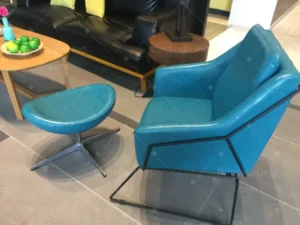
Padel is a social sport, and operators earn a large share of revenue off-court. The FF&E package therefore includes tiered or bench spectator seating, reception counters, café tables and chairs, lounge furniture, and terrace furniture for outdoor courts. For the terrace scope, see our guide to outdoor furniture manufacturers in China, and for shade over seating or between courts, outdoor pergolas from China are commonly added to the same container plan.
Changing rooms and back of house
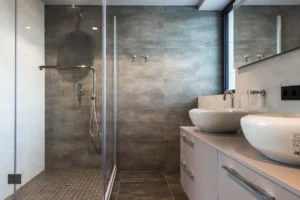
Changing rooms are a procurement package of their own: steel or HPL lockers from China, changing benches, vanity counters, mirrors, shower enclosures, sanitary ware and bathroom accessories, plus non-slip wet-area tiles. These items come from furniture, sanitary ware and tile factories respectively — three more source production lines folded into the same consolidated shipment.
Sourcing this for a commercial project?
FBM Sourcing works with project owners, developers, main contractors and FF&E contractors on hotel, apartment, school, office and other commercial building projects. Send us your BOQ, drawings or product list — our team will review it and get back to you.
Can You Source Padel Court Glass and Turf from China?
Yes — and in practice most of the world’s new padel courts are built with Chinese glass, steel and turf, whether the court brand on the invoice is European or not. Court glass is monolithic thermally toughened safety glass to EN 12150, normally 12 mm for back walls, carrying an EN 12600 impact classification, with heat-soak testing to EN 14179 available as an option for high-use venues. Panels are produced to tight dimensional tolerances with countersunk fixing holes matched to the frame design, which is why glass and steel structure should always be engineered and quoted together, never as two disconnected purchases.
Turf is the same story from a different production line. Padel-specific artificial grass — usually sand-dressed monofilament or fibrillated yarn — comes from factories that run sports turf exclusively, and the roll widths, pile height and infill specification are confirmed against the court drawings before production. A competent China sourcing agent will also flag the FIP approval question early: recreational courts do not need it, but a club that wants to host sanctioned tournaments should lock a compliant surface specification at the RFQ stage, because changing turf after the courts are built is the most expensive way to discover the difference.
How Does Padel Club Procurement from China Work, from BOQ to Delivered Containers?
The working sequence on a real project looks like this:
- 1. Drawings and BOQ review. Court layouts, hall sections and interior drawings are broken into a category-by-category procurement list with quantities.
- 2. Category-matched RFQs. Each category goes to factories on its own source production line — turf, glass, steel, lighting, seating, lockers, sanitary ware — and comes back as comparable quotations.
- 3. Specification lock and samples. Finishes, colours, yarn samples, glass drawings and photometric layouts are confirmed in writing before any deposit-stage production planning.
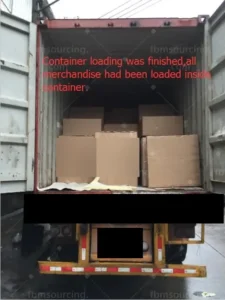
- 4. Production and inspection. One inspection is carried out by FBM Sourcing’s own team at each factory once bulk production is finished, before shipment, with photo and video records.
- 5. Consolidation and shipping. Finished goods from all factories are consolidated and loaded for the destination port.
On volumes: a single padel court’s glass, steel, mesh and turf is a dense, heavy load that containerises well. Sometimes, on a large project, the padel court materials alone fill full containers; sometimes the padel court materials share containers with the other product categories of the same project; and sometimes, in one batch, we combine a dozen or more product categories from several projects of the same client into a few containers — always full containers, and for us this is routine, well-practised work.
On timing: glass, steel, turf and furniture categories run in parallel, and each lead time is confirmed by the factory in writing. Sea freight is added on top by route, so operators planning a multi-club roll-out usually anchor the China package to the build-out programme several months before each opening date.
Which Standards and Certifications Matter for Sports Club Products?
Standards do two jobs on a sports club project: they keep players safe, and they keep containers out of trouble at the destination. The ones that matter most:
- EN 12150 — thermally toughened soda lime silicate safety glass; the reference standard for padel court glass, with EN 12600 impact classification and optional EN 14179 heat-soak testing.
- EN 12193 — sports lighting; competition-class courts at a minimum of about 500 lux with high uniformity.
- FIP approval — the International Padel Federation’s homologation route for competition courts and surfaces.
- EN 16139 — strength and durability for non-domestic seating, relevant to café, lounge and spectator furniture in Europe.
- Destination electrical certification — CE-marked drivers and fittings for Europe; for Australian padel projects, SAA certification for lighting and electrical products before production, not after arrival.
Factories on genuine sports-product lines hold current type-test reports against these standards; part of the RFQ stage is checking that the report matches the exact product being quoted — same glass thickness, same yarn, same fixture family — and that it has not quietly expired.
Marina and yacht clubs follow the same members-club pattern but add a corrosion specification that governs every exposed item; that package is described in how procurement works for marina and yacht club fit-out projects.
Frequently Asked Questions
Can you source padel court glass and artificial turf from China?
Yes. Padel court enclosures use 10–12 mm tempered glass produced to EN 12150, with panels pre-drilled for the steel frame, and padel turf comes from dedicated artificial grass production lines. Both categories ship together with the steel structure, lighting and FF&E in the same full containers, so a complete court package arrives as one consolidated shipment.
What certifications matter for sports flooring and court lighting?
For court glass, EN 12150 with an EN 12600 impact classification is the key reference. For lighting, EN 12193 governs sports lighting, and competition-class padel courts are lit to a minimum of about 500 lux with high uniformity; Australian projects also need SAA-approved electrical products. If the club plans sanctioned tournaments, specify turf that has passed the International Padel Federation (FIP) approval process.
Do you handle the whole club package or only the court materials?
The whole package. A padel or sports club project typically combines court surfaces, glass walls, steel structure, LED lighting, spectator seating, changing-room lockers and benches, sanitary ware, and reception, café and outdoor furniture. FBM Sourcing quotes each category from the matching source production line, inspects everything with its own team, and consolidates the full scope into full containers to your destination port.
How long does production take for a sports club procurement package?
Court glass, steel structure, turf and furniture categories run in parallel rather than one after another, and each lead time is confirmed by the factory in writing. Sea freight is then added on top depending on the route, so most clubs plan the China package around their build-out programme several months ahead of opening.
Get a China Procurement Quote for Your Project
If you are developing a padel club, tennis centre or multi-sport venue — a single site or a chain roll-out — send us your drawings, BOQ or product list with quantities, destination port and timeline. FBM Sourcing will map the scope to the right source production lines, return category-by-category quotations, and manage inspection and consolidated full-container shipping as one accountable package. Use the quote button above or message us on WhatsApp to start with your project details.