FBM Sourcing, your China sourcing partner, ships project orders by full container. The minimum order is one consolidated full container load, and everything inside it belongs to the same client. How much packed cargo a 20ft or 40HQ container takes is set in the load plan. Whether a single product category fills a container on its own or not, the answer on a project order is the same: the box gets filled with that client’s own goods.
Sometimes, on a large project, the tiles alone fill full containers; sometimes the tiles share containers with the other product categories of the same project; and sometimes, in one batch, we combine a dozen or more product categories from several projects of the same client into a few containers — always full containers, and for us this is routine, well-practised work.
One Container, One Client
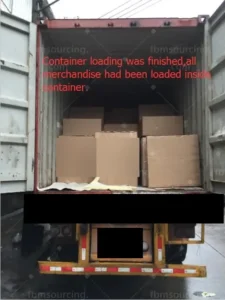
With a full container load the box is loaded with one client’s goods only, sealed at the consolidation warehouse, and not opened again until it reaches the destination. That is the standard method for hotel, apartment, school, office and other commercial project orders — tiles, cabinetry, doors, sanitary ware, lighting and furniture drawn from several specialist factories and loaded into one or more 20ft or 40HQ containers. It gives full control over load sequencing, so goods come off the truck in the order the site needs them for installation, and it removes the handling that loose cargo picks up when it is re-stowed at shared depots.
What Happens When One Category Does Not Fill a Box on Its Own?
It gets consolidated — not shrunk. Three situations cover almost every project package:
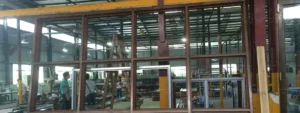
- The category fills containers by itself. On large projects a single category routinely runs to several full containers: aluminium windows on a hotel, or tiles on a mid-rise, where one category can reach container quantities on its own.
- The category shares the container with the rest of the same project. Doors, hardware, sanitary ware and lighting for the same building are received, inspected and loaded together, so the project still ships as a full container rather than as scattered small consignments.
- Several projects of the same client are combined in one batch. A dozen or more product categories across a client’s projects are brought into the warehouse in the same window and loaded into a few containers together. This is ordinary, well-practised work for FBM Sourcing, not an exception — and it is the reason a buyer with several sites running at once does not end up paying for half-empty boxes.
What does not happen is mixing one client’s project goods with another shipper’s cargo. Every container we load carries one client’s goods.
Sourcing this for a commercial project?
FBM Sourcing works with project owners, developers, main contractors and FF&E contractors on hotel, apartment, school, office and other commercial building projects. Send us your BOQ, drawings or product list — our team will review it and get back to you.
Key Facts About Full-Container Project Shipments
- Practical capacity: how much packed cargo a 20ft or 40HQ container takes is set in the load plan for your actual cartons.
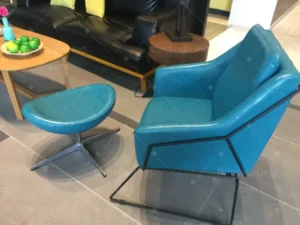
- Multi-factory consolidation: goods from several specialist factories are received, checked against packing lists and loaded as one shipment — standard practice for whole-project orders spanning tiles, cabinetry, sanitary ware and furniture.
- One set of documents: one container means one bill of lading and one customs entry, instead of one document set per factory.
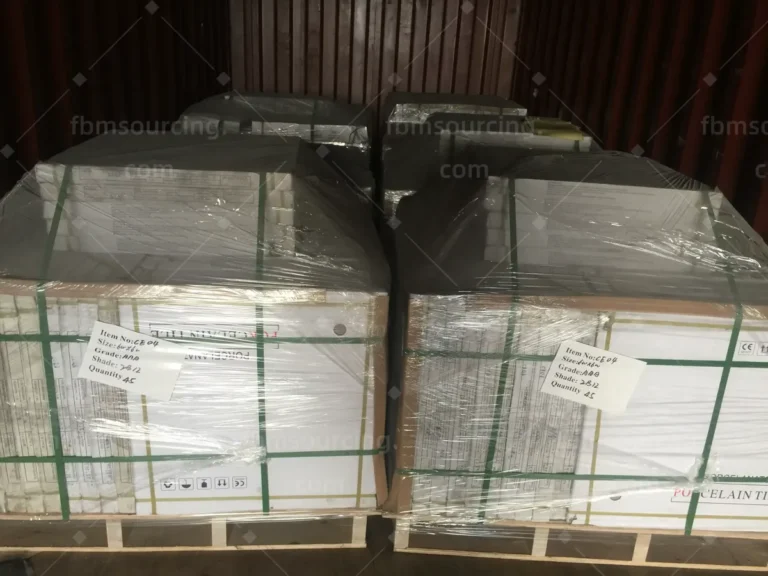
- Loading sequence is a decision, not an accident: heavier floor-level items such as tile pallets go in first, fragile crated items such as cabinetry and sanitary ware are stacked and blocked above, and the order is set against how the site will unload.
- Schedule: a consolidated container leaves when the slowest factory in the load plan finishes, so production dates across the package are aligned before loading is booked, not after.
How Does Multi-Factory Consolidation Work for a Project Order?
Most whole-project procurement — a hotel FF&E package, an apartment building’s cabinetry and fixtures, a school’s material package — draws on multiple specialist factories that each produce one category. As a building material sourcing agent, FBM Sourcing receives finished, inspected goods from each factory at a consolidation warehouse, sequences them for loading, and loads everything into full containers — turning several separate factory outputs into a single, trackable shipment with one arrival date. Our own team inspects at the factory before shipment, with photo and video records, so nothing enters the container that has not been checked against the drawings and the approved samples.
Get a Quote for Your Project
Send us your product list or BOQ, estimated volume and destination port, and our team will review it and get back to you about your China procurement project. See a multi-category consolidation in practice in our municipal outdoor FF&E case study, where six product categories from six factories shipped as 3 x 40HQ.