Fixed FF&E is the furniture and joinery that is physically attached to the building — headboard walls, wardrobes, vanities, built-in desks, reception desks, bar counters and feature panels — and it normally sits inside the main contractor’s or joinery subcontractor’s package. Loose FF&E is everything movable — beds, case goods, seating, tables, lamps, artwork, mirrors, drapery, mattresses and outdoor furniture — and it normally sits in the owner’s FF&E procurement package. The split decides who buys each item, how it is coded at customs, which trade installs it and when it has to leave China. FBM Sourcing operates as a sourcing agent and sourcing partner, not a trading company.
What Counts as Fixed FF&E and What Counts as Loose FF&E?
The working test on most hotel projects is simple: if the item has to be screwed, glued, scribed or plumbed to the structure to work, it is fixed; if you could carry it out of the room without tools, it is loose. Brand-standard FF&E matrices for the major hotel operators use the same “attached versus unattached” logic, sometimes written as “built-in” versus “movable” or “FF&E versus millwork”. If you are new to the vocabulary, our explainer on what FF&E means on a construction project covers the base terms.
The reason the split is treated so seriously is contractual rather than semantic. Fixed items depend on the building being at a certain stage; loose items depend on the building being finished. Putting them in the same package with the same delivery date is how projects end up with 200 wardrobes waiting on a slab that is not yet plastered.
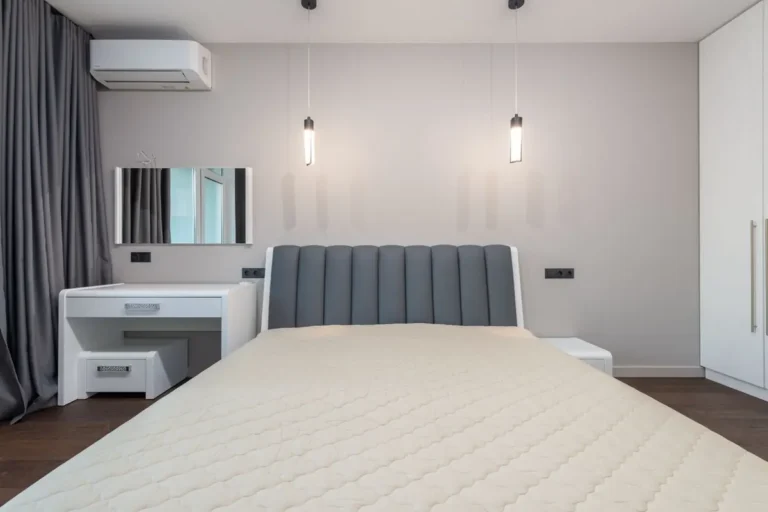
- Fixed / built-in FF&E: headboard walls and upholstered wall panels, wardrobes and closets, bathroom vanities and vanity tops, built-in desks and luggage units, minibar housings, TV feature walls, reception desks, back bars and bar counters, restaurant banquettes on plinths, decorative wall and ceiling panels.
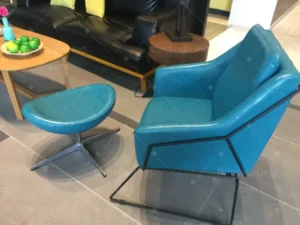
- Loose / movable FF&E: bed bases and mattresses, freestanding case goods (nightstands, dressers, freestanding desks), lounge and dining seating, occasional and dining tables, table and floor lamps, artwork and mirrors, drapery and sheers, outdoor furniture, decorative accessories.
- Typical package owner: fixed items under the main contractor or joinery subcontractor (often Division 06); loose items under the owner or a dedicated FF&E contractor (Division 12).
- Typical sequencing gap: fixed items are needed on site well before loose items, because installation follows the wet trades while loose furniture only goes in after floor finishes and final clean.
- Customs treatment: movable furniture is generally classified under HS Chapter 94 (9401 seating, 9403 other furniture, 9404 mattresses, 9405 lighting), while built-in joinery for permanent installation is often classified under HS 4418 as builders’ joinery, which can attract different duty rates and paperwork.
Where the Line Is Drawn in the Contract
In North American practice the split follows CSI MasterFormat. Architectural woodwork — wardrobes, vanities, reception desks, wall panelling — is specified under Division 06 40 00 (Architectural Woodwork), while movable furnishings are specified under Division 12 00 00 (Furnishings), which is why “Division 12” is shorthand for the owner’s FF&E package on so many hotel jobs. UK and Middle East projects reach the same outcome through a joinery package in the main contract and a separate FF&E schedule issued by the interior designer.
The second instrument is the operator’s brand-standard FF&E matrix. Every branded hotel prototype comes with a room-by-room schedule that tags each item as contractor-supplied, owner-supplied or operator-supplied (OS&E and technology are usually the operator’s list). A 150-key select-service prototype will typically list 60-90 distinct FF&E line items per guestroom type across fixed and loose, and the tag on each line is what your procurement package inherits. The CSI MasterFormat structure is the reference most consultants cite when the tags are disputed.
The practical rule: whichever document is contractually superior wins. If the FF&E matrix says “headboard — owner” but the joinery specification also draws the headboard as part of the bedhead wall, that conflict has to be resolved before tender, not after the joinery factory has cut the panels.
Who Buys What: Owner, GC, FF&E Contractor and Operator
Four parties can hold purchasing responsibility on a hotel, and the split rarely maps one-to-one onto fixed versus loose. The general contractor usually buys and installs the Division 06 joinery because it is on the critical path with drywall, MEP and finishes. The owner buys Division 12 loose furniture directly, or appoints an FF&E contractor or purchasing agent to do it. The operator supplies technology, signage and OS&E under its own agreements. On owner-developed China packages, the owner frequently pulls the joinery out of the GC’s scope and procures it alongside the loose furniture, precisely because both come from the same Chinese production clusters.
The table below shows where the common items land on most projects, who tends to buy them, and the sequencing note that matters when the goods are coming by container. Sailing times, which the carrier confirms at booking, carry the offset straight through: a fixed item that must be on site weeks before the loose furniture has to leave the factory that much earlier as well.
| Item | Typically fixed or loose | Who usually procures | Sequencing note |
|---|---|---|---|
| Headboard wall / upholstered wall panel | Fixed (grey zone if wall-hung only) | GC or joinery sub; often owner on China packages | Needs site measurement after framing; ships with joinery wave |
| Wardrobe / closet | Fixed | GC or joinery sub; owner on China packages | Site-measured; installs before flooring in many specs |
| Bathroom vanity and top | Fixed | GC (plumbing coordination) | Must be on site for plumber second fix |
| Built-in desk / luggage unit | Fixed | GC or owner | Ships with joinery; power and data cut-outs coordinated |
| Reception desk / bar counter | Fixed | GC or owner (feature joinery) | Longest shop-drawing cycle; ships first |
| Bed base and mattress | Loose | Owner / FF&E contractor | Lands shortly before install; keep in dry warehouse |
| Nightstands, dressers, freestanding desks | Loose | Owner / FF&E contractor | Fully assembled; room-by-room labelled |
| Lounge, dining and desk seating | Loose | Owner / FF&E contractor | Fire-test certificates travel with the shipment |
| Table and floor lamps | Loose (grey zone: wall sconces) | Owner / FF&E contractor | Electrical certification per destination market |
| Artwork and mirrors | Loose (grey zone: full-height fixed mirrors) | Owner / FF&E contractor | Crated; installs after final paint |
| Drapery, sheers, blackout | Loose (tracks often fixed) | Owner / FF&E contractor | Tracks ship with joinery; fabric ships with loose wave |
| Outdoor furniture | Loose | Owner / FF&E contractor | Often the last container; can be held at factory |
Sourcing this for a commercial project?
FBM Sourcing works with project owners, developers, main contractors and FF&E contractors on hotel, apartment, school, office and other commercial building projects. Send us your BOQ, drawings or product list — our team will review it and get back to you.
Why the Fixed/Loose Split Matters More on a China Order
When both scopes are bought locally, a blurred split costs a few phone calls. When both scopes are coming from China in the same procurement programme, a blurred split costs container space, duty and weeks of programme, for four reasons.
Customs classification differs. A wardrobe declared as furniture under HS 9403 and the same wardrobe declared as builders’ joinery under HS 4418 can carry different duty rates and different documentation in the destination country. Mixing fixed joinery and loose furniture on one commercial invoice without line-level HS codes is one of the commonest causes of a hold at destination. Fabric-covered headboards, mattresses and upholstered seating also carry their own fire-test paperwork — CAL 117-2013 or 16 CFR 1633 for the US, BS 5852 or BS 7177 for the UK — that a joinery line does not.
Installation trades differ. Fixed items are installed by carpenters and joiners working to the GC’s programme, coordinated with plumbers and electricians for vanities, minibar housings and desk power. Loose items are placed by an FF&E installation crew after handover of the rooms. If the wrong party receives the wrong container, the goods sit in the wrong warehouse under the wrong insurance.
Sequencing differs. Fixed joinery ships in the first wave so it can be installed while the building is still a construction site; loose furniture should land shortly before the room-by-room install so it is not stored on site for months. On a 120-key hotel this typically means the joinery wave leaving China well ahead of the loose wave, with the last loose containers timed to arrive after the floors are laid and the rooms are clean. Our guide to FF&E delivery, warehousing and installation on a hotel project covers the receiving side in detail.
Site measurement dependency. Wardrobes, vanities, headboard walls and reception desks cannot go into production until the walls they fit against exist and have been measured. Loose furniture can be produced from the drawings alone. That single difference means the two scopes have different release dates for shop drawings, different deposit dates and different production windows, even inside one purchase order. See how site measurement gates custom joinery production for the typical measure-to-cutting timeline.
The Grey-Zone Items and How to Allocate Them
A handful of items sit on the fence on nearly every hotel and cause most of the disputes. The rule we apply is to allocate by installation dependency, not by what the item is called.
Wall-mounted headboards. A headboard bolted to a French cleat on a finished wall is loose in behaviour: it does not need site measurement, it can go in with the bed. A headboard that forms the full bedhead wall with integrated lighting, switches and nightstands is fixed. Decide by whether an electrician has to be present when it goes in.
Minibar cabinets and luggage benches. If the minibar housing is part of the desk or wardrobe run, it is fixed and belongs with the joinery, with the minibar unit itself supplied loose by the operator’s OS&E list. A freestanding luggage bench is loose; a fold-down luggage rack screwed to the wardrobe end panel is fixed.
TV panels and feature walls. The panel and cable management box are fixed and go with the joinery wave; the television is technology under the operator’s package. Coordinate the cut-out size early because a 55-inch and a 65-inch set need different apertures. Running both scopes through one ff&e procurement china package is what keeps the joinery wave and the loose wave on the same programme instead of two unrelated delivery dates.
Bathroom accessories. Towel rails, robe hooks, tissue holders and grab bars are screwed to tiled walls and are normally treated as fixed under the plumbing or bathroom fit-out package, even though they are small and light. Vanity mirrors with integrated lighting are fixed; a framed decorative mirror is loose.
Lighting. Ceiling and wall lights are electrical fit-out, not FF&E; table and floor lamps are loose FF&E; bedside reading lights integrated in the headboard travel with whichever package owns the headboard. Ship lamps with the loose wave but make sure plugs, voltage and the destination’s electrical mark are locked at the shop-drawing stage. The number of rooms of loose FF&E per 40HQ container is set in the load plan; joinery is denser and heavier, which is another reason it ships in its own containers.
How to Write the Split into Your BOQ
The split has to live in the bill of quantities, not in an email chain. Five lines cover it:
- Tag every FF&E line F or L (fixed or loose) in a dedicated column, and add a third code, G, for grey-zone items that must be resolved before tender.
- Name the procuring party per line — owner, GC, FF&E contractor or operator — so the tag and the buyer are always read together.
- State the installation dependency for each F line: “after framing and first fix”, “before floor finish”, “with plumbing second fix”. This drives the shipping wave.
- Split the delivery dates into waves: joinery wave, loose wave one (case goods and beds), loose wave two (seating, lamps, artwork, outdoor). Put a required-on-site date on each wave, not on the package.
- Add the HS code and certification reference per line so the commercial invoice, packing list and test certificates can be produced directly from the BOQ without re-classification at the port.
Written this way, the same BOQ becomes the RFQ to the factories, the packing plan for the containers and the receiving checklist at the warehouse. If you are still building the schedule, our breakdown of what a hotel FF&E package from China includes lists the line items most projects carry.
One China Procurement Package, Two Scopes, the Same Containers
The point of separating fixed and loose is not to buy them from two different places. Guangdong’s furniture and joinery clusters produce both, often within a few kilometres of each other, and a single China procurement package can carry both scopes as long as someone on the ground manages the split. FBM Sourcing manages the entire China procurement package for overseas construction projects. That means one contract that holds the joinery factory, the case-goods factory, the seating workshop and the soft-goods maker on separate production calendars, with our own team carrying out one full inspection at the factory once production is finished, with photo and video records before anything is loaded.
In practice we run the joinery and the loose furniture as two waves under one order. Joinery shop drawings are released as soon as site measurements arrive and production runs on the factory’s written lead time after approval; loose case goods and seating run on their own written lead time from deposit and are held at the factory until the loose wave is called. Fixed and loose items can share a container when the destination programme allows — wardrobes and nightstands for the same floor in the same box, labelled by room — but more often the joinery fills its own containers and the loose furniture follows later, so the GC and the FF&E installer each receive exactly the goods they are responsible for. A China sourcing agent that manages both scopes also keeps one HS-coded invoice per container, which is what keeps customs clean at the other end.
The budget side follows the same logic. Because fixed joinery is site-measured, custom and heavy, it usually represents a larger share of the per-key figure than its line count suggests, while loose FF&E is where quantity discounts and standardised models do the work.
Once the fixed and loose scope is split, the box-built guestroom pieces, headboards, nightstands, wardrobes, desks, luggage benches and minibar cabinets, usually go to one kind of plant. Our guide to hotel casegoods manufacturers in China sets out the manufacturer types and the product evidence to request from each.
Get a China Procurement Quote for Your Project
If your hotel, aparthotel or serviced-apartment project has a fixed and loose FF&E scope to source from China, send us the joinery drawings, the FF&E schedule or BOQ with the F/L tags if you have them, room counts and quantities, the destination port and the site programme with the required-on-site dates for the joinery wave and the loose wave. Our team will review the package, flag the grey-zone items that need a decision, and set out how the two scopes would be produced, inspected and shipped under one procurement package.
Use the quote button above or WhatsApp +86 135 6007 5057 to start the conversation.
FBM Furniture
If your package is mainly fixed furniture and joinery, see fixed furniture and joinery on fbmfurniture.com, the site of FBM Furniture, the furniture sourcing line of FBM Sourcing Limited.