A pre-order factory audit for a construction or hospitality project answers one question: can this factory produce this specific scope, to this specification, in this window, and prove it afterwards. It covers five blocks — legal and trading status, physical production capability, quality system and in-process controls, compliance documentation for the destination market, and commercial and capacity fit against your programme. It is not a walk-through and it is not a questionnaire: on a container-scale package the audit is where the shortlist gets cut, because a factory that cannot show a moisture-content log, a spray-booth schedule or a valid type-test report for the specified standard will not be able to produce them later when the submittal is due. This kind of coordination is what a sourcing partner like FBM Sourcing is for.
What Is a Pre-Order Factory Audit Actually For?
On a project order the audit has a narrow purpose, and confusing it with a general supplier assessment is what makes audits feel like paperwork. It exists to convert claims into evidence before money moves.
Three practical reasons it sits before the purchase order rather than after:
- Capability is scope-specific. A factory that produces excellent case goods in melamine may have no veneer press, no dedicated finishing line, and no experience with the fire-performance documentation a hotel corridor needs. Capability is verified against your BOQ, not in general.
- Capacity is calendar-specific. A monthly output figure is meaningless without knowing what is already committed. The relevant number is free capacity in the months your programme needs, and that only exists as an answer on a specific date.
- Documentation cannot be created retrospectively. Type-test reports, material certificates and traceability records either exist within a valid period or they do not. Discovering the gap at submittal stage costs a re-test cycle the programme has not allowed for.
An audit at this stage is also the cheapest point at which to change your mind. Once tooling is cut and deposits are paid, the options narrow to managing a problem rather than avoiding it.
What Does a Pre-Order Factory Audit Cover?
1. Legal and trading status
The business licence is checked for the 18-digit unified social credit identifier, the registered scope of business, registered capital and the legal representative, and the record is cross-checked against the national enterprise credit system rather than accepted as a photograph. Separately, the audit confirms whether the entity holds its own customs registration and export rights, or whether it exports through an agent — a distinction that determines whose name can legitimately appear on export documents and who can issue a VAT export invoice. Where the manufacturer and the trading entity are different companies, that relationship needs to be stated on paper before contracts are drafted, not discovered when a bill of lading is issued.
2. Physical production capability
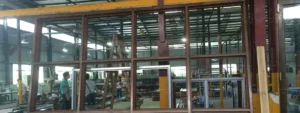
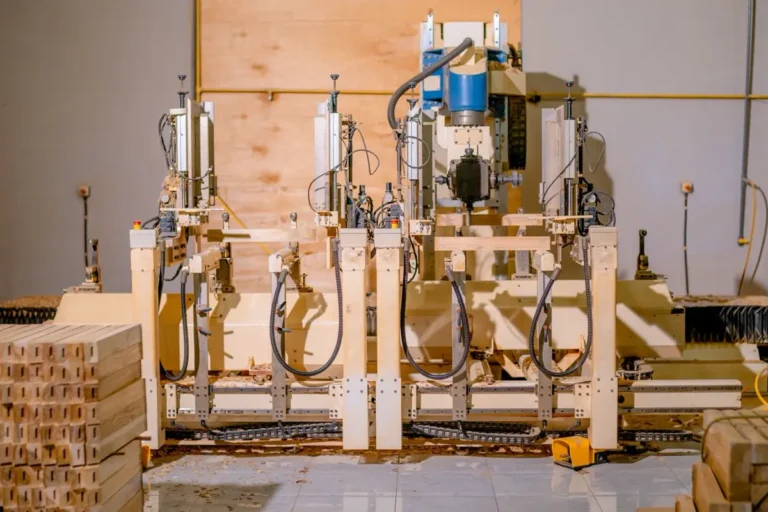
This block is walked, measured and photographed rather than described. For furniture and joinery the audit records the panel processing line (beam saw, CNC router, edgebander and the throughput each is rated for), whether there is a veneer press and a dedicated sanding line, the number and type of finishing booths, whether drying is by open-air, UV or oven, and whether there is a climate-controlled area for assembly. For solid wood it records the kiln and, critically, the moisture-content meter and its log — timber for interior use in a conditioned building needs to be kiln-dried to the moisture content stated in the specification and measured at inspection, and a factory with no log has no process.
For building materials the equivalents differ by category: for aluminium windows it is the extrusion source, the thermal-break line, the corner-crimping and welding stations and the water-test rig; for tile it is the press tonnage, kiln length and the rectification line; for sanitary ware it is the casting, glazing and firing sequence plus the pressure-test bench. In every case the question is the same — is the process step that your specification depends on physically present on this site.
3. Quality system and in-process controls
An ISO 9001:2015 certificate is a starting point, not a finding. What matters is whether the documented system is the system actually running: are there incoming material inspection records, are there in-process check sheets at the stations where defects are created rather than only at final, is there a non-conforming material area that is actually used, and is there a rework log that shows what went wrong last month. A factory whose quality file is immaculate and whose rework log is empty is usually not recording rework.
The audit also fixes the sampling basis that will be used later. Pre-shipment inspection on project orders is normally run on ISO 2859-1 sampling with an agreed acceptance quality limit and a defect classification agreed in writing — our explanation of AQL sampling on pre-shipment inspection covers how the sample size and accept/reject numbers are derived. Agreeing that at audit stage removes the most common argument at the container door.
4. Compliance documentation for the destination market
Here the audit is checking for specific, current documents against the standards named in your specification — not a general claim of compliance. For hospitality and commercial interiors that usually means upholstery flammability to CAL TB 117-2013 or BS 5852, reaction-to-fire classification to EN 13501-1 for wall and ceiling finishes, formaldehyde emission class for panel products, EN 1729 sizing for education furniture, and product-specific structural or weather-performance testing for windows and facade elements. The audit records the test house, the report number, the tested construction and the date, because a report on a different construction from the same factory is not evidence for your item. The distinction between a factory’s own test data and a report from an accredited laboratory is set out in our guide to factory test reports versus accredited lab testing.
5. Commercial and capacity fit
Finally the audit checks the commercial mechanics that decide whether a good factory is a good factory for this project: minimum quantities against your line quantities, whether the factory will hold finished goods while the rest of the package completes, payment terms it will actually accept, its position on tooling ownership, and how it handles a specification change mid-production. It also checks the calendar — committed orders in your production window, and whether the factory’s own shutdown schedule intersects your programme. A management-system certificate is a different document again — see what ISO 9001 and ISO 14001 certificates mean on a Chinese factory quote.
Sourcing this for a commercial project?
FBM Sourcing works with project owners, developers, main contractors and FF&E contractors on hotel, apartment, school, office and other commercial building projects. Send us your BOQ, drawings or product list — our team will review it and get back to you.
How Is Capacity Verified Rather Than Claimed?
Stated capacity is the single most over-reported figure in Chinese manufacturing, and it is also the easiest to test on site. Capacity is verified by triangulation, not by asking.
- Bottleneck arithmetic. Output is set by the slowest station, usually finishing rather than machining. Counting spray booths, curing racks and drying time per coat gives a defensible ceiling regardless of how many CNC machines are on the floor.
- Physical evidence of throughput. Raw board and profile stock on hand, work-in-progress on the floor, finished-goods area, and whether the packing line is running are all observable. A factory claiming high monthly output with an empty finished-goods area and no inbound stock is claiming a peak, not a rate.
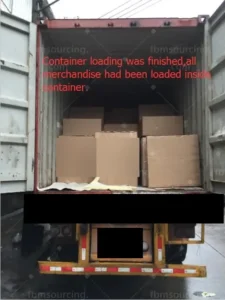
- Container conversion. Project capacity is ultimately measured in containers, not units. A package expressed in cubic metres converts, through the load plan, into how many container loads the factory has to produce and when. Our guide to 40ft container loading, CBM and weight limits sets out that conversion.
- Calendar overlay. Committed orders in your window, staffing at that time of year, and the annual shutdown. The Chinese New Year shutdown removes weeks of effective capacity every year and its effect on programmes is set out in Chinese New Year factory shutdown, production and shipping.
The output of this exercise should be a number your programme can use: how much of your scope this factory can complete in each month of your window, with the constraint named. “Yes we can do it” is not that number.
What Does a Factory Audit Not Tell You?
Being clear about the limits is what keeps an audit useful rather than reassuring.
An audit is a snapshot. It tells you the factory’s state on the day, with the staffing and order book of that week. It does not guarantee the twelfth container is built like the first, which is why an audit is the beginning of a control regime rather than a substitute for one. It also does not price the work: a strong factory audit result and a competitive quotation are independent findings, and a package should be evaluated on both. Comparing offers on the same basis is a separate discipline — see how to compare factory quotes from China like for like.
Nor does an audit remove the need for a full pre-shipment inspection. The purpose of the audit is to establish that the controls can work; the purpose of inspection is to confirm that on this order they did. Our page on factory QC and inspection in China sourcing covers how the two connect across a production cycle.
How FBM Sourcing Runs Factory Audits for Project Orders
FBM Sourcing manages the entire China procurement package for overseas construction projects, and factory auditing is one of the stages that responsibility covers. All auditing and inspection is carried out by FBM Sourcing’s own team on site at the factory, with photo and video records delivered before shipment, and the report you receive is written by the people who stood on the floor. Your own project team is welcome to attend the inspection with us.
In practice the audit is run against your BOQ rather than as a generic template. We take the specified items, identify which production steps each one depends on, and verify those steps exist and are controlled — the press for veneered case goods, the thermal-break line for the window system, the moisture log for solid timber, the test report matching the specified construction for a fire-rated finish. Capacity is reported as free capacity in your programme months with the bottleneck named, and the sampling basis and defect classification for later inspection are agreed in writing at the same time.
Where a package spans several factories — which most project packages do — the audits are run so the results are comparable, and the weakest link in the programme is identified before the schedule is committed, because on a consolidated shipment the slowest factory sets the container date. All quotations, invoices and shipping documents are issued by FBM Sourcing — you deal with us, and we carry the responsibility. For suppliers you nominate, we charge a 5% commission; for products we source for you, we quote a direct price. Factory identities are not disclosed to new clients; when a client visits China we take them to see the products in production.
A visit answers what a supplier can make. Establishing that the entity behind the quotation is a producer at all — the credit code, the ownership chain, the production evidence and the certificate schedule — comes first, and is described in is that Chinese supplier a real factory.
Get a China Procurement Quote for Your Project
If you have a hotel, apartment, school, office or retail package to source from China and want the production capability verified before you commit, send us the BOQ, drawings or product schedule with quantities, the destination port and the required-on-site dates. Our team will identify what has to be verified for each line, run the audits, and set out the quotation.
Use the quote button above or WhatsApp +86 135 6007 5057 to start the conversation.