Structural steel and aluminium components supplied into the EU must be CE marked under EN 1090-1 — mandatory since 1 July 2014 — and the mark is only valid when the fabricator holds a Factory Production Control (FPC) certificate issued by a Notified Body under assessment system 2+, fabricates to EN 1090-2 (steel) or EN 1090-3 (aluminium) at the Execution Class the project engineer has specified, and issues a Declaration of Performance for each component. A Chinese factory can do all of this — a number of export fabricators hold EN 1090-1 FPC certificates for EXC2 and EXC3 — but the certificate, the execution class, the welding qualifications and the material traceability have to be verified for the exact scope being ordered, and purely architectural metalwork generally sits outside EN 1090 altogether. This guide sorts a typical project metalwork package into what needs the mark and what does not, lists the documents that prove it, and explains how a building material sourcing agent and sourcing partner checks them before a European order is placed.
What Is EN 1090 and Which Parts Matter to a Buyer?
EN 1090 is a family of standards; only Part 1 is the harmonised standard that triggers CE marking under the Construction Products Regulation (EU 305/2011). The others are the technical rules the fabricator works to.
- EN 1090-1:2009+A1:2011 — requirements for conformity assessment of structural components (steel and aluminium). Harmonised under the CPR; assessment and verification of constancy of performance (AVCP) system 2+: the manufacturer runs initial type testing and factory production control, and a Notified Body audits and certifies the FPC. Output = FPC certificate (with the body’s four-digit number), Declaration of Performance (DoP) and CE mark.
- EN 1090-2:2018 — technical requirements for the execution of steel structures: materials, welding, mechanical fastening, tolerances, surface treatment, inspection and testing. It defines Execution Classes EXC1 to EXC4.
- EN 1090-3:2019 — the equivalent for aluminium structures (curtain wall support frames, aluminium canopies and walkways, some balustrade structures).
- EN 1090-4 and EN 1090-5 — cold-formed thin-gauge steel and aluminium elements and sheeting (roof and wall cassettes, purlins).
- Design itself is not in EN 1090: the project’s engineer designs to EN 1993 (Eurocode 3, steel) or EN 1999 (Eurocode 9, aluminium) and specifies the execution class; the fabricator executes.
Great Britain runs the parallel UKCA regime with BS EN 1090-1 as the designated standard and a UK Approved Body in place of the Notified Body; at the time of writing CE marking continues to be recognised for construction products in GB, and Northern Ireland follows EU rules. Our guide to UKCA vs CE marking for China-made products on UK projects covers that split across the whole package.
Which Project Metalwork Needs CE Marking Under EN 1090, and Which Does Not?
EN 1090-1 covers “structural components” — elements that are designed and fabricated to carry load as part of the building structure and are placed on the market as such. A mixed hotel or office package from China usually contains both kinds, and sorting them is the first job:
- Inside EN 1090 (CE mark required): steel frames, beams, columns and trusses; mezzanine floor structures; structural stair stringers, landings and steel stair flights that carry floor load; canopy and porte-cochère primary frames; roof and wall purlins and rails; secondary steelwork such as brackets and support frames for plant, signage structures and curtain-wall support steel; aluminium structural frames under EN 1090-3.
- Generally outside EN 1090 (no CE mark under this standard): decorative metal screens and perforated panels, aluminium or steel cladding trims, non-load-bearing partitions, lift-lobby cladding, feature ceilings, letter-box banks, bollards, most handrails and balustrades, furniture frames and signage faces. These still have to meet the relevant performance rules — balustrades, for example, must resist the horizontal loads of EN 1991-1-1 and national rules such as BS 6180 and are often supplied with a load test or engineer’s calculation — but they are not CE marked under EN 1090-1. Some may fall under other harmonised standards (curtain walling kits under EN 13830; glass under EN 12150/14449).
- Grey zone: balustrade posts welded to structural stair stringers, feature stairs that are also the fire escape, and canopy frames where the “decorative” screen is also the structure. The project engineer decides; the fabricator’s certificate scope must then cover the decision.
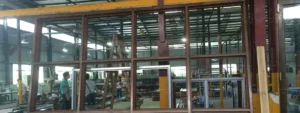
Our steel structures, metal stairs and stainless steel fabrication pages cover the product ranges; this article is about the compliance layer on top of them.
What Do the Execution Classes Mean for a Chinese Fabricator?
The execution class drives almost every requirement in EN 1090-2 — welding quality system, welder qualification, NDT extent, tolerances, traceability — and therefore the price and the shortlist of capable factories.
- EXC1 — low consequence of failure (agricultural buildings, simple sheds): EN ISO 3834-4 elementary welding quality, minimal NDT.
- EXC2 — the default for most commercial buildings: hotels, apartment blocks, offices, schools, retail. EN ISO 3834-3 standard welding quality requirements; welders qualified to EN ISO 9606-1; welding procedures qualified by WPQR to EN ISO 15614-1; a Responsible Welding Coordinator to EN ISO 14731; full traceability of material to inspection certificates; supplementary NDT on the percentage of welds EN 1090-2 sets for the weld type and utilisation, in addition to visual inspection.
- EXC3 — high consequence or fatigue-loaded structures: stadium roofs, long-span canopies, bridges, structures with dynamic loads. EN ISO 3834-2 comprehensive welding quality; higher NDT percentages; tighter control of weld sequence and distortion. Fewer Chinese fabricators hold EXC3 certificates than EXC2.
- EXC4 — extreme consequence (major bridges, nuclear): the most demanding NDT extent EN 1090-2 sets. Rare on building projects and outside the scope of most export fabricators.
Material for EU work is ordered to the European grades and certificates: structural sections and plate to EN 10025 (S235, S275, S355JR/J0/J2), hollow sections to EN 10210 (hot-finished) or EN 10219 (cold-formed), with EN 10204 type 3.1 inspection certificates and heat-number traceability to the drawing. Chinese mills produce these grades; the pitfall is a factory substituting Q235B/Q355B to Chinese GB/T 700 and GB/T 1591 without the EN 10204 3.1 paperwork, which breaks the DoP even when the mechanical properties are similar. Bolts to EN 14399 (preloaded HR/HV) or EN 15048 (non-preloaded) in grades 8.8/10.9, with CE marking of the bolting assemblies themselves. Corrosion protection to EN ISO 12944 (C3 urban, C4 industrial/coastal, C5 marine; durability “high” means 15–25 years to first major maintenance) with paint systems from Part 5, or hot-dip galvanising to EN ISO 1461 (minimum mean coating 85 µm on steel 6 mm and thicker), with dry-film thickness measured to EN ISO 2808.
Sourcing this for a commercial project?
FBM Sourcing works with project owners, developers, main contractors and FF&E contractors on hotel, apartment, school, office and other commercial building projects. Send us your BOQ, drawings or product list — our team will review it and get back to you.
How Do You Verify a Chinese Factory’s EN 1090 Certificate?
The document that makes the CE mark valid is the FPC certificate; everything else hangs off it. Check it in this order before any deposit is discussed:
- Notified Body number on the certificate appears in the EU NANDO database with EN 1090-1 in its scope (for UKCA, the Approved Body in the UKMCAB list). A certificate from an unlisted “certification company” does not support a CE mark.
- Scope lines: the certificate states the execution class(es) covered (EXC2, EXC2/EXC3), the welding processes (135 MAG, 136 flux-cored, 121 SAW, 141 TIG), the material groups and thickness ranges, and the product type (steel structures, aluminium structures, cold-formed elements). An EXC2 certificate does not cover an EXC3 canopy; a steel certificate does not cover aluminium under EN 1090-3.
- Validity and site: the certificate names the manufacturing site and is subject to annual surveillance; ask for the latest surveillance report and confirm the address is where your components will actually be made, not a head office or a trading company.
- Welding file: WPS and WPQR references, welder qualification certificates to EN ISO 9606-1 (with expiry dates), the RWC’s qualification (IWE/IWT/IWS) and the EN ISO 3834 certificate at the part matching the execution class.
- Declaration of Performance method: EN 1090-1 lets the manufacturer declare under several methods — declaring geometry and material only, declaring performance of a component the manufacturer designed, or declaring that the component is made to the purchaser’s specification and design (the usual route for a project where the engineer has designed the structure). The DoP must name the method, the standard and the essential characteristics (tolerances, weldability, fracture toughness, load-bearing capacity where declared, durability, reaction to fire).
- Quality records per batch: EN 10204 3.1 mill certificates traced to heat numbers on the cutting list, NDT reports (visual testing and the supplementary UT/MT/PT extent required by EN 1090-2, by a qualified inspector to EN ISO 9712), dimensional inspection against the EN 1090-2 Annex B essential tolerances, coating thickness records, and the CE label format with the Notified Body number, manufacturer, year and DoP reference.
Where a Chinese factory presents a mill certificate, welding report or coating log produced in-house, it is still useful evidence of control, but it is not the same as the certificate behind the mark; factory test reports vs accredited lab testing explains the weight each document carries.
What Happens on the EU Side After the Container Arrives?
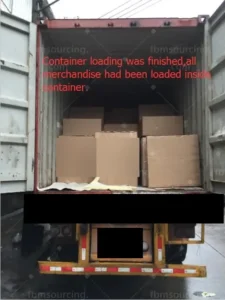
The EU-established business that places the components on the market — normally the developer, main contractor or steelwork sub-contractor buying from China — is the importer under the CPR. The importer must ensure the DoP and CE marking are in place, indicate its own name and address on the product, packaging or accompanying documents, keep the DoP and technical documentation for 10 years, and cooperate with market surveillance. Site erection then follows EN 1090-2 as well (bolting, site welding, alignment), which is the contractor’s scope, not the factory’s. Structural steel also travels as long, heavy cargo: beams over 12 m and trusses go breakbulk or in open-top / flat-rack containers, smaller members and stairs stack inside 40 ft high-cubes; our article on shipping and customs documents for China project orders covers the paperwork that accompanies the DoP.
How FBM Sourcing Handles EN 1090 Metalwork on a European Package
FBM Sourcing manages the entire China procurement package for overseas construction projects. On a European hotel, apartment, office or retail package the metalwork schedule is split into EN 1090 structural lines, architectural metalwork lines and items under other harmonised standards, and the execution class from the engineer’s specification is written against each structural line. Factories are shortlisted on the scope of their FPC certificate, their EN ISO 3834 level and welder file for the exact processes and thicknesses, and their track record with EN 10025 material and EN 10204 3.1 traceability; the certificate is checked in NANDO before the order is confirmed. Before shipment our own team inspects the finished components at the factory — material marking against the cutting list, weld visual inspection, dimensional checks against the tolerance tables, coating thickness and CE labelling — with photo and video records before shipment, and the DoP, certificates and inspection file are compiled for the EU importer to retain. All quotations, invoices and shipping documents are issued by FBM Sourcing — you deal with us, and we carry the responsibility. For suppliers you nominate, we charge a 5% commission; for products we source for you, we quote a direct price. We ship by full container; structural steel either fills its own containers or consolidates with stairs, railings, screens and other categories from the same project.
Furniture has its own European strength regime, separate from construction products: see what EN 16139 requires from contract furniture on European projects for the L1–L3 severity levels and the test reports to demand.
Get a China Procurement Quote for Your Project
If you are sourcing structural steel, stairs, canopies, mezzanines or architectural metalwork for a European project and want the EN 1090 documentation managed as part of the full package, send us the steelwork drawings or schedule, the execution class, quantities, the destination port and the required-on-site dates. Our team will review the package line by line and set out a quotation.
Use the quote button above or WhatsApp +86 135 6007 5057 to start the conversation.