
For a construction project in England, Scotland or Wales, China-made building products can be placed on the market with either a CE mark or a UKCA mark: at the time of writing Great Britain continues to recognise CE marking for construction products with no fixed end date, while UKCA remains valid and is the mark you will get if the conformity assessment was done by a UK Approved Body rather than an EU Notified Body. Northern Ireland follows EU rules, so products for a Belfast project need CE (or CE plus UKNI where a UK body was used). Contract furniture is not a CE- or UKCA-marked product at all — it is covered by BS EN 16139 and BS 5852 fire requirements, not by a conformity mark — whereas lighting, electrical items, windows, doors, tiles, sanitary ware, glass and structural metalwork are. The practical questions for a UK project buyer sourcing from China are therefore not “which mark” but: does this product line fall under a marking regime at all; is the Declaration of Performance or Conformity behind the mark genuine and specific to what is being ordered; and who is the importer of record with the legal duties that come with it — and those are the questions this guide answers. That is the role FBM Sourcing plays as a sourcing agent and sourcing partner on projects like this.
What Is the Current Position on CE and UKCA in Great Britain?
UKCA (UK Conformity Assessed) was introduced as the Great Britain replacement for CE marking after the UK left the EU single market. The original plan was to stop recognising CE in GB after a transition period; that plan was revised several times, and the position that has settled is:
- Most product regulations (electrical equipment, machinery, toys, EMC, RoHS and others under the Department for Business and Trade): CE marking is recognised in GB indefinitely alongside UKCA. A CE-marked LED luminaire, for example, can be placed on the GB market without a UKCA mark.
- Construction products under the UK Construction Products Regulations (the retained version of EU Regulation 305/2011): CE marking continues to be recognised for placing on the GB market with no end date currently set, while the government reforms the construction products regime following the Grenfell inquiry and the independent review of the system. UKCA marking is accepted in parallel.
- Northern Ireland: under the Windsor Framework, EU rules apply. Products need CE marking, and if the third-party assessment was done by a UK Approved Body the product carries CE plus the UKNI indication. UKCA alone is not valid for NI.
- Both marks may appear on the same product, and many Chinese exporters now supply this dual marking so one production run serves EU, GB and NI orders.
Because the construction products regime is under active reform, a project with a long procurement programme should confirm the position at the time of ordering. Neither mark, in any case, is proof that a product satisfies the Building Regulations — Approved Document B (fire), L (energy), M (access) and the rest are separate requirements the specification must address on top of the marking.
Which China-Sourced Products Need a Mark, and Under Which Regime?
A single project package usually contains products under three different rules, and it helps to sort the BOQ before asking factories for documents.
Construction products (CE under EU CPR / UKCA under UK CPR)
A construction product is CE- or UKCA-marked when it is covered by a harmonised European standard (hEN) — in GB, the equivalent “designated standard”. The mark is supported by a Declaration of Performance (DoP) that states the declared performance for each essential characteristic. Common lines on hotel, apartment, school and office packages from China:
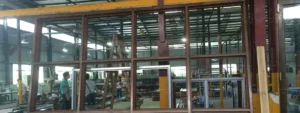
- External windows and pedestrian doorsets — EN 14351-1 (thermal transmittance, air permeability, watertightness, wind resistance, acoustics).
- Internal fire-resisting and smoke-control doorsets — EN 16034 (with EN 14351-2 for internal doors), assessment system 1, meaning a notified or approved body certifies the factory and the product.
- Ceramic tiles — EN 14411; wall and floor coverings including laminate and vinyl — EN 14041; wood flooring — EN 14342.
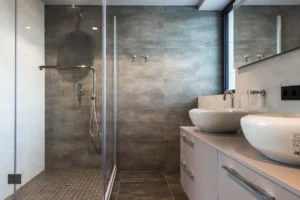
- Sanitary appliances — WC pans and suites EN 997, washbasins EN 14688, baths EN 14516, shower trays EN 14527, kitchen sinks EN 13310, shower enclosures EN 14428.
- Glass in building — thermally toughened EN 12150-2, laminated EN 14449, insulating glass units EN 1279-5.
- Structural aluminium and steel components — EN 1090-1, execution class per EN 1090-2/-3, assessment system 2+ (factory production control certified by a body).
- Thermal insulation, gypsum boards, curtain walling kits (EN 13830), radiators, roofing sheets, plumbing fittings and many others.
Our earlier note on whether doors and windows imported from China need CE marking covers the EU side of the window and door case in more depth; this article is about the GB and NI position across the whole package.
Electrical and lighting products (CE under LVD/EMC/RoHS; UKCA equivalents)
Luminaires, drivers, switches, sockets, hand dryers, hotel-room appliances and any powered item are marked under the Low Voltage, EMC and RoHS regimes rather than the CPR. The supporting document is a Declaration of Conformity (DoC), not a DoP; the manufacturer self-declares against the standards (for a luminaire, typically EN IEC 60598-1 and the relevant Part 2, EN IEC 55015 and EN IEC 61547 for EMC, IEC/EN 62471 for photobiological safety), and the test reports behind the declaration are what a buyer should ask to see. UK plugs and sockets to BS 1363 are a separate national requirement.
Furniture, upholstery and loose FF&E (no conformity mark)
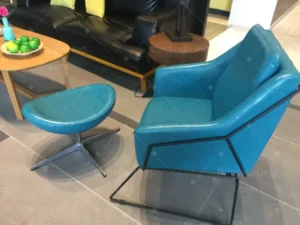
Beds, casegoods, seating, tables and mattresses do not carry CE or UKCA. What UK projects require instead is performance and fire evidence: BS EN 16139 strength and durability for non-domestic seating, BS EN 1728/1730 test methods, BS 5852 (Crib 5 for contract upholstery), BS 7176 for upholstered furniture in non-domestic premises, BS 7177 for mattresses in medium- and high-hazard settings, and the Furniture and Furnishings (Fire) (Safety) Regulations for domestic-type furniture in build-to-rent and student accommodation. A Chinese factory that offers a “CE certificate” for a sofa is offering a document with no legal meaning; ask for the fire test report from a laboratory the specifier will accept. See factory test reports vs accredited lab testing for how to tell the two apart.
The UK government has also consulted on a General Safety Requirement for products outside designated standards; see our reading of the Construction Products Reform White Paper and the GSR consultation.
For the general safety law behind these marks, see our reading of the UK General Product Safety Regulations 2005.
Sourcing this for a commercial project?
FBM Sourcing works with project owners, developers, main contractors and FF&E contractors on hotel, apartment, school, office and other commercial building projects. Send us your BOQ, drawings or product list — our team will review it and get back to you.
On the factory side of the same question — whether one Chinese manufacturer can hold both marks, what changes in its assessment route, and which documents to collect before shipment — see can a Chinese factory hold both UKCA and CE.
What Is the Difference Between a Notified Body and an Approved Body?
This is the point on which UKCA and CE actually diverge for a Chinese factory. Under both regimes, the level of third-party involvement is set by the product’s Assessment and Verification of Constancy of Performance (AVCP) system:
- System 4: manufacturer declares everything itself (most sanitary ware, many tiles by end use). No body involved.
- System 3: a body carries out the initial type testing; the manufacturer runs factory production control (FPC). Typical for external windows and doors without fire performance, laminate flooring, many glass products.
- System 2+: a body certifies the factory’s FPC and audits it; the manufacturer does the testing. Typical for structural steel and aluminium under EN 1090.
- System 1 and 1+: a body certifies the product itself, with initial testing, FPC audit and (for 1+) audit testing of samples. Fire-resisting doorsets, fire-performance products, some insulation.
Where a body is involved (systems 3, 2+, 1, 1+), an EU Notified Body supports a CE mark and a UK Approved Body supports a UKCA mark. Each has a four-digit number that appears next to the mark and in the DoP; the EU numbers can be checked in the NANDO database and the UK numbers in the UK Market Conformity Assessment Bodies (UKMCAB) database. A Chinese window factory whose EN 14351-1 type testing was done by an EU notified body has a valid CE mark, which GB currently recognises; if it wants a UKCA mark as well, a UK approved body has to have carried out or formally accepted the type testing. In practice most Chinese factories exporting to the UK have kept their EU notified-body route and rely on GB’s continued recognition of CE, adding UKCA only where a client demands it. For system 4 products the manufacturer can affix either mark itself, provided the testing behind the DoP is to the right standard.
What Documents Should the Buyer Get from the Chinese Factory?
For each marked product line the documentation set is the same in principle for CE and UKCA, and it should be obtained and checked before the order is confirmed rather than requested at customs:
- Declaration of Performance (construction products) or Declaration of Conformity (electrical): in English, identifying the product type by a unique code that also appears on the product or its packaging, the intended use, the harmonised or designated standard and its year, the AVCP system, the notified or approved body and its number where one is involved, and the declared performance for each essential characteristic. “NPD” (no performance determined) against a characteristic your specification relies on is a gap, not an answer.
- The type test report or product certificate behind the DoP: for system 3 products the initial type test report from the body; for system 1 the certificate of constancy of performance; for 2+ the FPC certificate. Check that the tested configuration (frame profile, glazing, hardware, panel build-up) is the one being ordered.
- The mark itself: the CE or UKCA symbol with the body number, the manufacturer’s name and address, the last two digits of the year of first affixing, the DoP reference and the declared performances, on the product, its label or the accompanying documents as the standard allows.
- Manufacturer identity: the DoP must be issued by the actual manufacturer named on the mark. A DoP issued by a trading company for goods it did not make is invalid, and this is the most common defect on China-sourced documents. If the factory is not the DoP holder, the buyer needs to know who is and why.
- Retention: the DoP and technical documentation must be available for 10 years after the product was placed on the market. The party that keeps them is the importer.
Who Is the Importer, and What Are Their Duties?
Under both the EU and UK Construction Products Regulations the importer — the business established in the market that places a third-country product on it — carries legal duties: to place on the market only compliant products, to ensure the manufacturer has done the assessment and drawn up the DoP and technical documentation, to ensure the product bears the mark and is accompanied by the required documents, to indicate its own name and address on the product or packaging or in a document accompanying it, to keep a copy of the DoP for 10 years, and to cooperate with the market surveillance authority. On a UK project sourced from China the importer is normally the UK entity buying from the factory: the developer, the main contractor or the fit-out contractor. That is worth stating plainly, because it means the buyer’s own name goes on the paperwork and the buyer, not the factory, answers to Trading Standards or the Office for Product Safety and Standards if a product is challenged. Where the buyer’s UK entity is the importer, the marking and documentation duties above are its duties, and it needs a supply chain that delivers the documents in a form it can hold for a decade. How the shipping and customs documents fit together for a project consignment is set out in shipping and customs documents for China project orders.
What About Fire Performance and Building Regulations?
The mark says the product’s performance was declared to a standard; it does not say the performance is adequate. Reaction to fire is declared as a Euroclass under BS EN 13501-1 (A1, A2, B, C, D, E, F with smoke s1–s3 and droplet d0–d2 sub-classes), and Approved Document B and the ban on combustible materials in the external walls of relevant buildings over 18 m set which class is required where. A CE-marked wall panel declared as class D is compliant with the CPR and non-compliant with the wall it was specified for. Fire-resisting doorsets are the highest-risk item on most packages: EN 16034 requires a system 1 body, and the UK market additionally expects test evidence to BS 476-22 or BS EN 1634-1 for the exact leaf, frame, glazing, ironmongery and seal configuration, plus third-party certification schemes that many local authorities and insurers now insist on. On what the specification should demand across the fire-rated lines of a package, see fire rating standards for building materials and finishes; on how UK developers set up the whole package, see how UK developers source building materials from China.
The EU side of the same question — Declarations of Performance, DIBt approvals and KOMO — is set out in our guide to how German and Dutch contractors source building materials from China.
UKCA vs CE at a Glance for a China-Sourced UK Project
| Question | Great Britain (England, Scotland, Wales) | Northern Ireland |
|---|---|---|
| Construction products: which mark is accepted? | CE (recognised, no current end date) or UKCA | CE; CE + UKNI if a UK approved body was used |
| Electrical and lighting: which mark? | CE or UKCA (CE recognised indefinitely) | CE |
| Furniture and mattresses | No mark; BS EN 16139 / BS 5852 / BS 7176 / BS 7177 evidence | Same |
| Third-party body | EU Notified Body (CE) or UK Approved Body (UKCA) | EU Notified Body, or UK body with UKNI |
| Supporting document | Declaration of Performance (CPR) / Declaration of Conformity (electrical) | Same |
| Importer duties | UK entity placing the goods on the market: name on product/packaging, keep DoP 10 years | Same, under EU rules |
| Does the mark prove Building Regulations compliance? | No — ADB, ADL, ADM etc. are separate | No — NI Technical Booklets apply |
How FBM Sourcing Handles Marking and Documentation on a UK Package
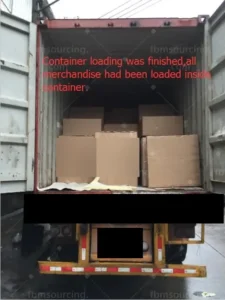
FBM Sourcing manages the entire China procurement package for overseas construction projects. On a UK package the BOQ is sorted at the outset into lines that need a DoP under the construction products rules, lines that need a DoC under the electrical rules, and lines — furniture and soft FF&E — that need fire and performance test evidence instead of a mark. Factories are shortlisted on whether they hold the right documents for the exact configuration being ordered, not on whether they say “CE available”; the DoP or DoC, the body’s number and the underlying test report are checked before the order is confirmed, and the marking and document set required at delivery is written into the purchase order. Our own team checks the mark, the labels and the accompanying documents on the production units before shipment, with photo and video records delivered before shipment, and the document set is compiled so the UK importer can hold it for the required 10 years.
All quotations, invoices and shipping documents are issued by FBM Sourcing — you deal with us, and we carry the responsibility. For suppliers you nominate, we charge a 5% commission; for products we source for you, we quote a direct price. As a building material sourcing agent for the whole package rather than a single product line, we treat the marking and fire documentation as deliverables of the order in the same way as the goods.
Structural steel is the one line on a UK package where the marking regime bites hardest; see does structural steel and metalwork from China need EN 1090 CE marking for execution classes and certificate checks.
Get a China Procurement Quote for Your Project
If you are sourcing windows, doors, tiles, sanitary ware, lighting, glass, metalwork or FF&E from China for a UK hotel, build-to-rent, student accommodation, school, office or retail project and want the marking, DoP and fire documentation managed as part of the full package, send us the BOQ or product schedule, the quantities, the destination port and the required-on-site dates. Our team will review the package line by line and set out a quotation.
Use the quote button above or WhatsApp +86 135 6007 5057 to start the conversation.