FBM Sourcing has not published a ranked list of named locker factories in China, and the first section explains why: we checked the full Shanghai and Shenzhen A-share registers and the product-segment tables inside the relevant annual reports, and could not verify a single listed Chinese issuer that reports lockers as a product line. What we publish instead is the part that survives verification: the manufacturer types that actually build lockers, the one locker-relevant industrial cluster we could confirm against an industry association source, the current standards a locker package can be written against, and the product evidence to request before an order is placed.
This page is written for developers, general contractors, builders, commercial project owners, interior design and construction companies and FF&E solution providers pricing a locker package for a gym, a school or university campus, or an office floor. If your question is how a locker order runs end to end rather than what kind of factory to approach, our guide to staff lockers from China and our page on staff locker cabinet sourcing cover that ground.
Why We Have Not Published a List of Named Factories Here
Our rule for any manufacturer listicle is that a company is named only when we have verified the exchange, the ticker and the current listing status, and confirmed that the product category appears as a reported segment in its own annual report. The rule exists because a name in a listicle gets quoted back to us months later by a project team that assumed we checked it.
For lockers, the rule produced nothing. We pulled the complete Shanghai and Shenzhen A-share registers, filtered both for furniture, home furnishing, metal products and office equipment issuers, then read the main-business-by-product revenue tables in those issuers’ 2025 annual reports from the official disclosure channel. In the listed office furniture group whose report came closest to the category, the phrase for storage cabinets appears exactly once in the whole document, in an industry-background section; its reported segments are office furniture, upholstered furniture, panel furniture, new-material flooring, and integrated home furnishing and other, with no locker revenue line. The custom wardrobe, kitchen cabinet and recliner issuers in the same filter make residential and soft-seating products only.
The honest conclusion is narrower than “there are no listed locker makers in China”: across the registers and reports we read, we could not verify any listed Chinese issuer reporting lockers as a product segment. Locker production sits overwhelmingly with private companies that file no public product-segment disclosure, so there is no public document to check a ranking against, and a list built anyway would be a list of whoever ranks well in search.
What Kinds of Factories Actually Make Lockers in China?
Lockers are not one product with one supply base. The word covers at least four manufacturing processes, and a factory excellent at one usually subcontracts the others, so which type you are talking to changes what you ask for.
Sheet metal furniture fabricators
The classic steel locker makers: coil steel in, then punching or laser cutting, press braking, welding or clinching, pretreatment, powder coating and assembly. Whether the plant owns its coating line is the most important thing to establish, because a subcontracted line is where finish consistency and corrosion claims break down. Evidence to request: coating line ownership in writing, coated panel test reports naming the method and laboratory, thickness measured on the sample rather than quoted from a brochure, and the powder type on the specification sheet.
Compact laminate and HPL panel fabricators
Compact laminate lockers are a panel-conversion business, not a metalworking one: the factory buys pressed compact grade sheets, then cuts, edges, drills and assembles them with stainless or aluminium hardware. Very few press their own laminate, so the performance claims belong to the sheet, not to the converter. Evidence to request: the sheet producer named, sheet grade and thickness, that producer’s test report against the laminate standard, and the hardware grade for wet-area use. A separate piece sets out how compact laminate, steel and plastic behave in wet areas and what evidence to ask for in each case.
Plastic and HDPE fabricators
Plastic lockers split into solid HDPE or polypropylene panel lockers, again panel conversion, and moulded lockers, which need tooling that has to be paid for and stored somewhere. Evidence to request: whether the design is moulded or panel-built, the polymer type and whether it is virgin or recycled, the surface burning characteristics report, and who owns the tool if one exists.
Wood-based panel casegoods makers
Melamine-faced chipboard and MDF lockers come out of the factories that build office storage casegoods and school casework. They are the least tolerant of moisture, so they belong in dry staff rooms and corridors; our comparison of steel and laminate office storage cabinets covers where each one stops working. Evidence to request: board producer and grade, a formaldehyde emission test report citing a standard and edition, and edgebanding type and thickness.
Lock, hardware and electronic locker system suppliers
The locking system is very often not made by the locker factory. Cam locks, hasp and staple, coin return, combination dials, RFID and app-controlled locks come from specialists, so on smart locker projects the electronics supplier is a second vendor inside the order. Evidence to request: lock supplier named, a keying and master-key schedule agreed before production, the power and network requirement in writing, and a spare-parts support statement.
The Industrial Belt Facts We Could Verify
One locker-relevant cluster is documented by a national industry association rather than by supplier marketing: the China National Furniture Association publishes an industrial cluster page for Pangcun, a town in Luoyang, Henan Province, described as the core of a steel furniture cluster radiating to neighbouring townships. The association states that the cluster contains more than 800 enterprises and employs more than 40,000 people, that its output covers nine product categories and more than 1,000 varieties including steel filing cabinets, medical, financial, library and school equipment, office and domestic furniture and security doors, and that steel office furniture from the cluster holds a 60 percent share nationally.
Two caveats belong with those figures. The page carries no publication or revision date, and the town-level economic figures printed alongside it are 2017 figures, so the enterprise count, employment figure and national share are an association-published description rather than current-year statistics. For any other province we found no dated official or association source giving locker-specific output, so we give no numbers for any other belt. A Luoyang quotation therefore says something about capacity and tooling availability, and nothing about an individual factory’s coating line or its ability to hold a keying schedule.
Pricing a locker package for a gym, school or office floor?
Send us the schedule, BOQ or drawing set. We will match the package to the right manufacturer type in China and come back with a quotation covering the lockers, the locking system and sea freight.
Which Standards Can a Locker Package Be Written Against?
A specification naming a standard and an edition is worth far more than one saying “commercial grade”. Each entry below was checked against the publisher’s own catalogue record, not a summary.
| Standard | What it covers | Status we verified |
|---|---|---|
| BS EN 16121:2023 | Safety, strength and durability of all non-domestic storage furniture, including office storage | BSI record: published 30 April 2025, status current. Scope excludes domestic, industrial, kitchen, catering and retail storage, and industrial storage lockers |
| BS EN 16122:2012 | Test methods for strength, durability and stability of storage furniture | BSI record: published 30 September 2012, status current. Scope excludes office, industrial, catering and retail storage, and industrial storage lockers |
| BS EN 438-1:2016 | High-pressure decorative laminates; entry point to the compact laminate series | BSI record: published 29 February 2016, status current; supersedes EN 438-1:2005 |
| ASTM E84-26a | Surface burning characteristics of building materials | Publisher catalogue shows E84-26a as Active and the preceding E84-26 as Historical |
| GB/T 3325-2024 | General technical requirements for metal furniture | Recommended standard, current, issued 26 October 2024, in force 1 February 2025; the 2017 edition is listed as abolished |
| GB/T 7911-2024 | High-pressure decorative laminates; the Chinese standard for the sheet | Recommended standard, current, issued 15 March 2024, in force 1 October 2024 |
| GB 18580-2025 | Formaldehyde emission limits for wood-based panels and their products | Mandatory standard, current, issued 30 May 2025, in force 1 June 2026; the 2017 edition is listed as abolished |
Two cautions. Both European storage furniture standards carve industrial storage lockers out of scope, so a supplier claiming conformity should be asked which product the claim covers; and the 2023 edition of BS EN 16121 brought office storage into scope where BS EN 16121:2013+A1:2017, recorded by BSI as withdrawn on 15 January 2024, excluded it. ASTM B117, the salt spray practice usually named in powder coating specifications, we could not settle: the editions we checked are marked Historical on the publisher’s catalogue pages, so we name the method only and record its status as unverified.
Gyms, Schools and Offices Do Not Buy the Same Locker
The biggest cause of a locker package going wrong is treating the three venue types as one line item; they differ in material, in locking and in how the units meet the floor.
Gyms and leisure centers
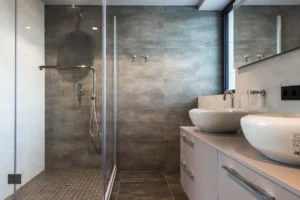
Wet and semi-wet zones drive the material choice, and this is where compact laminate and solid plastic earn their place over painted steel. Watch the split between dry change areas, where steel is usually fine, and the shower-adjacent zone, where it is not. Sloping tops, plinth or leg-mounted bases that let the floor be cleaned underneath, ventilation, and coin-return or RFID locking are the recurring requirements. Operators running several sites need identical units across a rollout, which pushes the package toward one factory; our page on gym and fitness center chain sourcing covers the wider package.
Schools and universities
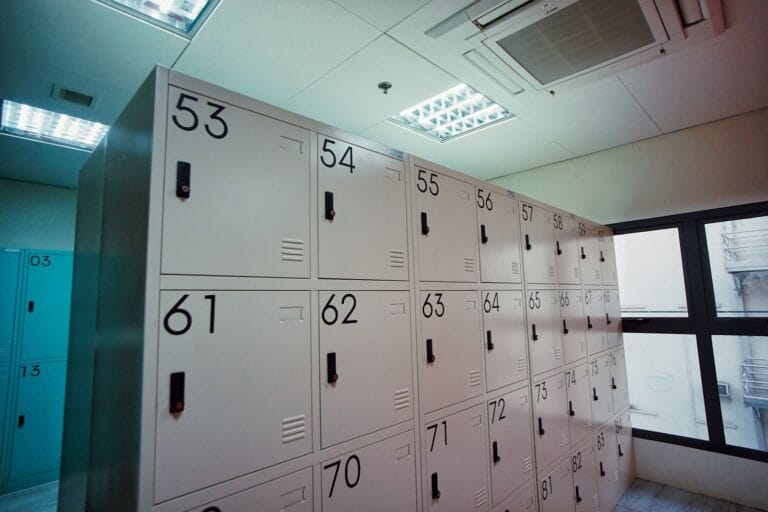
Volume, anti-tamper detail and height sizing dominate. Schools want long continuous banks rather than islands, hasp and padlock or combination locks rather than keyed cylinders that get lost, and a finish that can be repainted or replaced panel by panel. Formaldehyde emission evidence matters more here than almost anywhere else, which is where the panel standards above enter the specification. See our listing of school furniture manufacturers in China covers the adjacent product families.
Offices and staff areas
Office lockers have quietly changed shape. Shared-desk floors need personal day lockers built into storage walls and circulation, in the same finish as the joinery around them and increasingly with electronic locking tied to the client’s access system. That pushes them toward panel casegoods factories rather than sheet metal plants, and makes dimensional coordination with the interior package matter more than raw robustness.
Evidence to Request With a Locker Quotation
Each item below is a document or a physical article about the product, asked for at quotation stage.
| Evidence to request | What it establishes |
|---|---|
| Measured material thickness on the quoted sample | Whether the gauge or panel thickness being priced is what will be produced |
| Coating line ownership in writing, plus powder type | Whether finish consistency sits inside the quoting factory or with a subcontractor |
| Corrosion test report naming the method, the laboratory and its accreditation scope | Whether a durability claim is backed by an accredited laboratory |
| For compact laminate, the sheet producer named plus its test report against the laminate standard | Whether the performance claim belongs to the sheet actually being used |
| For panel lockers, a formaldehyde emission test report citing standard and edition | Whether the board meets the destination market requirement |
| Lock supplier named, with a keying and master-key schedule agreed before production | Whether the site keying plan is deliverable |
How FBM Sourcing Runs a Locker Package
We work from your schedule, BOQ or drawing set. The first job is deciding which manufacturer type the package belongs with, because steel gym lockers and laminate-faced office day lockers in one package are two factories, not one. From there we approach factories in the relevant process, collect quotations on one comparable specification sheet, and run samples before production starts.
Quality control on a locker order means one inspection by our own team at the factory after bulk production is finished, before shipment, with photo and video records, and the report goes to the client before the balance is paid. As your sourcing partner in China, we hold the specification, the keying schedule and the packing standard in one place, so the factory answers one set of requirements.
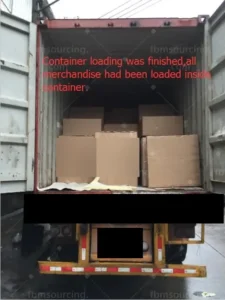
The packing and carton drawing is asked for early, because whether units ship knocked down or assembled changes container planning more than anything else. Sometimes, on a large project, the lockers alone fill full containers; sometimes the lockers share containers with the other product categories of the same project; and sometimes, in one batch, we combine a dozen or more product categories from several projects of the same client into a few containers — always full containers, and for us this is routine, well-practised work. Our article on container loading for office furniture explains how a loading plan is built.
Pricing a locker package for a gym, school or office floor?
Send us the schedule, BOQ or drawing set. We will match the package to the right manufacturer type in China and come back with a quotation covering the lockers, the locking system and sea freight.
Frequently Asked Questions
Are there any listed Chinese companies that manufacture lockers?
Across the full Shanghai and Shenzhen A-share registers and the 2025 annual reports we read for the furniture and office storage issuers on them, we could not verify a single listed Chinese issuer reporting lockers as a product segment; the report closest to the category mentions storage cabinets once, in an industry-background section, with no locker revenue line. That states what we could verify, not that no such company exists.
Which standard should a locker specification name?
For non-domestic storage furniture in European markets, BS EN 16121:2023 is the current requirements standard and BS EN 16122:2012 the current test method standard, though both scope texts exclude industrial storage lockers; the EN 438 series covers the compact laminate itself, and Chinese factories most often cite GB/T 3325-2024 for metal furniture and GB/T 7911-2024 for high-pressure laminate. Always name the edition, because a report against a withdrawn edition is not a report against the current one.
Is steel or compact laminate the right choice for a gym locker?
It depends on how wet the zone is: painted steel is normally acceptable in dry change areas and is the volume material for schools and staff rooms, while compact laminate and solid plastic hold up next to showers and pools, and many gym projects use both in the same room. Make the decision zone by zone, against the cleaning regime and the floor build-up, not once for the whole building.
What is the most common thing that goes wrong on a locker order?
The keying schedule, by a wide margin: banks arrive on site with locks that cannot be mastered the way the operator needs, or with a keying plan never agreed in writing before production. Agreeing the lock supplier, the master-key arrangement and the spare key quantity, then confirming them on the approved sample, removes most of that.
Can lockers be shipped assembled, or do they have to be knocked down?
Both are produced in China, and the choice changes the container count substantially, so settle it before quotations are compared. Knocked-down units ship far more efficiently but add site labour and need the fixing detail to be right; assembled units take more volume but arrive ready to set out, and on multi-floor projects the lift dimensions often decide it.
About FBM Sourcing
FBM Sourcing manages the entire China procurement package for overseas construction projects. Since 2014 we have worked with developers, general contractors, builders, commercial project owners, interior design and construction companies and FF&E solution providers across more than 20 countries and over 1,000 containers, as their sourcing partner in China — from the schedule or BOQ through factory selection, sampling, inspection by our own team before shipment, consolidation and shipping. All quotations, invoices and shipping documents are issued by FBM Sourcing, and sea freight is quoted to you before shipment. If you have a locker package to price, start at China building materials and FF&E procurement.