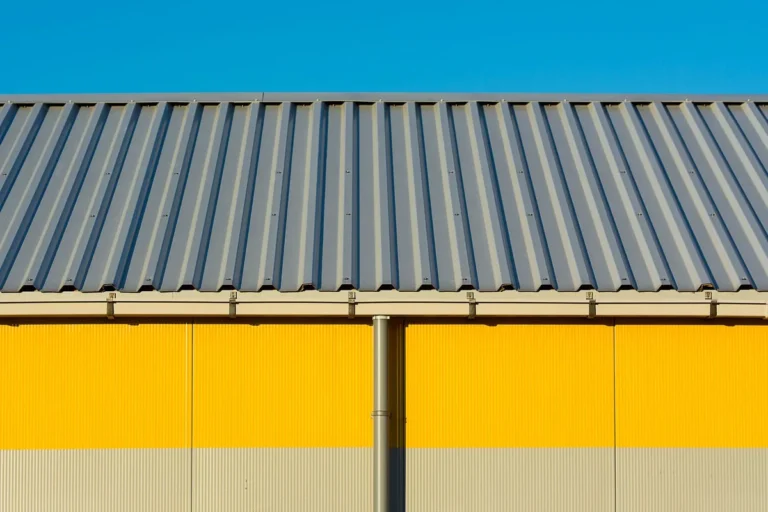
The metal roofing manufacturers in China that matter for commercial and industrial projects come from three trades: steel structure groups that deliver their own roof and wall envelope, coated coil producers that make the galvanized, aluminium-zinc and pre-painted steel every roof sheet starts from, and specialist roof system and sandwich panel manufacturers that roll-form standing seam and laminate PIR or mineral wool cores. A few are listed and verifiable, and they are named below with the role they actually play. For the rest, what makes a metal roof from China buildable at the destination is the substrate standard on the mill certificate, a wind uplift test on the exact assembly and a fire classification on the exact panel.
This guide is written for developers, general contractors, builders, commercial project owners and interior design and construction companies delivering warehouses, factories, logistics centres, cold stores, sports halls and transport buildings. It is not a ranking: listed companies appear in no particular order, and private manufacturers are described by type.
What Is Inside a Metal Roofing Package for a Commercial Building?
- Through-fastened profiled sheet: trapezoidal or corrugated steel sheet screwed through into the purlins, the default on industrial roofs and walls.
- Standing seam roofing: panels joined along a raised seam and held by concealed clips so long runs can move with temperature, in coated steel or aluminium-magnesium-manganese alloy.
- Insulated sandwich panels: two metal skins bonded to a PIR, PU or mineral wool core, the usual choice for cold stores and temperature-controlled buildings.
- Accessories and secondary steel: flashings, clips, fasteners, closures, sealants, purlins and girts. This is the part most often quoted loosely, and where leaks and uplift failures start.
Wind and fire performance are tested on assemblies, not sheets, so the package has to be bought as a system even when its parts come from different plants. Aluminium composite wall cladding is a separate trade, covered in our guide to ACP facade cladding manufacturers in China, and rooflights set into a metal roof are covered in our skylight and glass roof system guide.
Listed Chinese Companies With a Verifiable Role in Metal Roofing
We name only companies whose listing we have checked and whose roofing role is stated in their own disclosures or official materials. The order carries no ranking.
- Center International Group Co., Ltd., Shanghai Stock Exchange: 603098. Its 2025 annual report describes a building metal envelope business alongside building-integrated photovoltaics, providing design, manufacture and installation as the specialist envelope subcontractor to the owner or main contractor. Products listed include aluminium-magnesium-manganese sheet, mainly for public building roofs, and coated steel sheet profiled in the factory or on site, mostly for industrial roofs and walls. Role note: an envelope system contractor, not a coil mill. Evidence to request: wind uplift and water penetration test reports for the exact seam profile, clip and gauge proposed.
- Changjiang & Jinggong Steel Building (Group) Co., Ltd., Shanghai Stock Exchange: 600496. A steel structure group whose 2025 annual report describes delivering complete buildings, roofs and walls included, and identifies a metal roof envelope system business and a polyurethane and rock wool composite panel business among its asset groups. A 2025 credit rating report records special-grade qualifications for metal envelope system contracting awarded by Chinese industry associations. Role note: the structure-plus-envelope route, with one party carrying frame, purlins and roof. Evidence to request: roof assembly and panel test evidence separate from the structural steel certification, which says nothing about cladding.
- Zhejiang Huada New Materials Co., Ltd., Shanghai Stock Exchange: 605158. Based in Fuyang, Hangzhou, with its own cold rolling, hot-dip coating and colour coating lines. Its annual report states that its galvanized and colour-coated sheet is used as roof panels, wall panels and envelope structures for industrial buildings and warehouses, and the company reports colour-coated export volumes among the highest in China. Role note: a substrate producer supplying roll-formers, not a roof system company. Evidence to request: mill test certificates showing base metal thickness, steel grade, coating type and coating mass against the standard named in the order.
- Henan Mingtai Al. Industrial Co., Ltd., Shanghai Stock Exchange: 601677. An aluminium flat-rolled producer in Gongyi, Henan, whose 2025 annual report describes sheet, strip and foil across 47 alloy grades. Its official website markets 3004 aluminium-magnesium-manganese sheet for roof panels. Role note: the alloy coil behind aluminium standing seam roofs, not a roofing contractor. Evidence to request: alloy and temper certification, the paint specification if pre-painted, and the name of the roll-former that will profile it.
Most other roll-formers and sandwich panel lines in China are privately held, so the rest of this guide works by manufacturer type.
The Manufacturer Types Behind a Metal Roof
1. Steel structure groups with their own envelope business
- Where: fabrication bases across eastern and central China; the listed example above is registered in Anhui with its head office in Shanghai.
- What they make: frame, purlins, girts and roof and wall cladding under one contract.
- Where it goes wrong: the cladding is assumed to be covered by the structural certificates until the certifier asks for a roof test.
- Evidence to request: a roof assembly test matching the purlin section and spacing in the steel design, and the plant that profiles the sheet.
2. Coated coil producers
- Where: Boxing County in Binzhou, Shandong, recognised by the Ministry of Commerce in 2019 as a national foreign trade base for metal sections, whose export-base profile puts its colour-coated sheet capacity at roughly half the national total. Others sit in Zhejiang and inside the integrated steel mills.
- What they make: cold-rolled substrate, galvanized, aluminium-zinc and zinc-magnesium coated coil, and pre-painted coil.
- Where it goes wrong: total coated thickness quoted where the design assumed base metal thickness; the difference is coating and paint, and it comes out of structural capacity.
- Evidence to request: a mill certificate per coil with base metal thickness, yield strength, coating designation and mass, and paint film thickness on both faces.
3. Roof sheet roll-formers and sandwich panel manufacturers
- Where: spread between coil supply and demand. For mineral wool cores, Dacheng County in Langfang, Hebei, is described by its local government as China’s largest thermal insulation materials base, with about 40 percent of the national rock wool market.
- What they make: trapezoidal and corrugated sheet, standing seam and curved panels, PIR, PU and mineral wool core sandwich panels, and flashings.
- Where it goes wrong: a test report on a different gauge, profile or fastener spacing from the one quoted.
- Evidence to request: the tested configuration in full, core type and density, facing thickness, joint detail, and the fire classification report for that exact build-up.
4. Aluminium coil and aluminium standing seam specialists
- Where: aluminium flat-rolled producers in Henan supply the coil; roof system companies profile and curve it.
- What they make: 3xxx-series aluminium-magnesium-manganese coil, bare or pre-painted, profiled into standing seam panels for arched and long-span roofs.
- Where it goes wrong: aluminium sheet fixed onto steel clips or purlins without isolation, inviting galvanic corrosion.
- Evidence to request: alloy and temper certificates, the clip isolation detail, and an uplift test on the aluminium seam rather than its steel equivalent.
Pricing a metal roof or insulated panel package from China?
Send us your roof drawings, panel schedule and the standards your destination requires. Our team will review the package and map it to the right manufacturers.
Which Substrate and Coating Standard Should the Order Name?
A roof sheet lasts as long as its metallic coating and paint system. Chinese mills commonly produce pre-painted building sheet to GB/T 12754-2019, a legitimate national standard but not the one a European, American or Australian specification names, so the order has to state the destination standard and the certificate has to report against it.
| Market | Coated steel substrate | What else the order should name |
|---|---|---|
| Europe and UK | EN 10346, covering Z, ZF, ZA, AZ, AS and ZM coatings | EN 10169 for coil-coated steel; EN 14509 for metal-faced sandwich panels |
| United States | ASTM A653/A653M (galvanized); ASTM A792/A792M (55 percent aluminium-zinc) | The wind uplift test and roof fire classification the building code requires |
| Australia | AS 1397:2021, zinc and zinc alloyed with aluminium and magnesium | AS 1562.1:2018 for design and installation; NCC Specification 4 in cyclonic areas |
| China (origin) | GB/T 12754-2019, pre-painted steel for building use | A cross-reference only, alongside the destination standard |
Each coil certificate should show base metal thickness separately from total coated thickness (AS 1397 requires marking of base steel thickness and the steel base and coating designation), steel grade, coating type and mass in the notation of the standard ordered, and the paint system with film thickness on both faces. Colour is matched to the approved physical sample, not to a screen image.
How Is Wind Uplift and Cyclone Performance Proven for the Destination?
Wind resistance belongs to the assembly: profile, gauge, steel grade, clip or fastener, fastener spacing and purlin thickness. Change any one and an existing test no longer covers the roof.
Australia
Specification 4 of the National Construction Code covers metal roof cladding in cyclonic areas. In NCC 2025 these are wind regions B2, C and D under AS/NZS 1170.2; NCC 2022 applied it to C and D, with a Western Australian variation adding B2, so confirm the edition the state has adopted. Cladding, connections and immediate supporting members must stay in position under the low-high-low sequences of Table S4C2, which step from 4,500 cycles at 0.45 of the ultimate limit state wind pressure up to a single cycle at full pressure and back down. AS 4040.3 is the Standards Australia test method for sheet cladding in cyclone regions. Ask for a report from an accredited laboratory on the same profile, gauge, fastener and support spacing as the quoted roof. See our overview of NCC compliance for building materials from China.
United States
The International Building Code names ASTM E1592 as a wind uplift test for structural standing seam metal roof systems, and lists ASTM E1592 or UL 580 among the tests for through-fastened systems. Read the result against the project’s design uplift and the tested panel width, gauge and clip spacing.
Europe and the UK
Sandwich panels are placed on the market under EN 14509 with declared properties, which the project engineer checks against site wind actions for the thickness and span supplied.
What Fire Classification Does a Sandwich Panel Need?
Fire raises two questions: how the panel reacts to fire, and how the roof performs against fire from outside. Either way, the classification belongs to the tested build-up of core, facings, coating and joint, not to the core material alone. Our guide to fire rating standards for building materials covers the wider framework.
- Europe: reaction to fire under EN 13501-1; external fire performance of roofs under EN 13501-5, using the CEN/TS 1187 test methods t1 to t4, which different countries adopt, so one test method’s classification does not automatically transfer.
- United States: Class A, B and C roof assemblies are tested to ASTM E108 or UL 790; where a foam-core panel is used on exterior walls of Type I to IV construction, the wall assembly must be tested to NFPA 285.
- Australia: under NCC clause C2D10, external walls of Type A and Type B construction, including facade covering, framing and insulation, must be non-combustible as determined by AS 1530.1, so a foam core in a wall panel has to be settled with the certifier before the core is chosen.
Long Sheets, Container Length and Transit Damage
A 40-foot container is roughly 12.03 metres long inside, and many warehouse roof runs are longer. The options are end laps so each sheet fits the box, coil shipped and roll-formed on site where a standing seam must run unbroken from ridge to eave, or open top and flat rack equipment for over-length panels, as described in our guide to shipping oversized items from China. That choice belongs in the roof design, not the booking.
Metallic coated sheet that gets wet while tightly stacked can develop wet storage stain, so bundles need waterproof wrapping, and sandwich panels need joint protection.
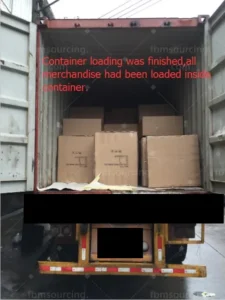
Sometimes, on a large project, the roofing sheets and panels alone fill full containers; sometimes the roofing sheets and panels share containers with the other product categories of the same project; and sometimes, in one batch, we combine a dozen or more product categories from several projects of the same client into a few containers — always full containers, and for us this is routine, well-practised work.
How the Quality Control Works
All inspection on FBM Sourcing packages is carried out by our own team at the factory before shipment, with photo and video records. For a metal roof, that means checking coil certificates against the order, taking coating and paint film thickness readings, comparing colour with the approved sample, measuring profile, length and panel thickness, and checking film, wrapping and loading. As the project’s sourcing partner in China, FBM Sourcing keeps the roof, the steel structure and the other building material categories in one package; structural steel is covered in our guide to EN 1090 CE marking for structural steel and metalwork.
Pricing a metal roof or insulated panel package from China?
Send us your roof drawings, panel schedule and the standards your destination requires. Our team will review the package and map it to the right manufacturers.
Frequently Asked Questions
Which Chinese companies make metal roofing for commercial and industrial projects?
Listed companies with a verifiable role include Center International Group (Shanghai: 603098), a metal envelope system contractor; Changjiang & Jinggong Steel Building (Shanghai: 600496), a steel structure group with roof envelope and composite panel businesses; Zhejiang Huada New Materials (Shanghai: 605158), a coated coil producer; and Henan Mingtai Al. Industrial (Shanghai: 601677), an aluminium sheet producer.
What is the difference between standing seam and through-fastened metal roofing?
Through-fastened sheet is screwed through into the purlins, which is quick but fixes the sheet in place. Standing seam panels are held by concealed clips, so long runs can expand and contract and no fasteners pierce the weather surface. They are tested differently for wind uplift, so a report for one does not cover the other.
Which coating standard should a metal roof sheet from China be ordered to?
The destination standard, with the mill certificate reporting against it: EN 10346 in Europe, ASTM A653/A653M or ASTM A792/A792M in the United States, and AS 1397:2021 in Australia. GB/T 12754-2019 is a useful Chinese cross-reference but does not replace the standard your specification names.
How is a metal roof proven for cyclone regions in Australia?
NCC Specification 4 requires metal roof cladding, connections and immediate supports in cyclonic areas to stay in position under the low-high-low pressure sequences of Table S4C2, tested on an assembly matching the roof as built, with AS 1562.1:2018 governing design and installation.
Can long roof sheets be shipped from China in a container?
Only up to the container’s internal length, roughly 12.03 metres for a 40-foot unit. Longer runs need end laps, coil shipped for roll-forming on site, or open top and flat rack equipment, decided before the roof is detailed.
About FBM Sourcing
FBM Sourcing manages the entire China procurement package for overseas construction projects. Since 2014 we have worked with developers, general contractors, builders, commercial project owners, interior design and construction companies and FF&E solution providers across more than 20 countries and over 1,000 containers, as their sourcing partner in China — from the schedule or BOQ through factory selection, sampling, inspection by our own team before shipment, consolidation and shipping. All quotations, invoices and shipping documents are issued by FBM Sourcing, and sea freight is quoted to you before shipment. If you have a metal roofing package to price, start at China building materials and FF&E procurement.