When a piece will not pass through the doors of a standard container, it ships one of three ways: in an open top container, loaded through the roof by crane, for cargo that is too tall to go in through the doors but still fits within the box; on a flat rack, which has no roof and no sides, for cargo that is over-width or over-height; or as breakbulk, lifted individually onto a multipurpose vessel, for single pieces too large for any container equipment at all. Which one applies is decided by three dimensions and a weight, and the decision has to be made before the piece is fabricated — because on most commercial project packages a 50 mm reduction, or one extra site joint, keeps the item in a standard box and saves a four-figure out-of-gauge surcharge and several weeks of schedule. This guide sets out the real internal dimensions to design against, what each type of equipment does, and how to keep an architectural metalwork or joinery package out of breakbulk altogether. As your China sourcing partner, FBM Sourcing manages this end-to-end.
What Are the Real Internal Dimensions of a Standard Container?
Design against the door opening, not the internal length, because that is the aperture the piece has to pass through. Figures vary slightly by manufacturer and container age, so confirm against the actual equipment before committing a fabrication drawing; the nominal values below are the ones to plan with.
- 20’ general purpose: internal roughly 5.90 × 2.35 × 2.39 m, door opening about 2.34 × 2.28 m, capacity around 33 m³.
- 40’ general purpose: internal roughly 12.03 × 2.35 × 2.39 m, same door opening, capacity around 67 m³.
- 40’ high cube: internal roughly 12.03 × 2.35 × 2.69 m, door opening about 2.34 × 2.58 m, capacity around 76 m³. This is the default box for a commercial project package.
- 45’ high cube: internal roughly 13.56 × 2.35 × 2.69 m, capacity around 86 m³.
Read those numbers against what a commercial interior package actually contains and the pinch points are obvious: a door leaf at 2,400 mm goes in flat without difficulty, but a pre-assembled 2,700 mm door set stood upright does not; a 3,200 × 1,600 mm sintered stone slab travels on an A-frame inside a 40’ high cube; a reception desk built in one piece at 4.5 m long will not turn inside the box even though it is shorter than the container. Volume planning for the package as a whole is covered in our guide to how many containers a hotel FF&E package needs.
When Do You Need an Open Top or a Flat Rack?
- Open top container. A standard 20’ or 40’ box with a removable tarpaulin roof and a swinging or removable door header, so cargo can be lowered in by crane. Use it when the piece is too tall or too awkward to travel through the doors but still sits within the container envelope — tall cabinets, machinery, upright assemblies. If nothing protrudes above the roof line the shipment stays in-gauge and is priced close to a standard box.
- Flat rack. A platform with fixed or collapsible end walls and no sides or roof, in 20’ and 40’ lengths, rated for concentrated heavy loads. Use it when the cargo is over-width, over-height or point-loaded — a feature staircase, a fabricated canopy, a boat-shaped bar, a plant skid.
- Platform (flat bed). No end walls at all, for cargo that overhangs in every direction.
- Breakbulk or conventional. The piece is lifted individually onto a multipurpose vessel rather than into any container. Reserved for genuinely large single items — long structural sections, escalator trusses, large tanks or vessels. Expect fewer sailings, port-specific handling arrangements and a longer and less predictable transit.
Anything that exceeds the container envelope is declared out-of-gauge, and carriers price it by the slots it blocks: an over-width piece sterilises the slots beside it, an over-height piece the slots above. That is why the cost curve is a staircase rather than a slope — 100 mm of overhang can cost as much as the next 800 mm, and 100 mm removed can cost nothing at all. Out-of-gauge dimensions must be declared with the booking and approved by the carrier before the equipment is released, and the verified gross mass declaration required under SOLAS applies to every container regardless of type.
Which Project Items Actually Go Out of Gauge?
On commercial building packages the same short list recurs, and almost all of it is avoidable at design stage.
- Architectural metalwork: feature staircases and stringers, entrance canopies, sculptural screens and large fabricated frames. See our note on metal stairs sourced from China for how these packages are normally split.
- Facade and glazing: unitised curtain wall panels above about 2.6 m, oversized single glazing units, large frameless doors and structural glass fins.
- Large-format surfaces: sintered stone and porcelain slabs, which fit inside a high cube but need A-frames, and stone or terrazzo pieces cut in one length.
- Joinery and millwork: reception desks, bar fronts, feature wall panelling and long counters built as single runs — the classic false economy, since a joint costs a fraction of a flat rack. Our guide to custom millwork and joinery packages covers how these are sectioned.
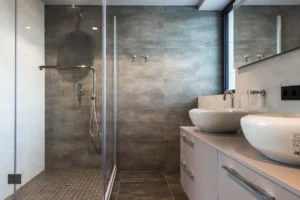
- Vertical transport and pods: lift and escalator components, and prefabricated bathroom pods, which are normally designed to the 40’ high cube envelope precisely because the alternative is breakbulk.
- Feature lighting and mirrors: large chandeliers shipped assembled, and single-piece mirrors above the door height.
Sourcing this for a commercial project?
FBM Sourcing works with project owners, developers, main contractors and FF&E contractors on hotel, apartment, school, office and other commercial building projects. Send us your BOQ, drawings or product list — our team will review it and get back to you.
How Do You Keep a Package Out of Breakbulk?
Five decisions, all taken before fabrication, remove out-of-gauge from most commercial commercial project packages entirely.
- Write a maximum single-piece dimension into the tender. Stating a limit against the 40’ high cube door opening — and requiring bidders to price sectioned delivery — forces the split to be designed rather than discovered.
- Design the joint, do not just allow it. A reception desk in three sections with a concealed mechanical joint and a site-applied finish reads as one piece; the same desk cut in half at the factory to make it fit does not. The joint belongs on the shop drawing, and the shop drawing belongs in the approval cycle.
- Check the site before the factory. Road width and bridge height on the final leg, gate and lift-shaft dimensions, and the crane or hoist available on the day frequently impose a tighter limit than the ship does. A piece that clears the ocean leg and cannot turn the last corner is still a failure.
- Nest and stand rather than lie flat. A-frames for slabs and glass, purpose-built steel stillages for metalwork, and vertical stacking convert an apparent over-length into an in-gauge load.
- Confirm the securing method with the factory. On flat racks and open tops the cargo must be braced, chocked and lashed to the securing arrangements the carrier accepts under the IMO Cargo Stowage and Securing Code, with welded stools or timber cradles fabricated as part of the item, not improvised at the port.
Where a piece genuinely has to travel out of gauge — a one-off feature stair, a bespoke canopy — commit to it early and price it early. Out-of-gauge bookings need carrier approval, sail on fewer services and can be rolled to a later vessel when slot capacity tightens, so the schedule allowance has to be larger than for a standard box. Our note on lead-time buffers in a construction programme sets out where that allowance belongs.
What Does an Out-of-Gauge Shipment Cost and Who Arranges It?
Out-of-gauge freight is quoted case by case rather than from a rate card, because the price is built from the slots blocked, the lifting arrangements at both ports and the securing materials. What you can plan for is the structure of the cost, and it has more line items than a standard container:
- The ocean freight for the equipment itself, plus the out-of-gauge surcharge for the sterilised slots.
- Lifting and handling at the load port, and again at the discharge port, where cargo outside the container envelope is often handled outside the normal terminal flow.
- Securing materials and any fabricated cradles, stools or A-frames.
- Inland transport at both ends on a low-loader or extendable trailer, with permits and, for genuinely wide loads, escorts.
- The destination terminal and local charges, which are covered in our note on port and local charges on a China shipment.
- Marine cargo insurance, which should be arranged specifically for the out-of-gauge pieces rather than assumed to follow the rest of the consignment.
Booking, carrier approval and the out-of-gauge dimension declaration are handled on the China side; customs entry, permits for the final road leg and the site lift remain with your own broker and contractor in the destination country. The document set that must travel with the cargo is set out in our note on shipping and customs documents for China project orders.
How FBM Sourcing Handles Oversized Items on a Project Package
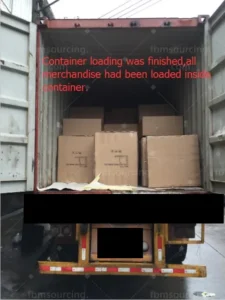
FBM Sourcing manages the entire China procurement package for overseas construction projects. On a hotel, apartment, school, office or retail package we run the dimensional check at drawing approval, not at booking: every fabricated item is measured against the 40’ high cube door opening and internal envelope, and anything that will not pass is raised with the factory and the designer while the joint can still be drawn. Most of the time the answer is a sectioned piece with a concealed site joint, which ships inside a standard box and installs as one element. Where an item genuinely has to travel out of gauge, we obtain the carrier approval, agree the securing arrangement and have the cradles or stools fabricated with the item rather than improvised at the port, and our own FBM Sourcing QC team records the loading and securing at the factory before shipment, with photo and video records. All quotations, invoices and shipping documents are issued by FBM Sourcing — you deal with us, and we carry the responsibility. For suppliers you nominate, we charge a 5% commission; for products we source for you, we quote a direct price. Sometimes, on a large project, the metalwork alone fills full containers; sometimes the metalwork shares containers with the other product categories of the same project; and sometimes, in one batch, we combine a dozen or more product categories from several projects of the same client into a few containers — always full containers, and for us this is routine, well-practised work.
If you have a feature staircase, a canopy, a long joinery run or any other oversized element in a commercial package, send us the fabrication drawings, the destination port and the required-on-site dates. Our team will check it against the container envelope and set out a quotation — use the quote button above or WhatsApp +86 135 6007 5057.