On most hotel projects nobody manages the entire FF&E package — it is split between the owner, the designer, a purchasing agent, several suppliers and the installer, and the gaps between them are where the schedule fails. Where one company does manage the whole package under a single contract, that contract normally covers a defined chain: specification review, factory selection, samples and mock-up, shop drawing approval, production, quality control, export documentation, consolidation into complete containers, and shipping to the destination port — with one party carrying responsibility for all of it. What it does not cover, unless it is written in, is the work that has to happen on the ground: site storage, delivery scheduling into the building, installation labour, snagging and the operator’s own OS&E purchasing. Knowing exactly where that line sits is the difference between one contract and one argument. FBM Sourcing works as your sourcing agent and sourcing partner throughout this process.
What Does “One Contract” Actually Cover?
A complete China procurement package for a hotel usually contains these nine steps, in this order. Anything named here is inside the contract; anything not named is somebody else’s scope, whatever the brochure implies.
- Specification review and buildability check — taking the FF&E schedule or spec book and confirming that each item can actually be made to that specification at project quantity. See what a hotel FF&E spec book should include.
- Factory selection and quotation — matching each category to production capable of that scope and certification, and returning one comparable quotation rather than a stack of incomparable ones.
- Samples, mock-up room and shop drawings — control samples, fabric and finish approvals, and a mock-up room before bulk production, with drawings approved before tooling.
- Production management — releasing the order in the right sequence, because lead times differ sharply by category and the longest item sets the ship date.
- Quality control — a full inspection once production is finished, before shipment, with photo and video records.
- Compliance documentation — fire certificates for upholstery to the destination standard, formaldehyde compliance for panel products, electrical approvals for anything powered.
- Export packing and marking — export packing standards plus room-by-room labelling so the site can check goods off as they come out of the box.
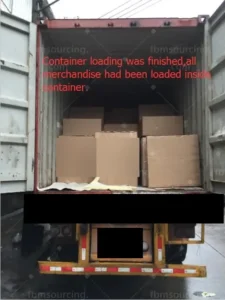
- Consolidation and loading — combining categories from several factories into complete container loads and supervising the load.
- Shipping documents and delivery to port — the documents a China project order comes with, issued under one name.
Two lines are commonly assumed to be inside and are not: customs clearance at destination, which needs an importer of record in the destination country, and installation. Both can be arranged, but they belong to a different scope and a different contract.
Who Holds Each Role on a Hotel Project?
Five parties recur on almost every hotel FF&E programme, and the package only holds together when each one’s edge is written down.
The owner or developer
Owns the budget, the brand standard and the programme dates, and is normally the importer of record. The owner signs the FF&E contract and carries the currency and duty exposure.
The designer or FF&E consultant
Owns the specification: the spec book, finishes, fabrics and the room-type schedules. They approve samples and mock-ups, but they do not buy.
The procurement company or sourcing agent
Owns everything between the approved specification and the container: factories, samples, production, QC, documents, consolidation, shipping. The whole responsibility question turns on whether this scope is one contract or four.
The main contractor
Owns site readiness and the base build. FF&E arriving before the building is weathertight is a storage problem, not a delivery success — which is why the delivery, warehousing and installation split has to be agreed early.
The installer and the operator
The installer places and assembles; the operator takes over OS&E, spare stock and the snag list. A fuller breakdown of the five-way responsibility split is in who is responsible for FF&E on a hotel project.
Sourcing this for a commercial project?
FBM Sourcing works with project owners, developers, main contractors and FF&E contractors on hotel, apartment, school, office and other commercial building projects. Send us your BOQ, drawings or product list — our team will review it and get back to you.
What Goes Wrong When the Package Is Split?
Splitting FF&E across several suppliers is not wrong in itself. What creates the failures is splitting it without naming who owns the joins.
- Nobody owns the sequence. Each supplier optimises its own lead time, so the casegoods are ready in week 10 and the lighting in week 22, and the container waits for the last item. A single package is planned backwards from the required-on-site date.
- Nobody owns the volume. Six suppliers shipping separately means six sets of freight and handling instead of complete container loads. Consolidation is only possible when one party controls the release dates.
- Nobody owns the defect. When a headboard arrives with the wrong fabric, a split package produces a discussion about whose fault it is; a single package produces a rework at the factory.
- Nobody owns the paperwork. Fire certificates that do not match the model shipped are found at handover, not at production, because no single party was checking evidence against goods.
- Nobody owns the attic stock. Spares get forgotten, and the replacement fabric two years later is a different dye lot — see how much attic stock to order.
What Should Be Written Into the Contract Before You Sign?
Whether the package is handled by one company or several, these lines decide whether “full responsibility” means anything.
For the wider picture of how a full FF&E procurement China package is structured — who holds the specification, how categories are grouped across factories, and where the sequencing risk sits — our main guide covers the whole process end to end.
- Scope boundary — the last step inside the contract, named explicitly (port of discharge, warehouse, or site).
- Incoterm — FOB, CIF or DDP, which decides who books carriage and who carries risk from where.
- Approval gates — sample approval, mock-up sign-off and shop drawing approval, each with a named approver.
- Inspection standard and evidence — what is checked, when, and what records are handed over before loading.
- Documentation list — the certificates required per category for the destination market.
- Payment structure — the deposit and balance terms, and what triggers each.
- Attic stock and spares — quantities ordered in the same production run as the main order.
- Remedy — what happens when goods do not match the approved sample, and who pays for the rework.
How FBM Sourcing Manages a Hotel FF&E Package
FBM Sourcing manages the entire China procurement package for overseas construction projects. On a hotel, apartment, school, office or retail package that means one contract covering the chain from approved specification to loaded container: buildability review of the spec book, factory selection and one comparable quotation, samples and mock-up management, shop drawing approval before tooling, production sequencing against the required-on-site dates, compliance documents matched to the models actually shipped, export packing and room-by-room labelling, consolidation into complete container loads, and loading supervision. Quality control is carried out by our own FBM Sourcing team on the factory floor — a full inspection once production is finished, before shipment, with photo and video records shared before anything is loaded; your own project team is welcome to attend the inspection with us. All quotations, invoices and shipping documents are issued by FBM Sourcing — you deal with us, and we carry the responsibility. For suppliers you nominate, we charge a 5% commission; for products we source for you, we quote a direct price. Sometimes, on a large project, the furniture alone fill full containers; sometimes the furniture share containers with the other product categories of the same project; and sometimes, in one batch, we combine a dozen or more product categories from several projects of the same client into a few containers — always full containers, and for us this is routine, well-practised work.
If you are deciding whether to run your FF&E package through one contract or several, send us the spec book or FF&E schedule, the room count, the destination port and the required-on-site dates. Our team will review it and set out what a single package would cover — use the quote button above or WhatsApp +86 135 6007 5057.
Once you know who holds each role on the package, the next question is what actually falls inside it — see what a whole-hotel FF&E and building materials package covers for the full category checklist and where the scope boundary sits.
Sourcing the Whole Hotel as One Package: Where to Go Next
This article is the hub of our whole-hotel package series. If the package you are pricing is furniture-led, the hotel furniture sourcing agent buyer guide walks through categories, lead times and landed-cost decisions in detail. If you are the developer buying building materials and FF&E direct across a wider pipeline, see China procurement for property developers. And for the full service scope — building materials and FF&E under one contract — start at the China building materials & FF&E procurement service.
For how this single-contract, buyer-side model compares structurally with a one-stop showroom supplier that sells from its own catalogue, see our companion breakdown of one-stop showroom supplier vs owner-side procurement agent.
Guides to Sourcing a Whole Hotel as One Package
Four companion guides go deeper into the parts of the package that most often decide whether a hotel programme runs smoothly: what the package actually covers, category by category; how cost-per-key value engineering is done without giving up the approved specification; how a dozen-plus categories are synchronised into one delivery programme; and how the procurement schedule is built backward from construction milestones.
FBM Furniture
If your package is mainly hotel guestroom furniture, see hotel guestroom furniture on fbmfurniture.com, the site of FBM Furniture, the furniture sourcing line of FBM Sourcing Limited.
Curious what an FF&E procurement company actually does day to day? See our breakdown of what an FF&E procurement company does, including scope and fees.