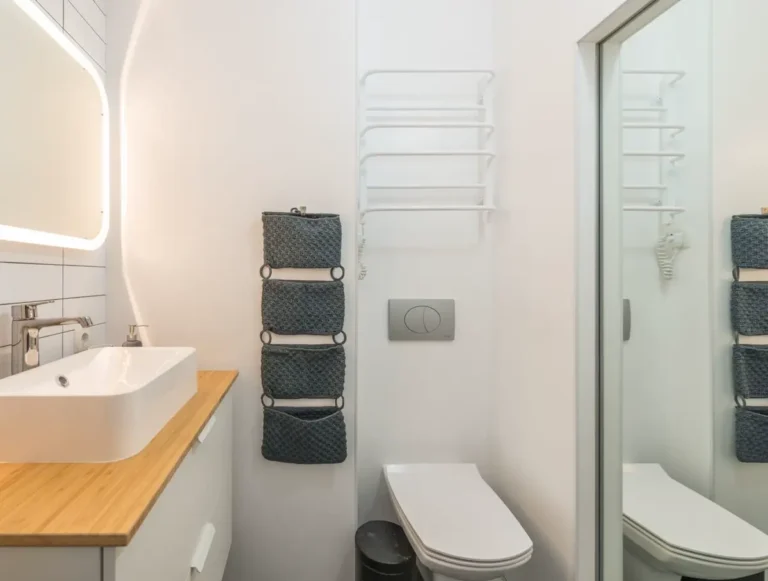
Wall-hung toilets are carried by a concealed steel frame built into the wall and hang clear of the floor; floor-mounted (close-coupled or back-to-wall) pans sit on the slab and bolt down. For commercial bathrooms the decision is made by three things and not by appearance: whether the wall can take the frame, whether the drainage is horizontal or vertical, and who maintains the building afterwards. A wall-hung installation costs more to build and needs a supporting frame rated to 400 kg under EN 997, but it cleans faster, survives high-frequency use better and gives housekeeping an unobstructed floor; a floor-mounted pan is cheaper, simpler to replace and the only realistic option where you cannot build out the wall or move the soil connection. As your China sourcing partner, FBM Sourcing manages this end-to-end.
What Is the Real Difference in the Wall Behind the Pan?
Everything that distinguishes the two systems is hidden. A wall-hung pan transfers its entire load into a concealed carrier frame that is fixed to the structural floor and, usually, to the wall behind, then boxed out with a duct or a stud wall. That frame carries the cistern, the flush plate opening and the connections.
- Load standard: EN 997 requires a wall-hung pan and its support to withstand a static load of 400 kg. The frame, not the tiles or the board, carries it.
- Duct depth: a concealed frame needs roughly 200–230 mm of wall build-out including finishes. On a compact hotel or student bathroom that comes out of the floor area, so it belongs in the layout at design stage, not on site.
- Set-out heights: standard rim height is around 400–420 mm from finished floor; accessible cubicles typically require 430–480 mm. The frame is adjustable at fixing, but only inside its own range.
- Access panel: the flush plate is the service access. Cisterns and valves behind a tiled duct with no removable plate become a demolition job at first fault.
- Drainage: wall-hung pans use a horizontal (P-trap) waste into the duct; floor-mounted pans are commonly vertical (S-trap) into the slab. This is the constraint that decides most refits, and the geometry is set out in S-trap vs P-trap toilets.
A floor-mounted pan needs none of that: the waste is set out on the slab, the pan bolts down, and the cistern is either close-coupled to the pan or concealed in a shallower duct. The trade is that the pan meets the floor on a footprint that has to be cleaned around, and the fixings are exposed to the wet floor.
Which Should You Specify for a Hotel, an Apartment Block or a School?
Hotels and serviced apartments
Wall-hung is close to the default in mid-scale and above. Housekeeping cleans a guest bathroom in minutes, and an uninterrupted floor is the single biggest time saver in that task; the concealed cistern also removes the noisiest part of a close-coupled unit from a room where acoustic separation is a brand standard issue. Where a project is chasing a franchise specification, the frame and flush plate are usually named in it — the mechanics are covered in meeting hotel brand standards.
Apartments, BTR and student accommodation
Mixed. New build with a service duct already in the layout goes wall-hung comfortably. Conversions and repeat-plan blocks with a slab penetration per bathroom usually stay floor-mounted, because moving 200 soil connections is a structural exercise. Where volumes are high and bathrooms are identical, the whole question often disappears into a prefabricated bathroom pod, where the frame is factory-installed and pressure-tested before the pod ships.
Schools, transport hubs and public washrooms
Wall-hung, and usually the heavy-duty version: a back-to-wall pan on a frame with a rear-fixed seat, robust flush plate and vandal-resistant fixings. High-frequency public washrooms are cleaned with a hose and a squeegee, and the floor has to be clear for that to work.
Healthcare and accessible cubicles
Wall-hung with a rated frame, because rim height is adjustable at installation and grab-rail fixings can be built into the same carrier. Accessible provision is set by the local code — for US projects the dimensional requirements are summarised in ADA compliance for hotel FF&E and bathrooms.
Sourcing this for a commercial project?
FBM Sourcing works with project owners, developers, main contractors and FF&E contractors on hotel, apartment, school, office and other commercial building projects. Send us your BOQ, drawings or product list — our team will review it and get back to you.
What Has to Be on the Specification Before You Order?
Toilets are ordered in hundreds and installed by a trade that will not be on site when the boxes are opened. These are the lines that decide whether the pans fit.
- Waste configuration and set-out: horizontal or vertical, and the exact centre-line dimension from finished floor and from the wall. A pan ordered against the wrong set-out is scrap.
- Frame or no frame, and by whom: frames are often a mechanical-contract item while pans are FF&E. Split responsibility is where the delays happen; name the supplier of both in the same package if you can.
- Flush volume and certification: dual flush 4.5/3 litres or 6/3 litres depending on market. Certification is not optional in most destinations — WaterMark in Australia, cUPC in North America, WRAS or the local approval in the UK and Europe. The scope of each is set out in sanitary ware certifications explained.
- Seat and hinge: soft-close, quick-release for cleaning, and top-fixed or bottom-fixed to match the pan. Seats are the first component to fail in high-traffic use, so order spares in the main run.
- Glaze and trap: fully glazed trapway and a rimless bowl are worth specifying in hospitality; both reduce cleaning time and staining.
- Spares: flush valves, inlet valves, seats and one or two complete pans per building. Concealed cistern components are model-specific, and a discontinued valve is a far bigger problem than a discontinued pan.
Whole-package context for the rest of the bathroom is in how to source commercial toilets and sanitaryware for a hotel or apartment project.
Which Costs More Over the Life of the Building?
Wall-hung costs more to buy and more to install, because you are buying a frame, a concealed cistern, a flush plate and a duct that a floor-mounted pan does not need. It usually costs less to operate: cleaning time per cubicle is lower, there is no floor joint to reseal, and the exposed component that fails most often — the flush plate and valve — is reachable in minutes through the access plate. Floor-mounted wins where replacement is likely to be frequent and unskilled, where the wall build-out is unaffordable in floor area, or where the drainage cannot move. On a repeat-plan building the cost difference is small per unit and large in total, so it is worth deciding once, early, and then holding the decision across the whole block.
How FBM Sourcing Handles Sanitaryware on a Project Package
FBM Sourcing manages the entire China procurement package for overseas construction projects. On a hotel, apartment, school, office or retail package we check the toilet set-out against the drainage drawings before an order is placed, confirm that the frame, pan, seat, flush plate and spares come from a matched system, and hold the certification evidence — WaterMark, cUPC, WRAS or CE as the destination requires — against the models actually being shipped rather than against a catalogue. Our own FBM Sourcing QC team inspects at the factory, as one inspection once bulk production is finished, before shipment covering glaze, bowl geometry, flush test and packaging. All quotations, invoices and shipping documents are issued by FBM Sourcing — you deal with us, and we carry the responsibility. For suppliers you nominate, we charge a 5% commission; for products we source for you, we quote a direct price. Sometimes, on a large project, the sanitaryware alone fill full containers; sometimes the sanitaryware share containers with the other product categories of the same project; and sometimes, in one batch, we combine a dozen or more product categories from several projects of the same client into a few containers — always full containers, and for us this is routine, well-practised work.
If you are specifying bathrooms for a hotel, apartment block, school or public building, send us the bathroom drawings, the quantities, the destination port and the certification required. Our team will review it and set out a quotation — use the quote button above or WhatsApp +86 135 6007 5057.