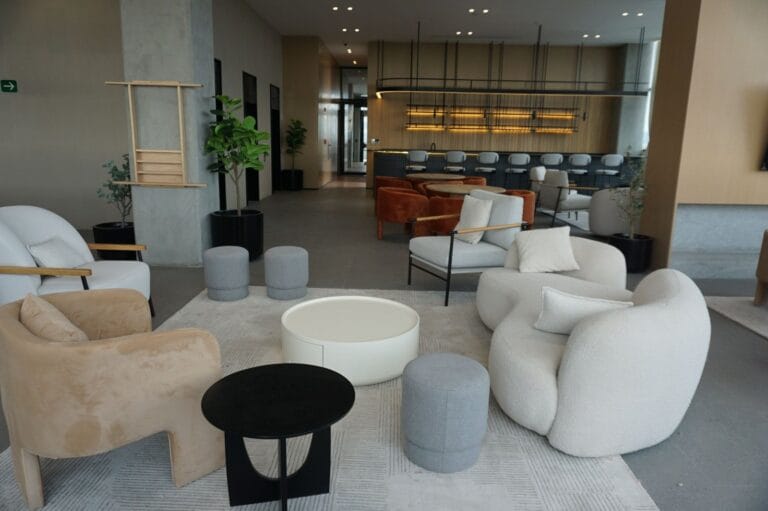
For upholstered seating on a UK project, the dividing line is the building, not the chair. Seating supplied for private use in a dwelling, which in practice takes in furnished build-to-rent apartments, houses in multiple occupation and holiday lets, falls under the Furniture and Furnishings (Fire) (Safety) Regulations 1988, a product law with fixed ignition tests and a mandatory permanent label. Seating for non-domestic premises such as hotel bedrooms, lobbies and PBSA common rooms is governed by the fire risk assessment required under the Regulatory Reform (Fire Safety) Order 2005, and the standard used to set ignition resistance for that assessment is BS 7176:2007+A1:2011, which tests cover and filling together as a composite to BS 5852.
This article is written for developers, general contractors, builders, commercial project owners, interior design and construction companies and FF&E solution providers ordering upholstered seating from China for a hotel, a purpose-built student accommodation (PBSA) scheme or a build-to-rent (BTR) building in the United Kingdom. It covers seating only; mattresses and bed bases sit under a separate standard, BS 7177:2008+A1:2011. Every regulation, standard and date below was checked against the official text on legislation.gov.uk, GOV.UK or the BSI product page on 22 September 2026.
Three Instruments, Three Different Jobs
| Instrument | What it is | What it covers |
|---|---|---|
| Furniture and Furnishings (Fire) (Safety) Regulations 1988 (SI 1988/1324, amended 1989, 1993, 2010 and 2025) | Product safety regulations under section 11 of the Consumer Protection Act 1987, binding on whoever supplies the furniture in the course of business | Furniture ordinarily intended for private use in a dwelling, supplied anywhere in the United Kingdom |
| Regulatory Reform (Fire Safety) Order 2005 (SI 2005/1541) | Fire safety law for premises in England and Wales, duties on the responsible person | Does not apply to domestic premises, meaning premises occupied as a private dwelling; requires a suitable and sufficient fire risk assessment of other premises |
| BS 7176:2007+A1:2011 | British Standard, status Current at BSI; the specifier picks the hazard category and the supplier tests and labels | Resistance to ignition of upholstered seating tested to BS 5852, BS EN 1021-1 or BS EN 1021-2; domestic and transport seating excluded |
A chair is therefore never “BS 7176 or FFR compliant” in the abstract. It either satisfies the schedules of the 1988 Regulations, which test cover and filling as separate components and demand a specific permanent label, or a named hazard category of BS 7176, which tests the actual composite and carries a different label. A factory in China can build either, but only if the specification says which.
What Do the Furniture and Furnishings (Fire) (Safety) Regulations Require?
As amended from 30 October 2025, regulation 3(1) defines “furniture” as furniture of any description which is ordinarily intended for private use in a dwelling; it includes beds and divans, sofa-beds, cushions, mattresses and pillows, and excludes bedding and floor coverings. For upholstered seating in scope:
- Upholstery (regulation 5): no furniture shall include upholstery which does not pass the cigarette test in Part I of Schedule 4.
- Filling material (regulation 6): no furniture shall include filling material which fails the relevant ignitability test; for polyurethane foam in slab or cushion form that is Part I of Schedule 1.
- Permanent covers (regulation 8): any visible part of the cover shall pass the match test in Part I of Schedule 5, unless an interliner passing the Schedule 3 test sits between cover and filling.
- Permanent label (regulation 11 and Schedule 7): in order, “CARELESSNESS CAUSES FIRE”; the name and postcode of the manufacturer or importer who first supplied the article in the United Kingdom; the batch number; the date of manufacture or import; descriptions of all filling and covering materials; and whether a Schedule 3 interliner is included. At least 10 point, durable, on an external surface.
- Prohibition on supply (regulation 15): no person shall supply any furniture in respect of which any requirement is not satisfied.
The label names the importer who first supplies the article in the United Kingdom, so its content must be agreed with the UK entity before the factory prints it. Regulation 4 also disapplies the Regulations where the supplier has reasonable cause to believe the goods will not be used in the United Kingdom, which is why a factory exporting to several markets fits this label only when the order asks for it.
What Changed on 30 October 2025?
The Furniture and Furnishings (Fire) (Safety) (Amendment) Regulations 2025 (SI 2025/531) were made on 28 April 2025, laid before Parliament on 30 April 2025 and came into force on 30 October 2025. GOV.UK’s statutory guidance describes three changes: certain baby and young children’s products removed from scope, the requirement for manufacturers to affix a display label to new products removed, and the time frame for instituting legal proceedings extended from six to twelve months. In the instrument, regulation 4 omits regulation 10 (display labels) with Schedules 6 and 8. The ignition tests in Schedules 1, 4 and 5 and the permanent label in Schedule 7 were not touched: a factory producing FFR-compliant sofas in 2024 produces them the same way today, minus the swing-tag display label.
How Does BS 7176 Work for Non-Domestic Seating?
BS 7176:2007+A1:2011 is listed as Current at BSI; the 1995 edition was withdrawn on 31 August 2007. Its scope reads: “This British Standard specifies requirements for the resistance to ignition of upholstered furniture used for seating when tested in accordance with BS 5852, BS EN 1021-1 or BS EN 1021-2, as appropriate. The levels of ignition resistance have been set after careful consideration of the fire risk of the particular end-use environment involved.” Seating for domestic use and transport is not covered. The test method, BS 5852:2006, is also Current and replaced BS 5852:1990.
The Fire Safety Order itself names no standard. Article 9(1) requires the responsible person to make a suitable and sufficient assessment of the risks to which relevant persons are exposed, and furniture is part of the contents that assessment considers. The link is made in guidance: the GOV.UK guide Fire safety risk assessment: sleeping accommodation lists “resistance to ignition of upholstered furniture for non-domestic use: BS 7176” among the furniture standards. The Furniture Industry Research Association (FIRA) published a Contract Flammability Guide for the non-domestic sector in 2011 reproducing the standard’s typical premises per hazard category; it predates the 2025 amendment, and FIRA notes the risk assessment may assign a product to a lower or higher level.
| BS 7176 hazard category | Typical premises listed by FIRA (2011 guide, Table 2) |
|---|---|
| Low hazard | Colleges, day centres, exhibitions, museums, offices, schools, universities |
| Medium hazard | Casinos, hospitals, hostels, hotel bedrooms, places of entertainment, public buildings, public halls, public houses and bars, restaurants, services messes |
| High hazard | Offshore installations, sleeping accommodation in certain hospital wards and in certain hostels |
| Very high hazard | Locked psychiatric accommodation, prison cells |
The test philosophy is what trips up factory quotations. Under BS 7176 each composite, the combination of cover and filling in the item, must satisfy the ignition requirements of its hazard category, and testing is on actual composites; under the 1988 Regulations the schedules use the BS 5852 method but adapt it to individual components. For a hotel bedroom chair at medium hazard, FIRA’s worked example says the foam would still need to meet Schedule 1 Part I and the upholstery be cigarette and match resistant, but the composite should also resist ignition at BS 5852 source 5, the wood crib. A fabric mill certificate on its own never proves a BS 7176 chair. FIRA also states that full compliance requires a permanently attached, clearly visible label reading “Complies with BS 7176 for (Low, Medium, High or Very High) Hazard”, and that there is no formal scheme for proving compliance: a supplier can claim it, but must justify the claim when challenged. Foam and fabric selection are covered in our notes on upholstery foam for contract seating and contract-grade upholstery fabric.
Specifying upholstered seating for a UK hotel, PBSA or build-to-rent scheme?
Send us the FF&E schedule and the building type. FBM Sourcing writes the fire requirement for each area into the factory specification, collects the composite test reports and label samples, and checks labels and documents at the pre-shipment inspection.
Hotel, PBSA, Build-to-Rent, HMO or Holiday Let: Which Side Does Each Fall On?
The building type decides the rule. The table draws only on the statutory text, GOV.UK guidance and the FIRA guide.
| Building or area | Governing rule for upholstered seating | What the sources say |
|---|---|---|
| Hotel bedrooms, lobbies, bars, restaurants | Fire Safety Order risk assessment, specified through BS 7176 | FIRA: hotels are covered by the RRFSO, not the FFR; for most hotels the furniture risk level is considered medium, certain areas high risk |
| PBSA common rooms, shared kitchens, reception, study areas | Fire Safety Order risk assessment, specified through BS 7176 | FIRA: furniture in these areas should meet at least the Medium Hazard category of BS 7176 |
| PBSA student bedrooms and studios | Not stated in the regulations; FIRA treats the FFR as the floor | FIRA: furniture for student living accommodation should, as a minimum, comply with the FFR. Whether a student room is a dwelling under regulation 3(1) is not spelt out in the statute; confirm with the local fire risk assessor |
| Build-to-rent apartments (furnished) | Furniture and Furnishings (Fire) (Safety) Regulations 1988 | GOV.UK: furniture used in domestic premises, including any supplied by owners or landlords, must comply with the 1988 Regulations; FIRA: all furniture in rented accommodation, including fixtures and fittings, must meet the full FFR |
| Build-to-rent amenity floors: lounges, co-working, gyms | Fire Safety Order risk assessment for the common parts | GOV.UK covers the common areas of flats and maisonettes; the category comes from the building’s own risk assessment |
| Houses in multiple occupation | FFR for the let rooms; Fire Safety Order for common areas | FIRA lists bed-sits among furnished accommodation let in the course of business; GOV.UK covers the common areas of HMOs |
| Holiday lets and serviced apartments let as dwellings | Furniture and Furnishings (Fire) (Safety) Regulations 1988 | FIRA: furniture for holiday homes and furnished residential properties must meet the full FFR; GOV.UK’s holiday-let guidance points owners to the premises fire risk assessment guides |
| Chalet hotels, holiday apartment complexes, aparthotels | Grey area | FIRA: these straddle both sectors; safety should be no less than the FFR, and advice should be sought from a recognised expert |
Two patterns follow. A hotel package is a BS 7176 package with a hazard category per area, and the factory needs composite test reports and the BS 7176 label. A BTR or HMO package is an FFR package for everything inside the apartment door, with the Schedule 7 label naming the UK importer, plus a BS 7176 line for the amenity floors. PBSA sits between. For product marking on the rest of a package, see UKCA versus CE marking and prefabricated bathroom pods for UK PBSA and hotel projects.
What Is Proposed to Change, and What Has Not, as of 22 September 2026?
The Department for Business and Trade opened a consultation titled Product regulation: fire safety of domestic upholstered furniture on 31 March 2026, with responses due by 23:59 on 23 June 2026, following its January 2025 policy paper. It proposes new requirements based on a smoulder test, ending mandatory open-flame testing; an option to choose between component or composite testing; and scope adjustments removing re-upholstery, repair and second-hand furniture while keeping outdoor furniture in scope. It says the Government will then prioritise finalising the reforms and setting out a timeline.
As of 22 September 2026 the consultation is listed on GOV.UK as closed and no government response has been published on its page. Nothing in the proposals is in force: the 1988 Regulations as amended on 30 October 2025 remain the law for domestic seating, and any UK order placed in China today should be specified to them. The consultation concerns domestic furniture only and does not mention BS 7176. Teams with a BTR or HMO package in design should watch for the response and any transition period it sets.
How Does This Translate into a Specification and a Factory Order?
Each seating line should carry the premises type, the governing rule and the label:
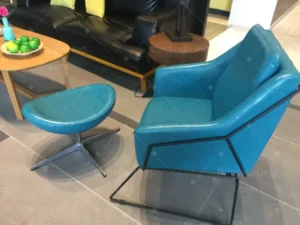
- Hotel bedroom lounge chair: BS 7176:2007+A1:2011, medium hazard as set by the operator’s fire risk assessment; the specified composite tested to BS 5852 at the ignition sources required for that category by an accredited laboratory; label “Complies with BS 7176 for Medium Hazard”.
- BTR apartment sofa: the 1988 Regulations as amended; foam to Schedule 1 Part I, upholstery to the Schedule 4 cigarette test, visible cover to the Schedule 5 match test or the interliner route; Schedule 7 permanent label with the UK importer’s name and postcode; no display label since 30 October 2025.
- PBSA common-room seating: as the hotel line. PBSA bedroom chair: as the BTR line unless the fire risk assessor specifies a BS 7176 category.
On the FBM Sourcing side, as the sourcing partner in China for the project, the work is translation and evidence, not testing; we are not a laboratory and issue no certificates. We write the premises type and the corresponding requirement into the specification each factory quotes against, ask each factory for the test report on the actual cover-and-filling combination it proposes and for a sample of the label it will fit, and then, at the single inspection our own team carries out at the factory after bulk production is finished and before shipment, check the labels against the sample and the documents against the order, with photo and video records. Whether the UK project team accepts a report from a Chinese laboratory or requires a UK-accredited one is covered in our article on FIRA testing for UK furniture projects sourced from China; for the wider package, see how UK developers source building materials from China.
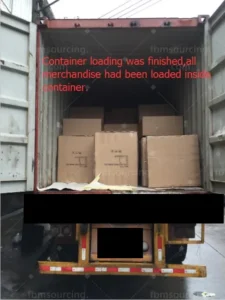
Sometimes, on a large project, the upholstered seating alone fill full containers; sometimes the upholstered seating share containers with the other product categories of the same project; and sometimes, in one batch, we combine a dozen or more product categories from several projects of the same client into a few containers — always full containers, and for us this is routine, well-practised work. What a UK project adds is only that the fire specification is decided per building type before the factory quotes.
Specifying upholstered seating for a UK hotel, PBSA or build-to-rent scheme?
Send us the FF&E schedule and the building type. FBM Sourcing writes the fire requirement for each area into the factory specification, collects the composite test reports and label samples, and checks labels and documents at the pre-shipment inspection.
Frequently Asked Questions
Does BS 7176 apply to sofas inside a furnished build-to-rent apartment?
No. BS 7176 states in its scope that upholstered seating for domestic use is not covered, and the GOV.UK sleeping accommodation guide says furniture used in domestic premises, including any supplied by owners or landlords, must comply with the Furniture and Furnishings (Fire) (Safety) Regulations 1988. Seating in the shared amenity areas is a separate line, specified through the fire risk assessment and BS 7176.
Is a BS 7176 label the same as the FFR permanent label?
No. The Schedule 7 permanent label carries “CARELESSNESS CAUSES FIRE”, the name and postcode of the manufacturer or importer who first supplied the article in the United Kingdom, a batch number, the date and descriptions of filling and covering materials, while the BS 7176 label described by FIRA reads “Complies with BS 7176 for (Low, Medium, High or Very High) Hazard”. A hotel chair carries the second; an apartment sofa the first.
Did the 2025 amendment remove the permanent label?
No. The amendment in force from 30 October 2025 omitted regulation 10, the point-of-sale display label, together with Schedules 6 and 8, while regulation 11 and Schedule 7, which set the permanent label, were not amended and remain in force.
Which hazard category should a hotel specify under BS 7176?
The category is set by the hotel’s own fire risk assessment under the Regulatory Reform (Fire Safety) Order 2005, not by the furniture supplier. FIRA’s non-domestic guide lists hotel bedrooms among typical medium-hazard premises and says that for most hotels the furniture risk level is considered medium, certain areas high risk.
Has the UK replaced the match test with a smoulder test yet?
Not as of 22 September 2026. The Department for Business and Trade consulted on requirements based on a smoulder test between 31 March and 23 June 2026, and the consultation is closed with no government response published. Until new regulations are in force, the cigarette, match and Schedule 1 foam tests of the 1988 Regulations remain the legal requirement.
About FBM Sourcing
FBM Sourcing manages the entire China procurement package for overseas construction projects. Since 2014 we have worked with developers, general contractors, builders, commercial project owners, interior design and construction companies and FF&E solution providers across more than 20 countries and over 1,000 containers, as their sourcing partner in China — from the schedule or BOQ through factory selection, sampling, inspection by our own team before shipment, consolidation and shipping. All quotations, invoices and shipping documents are issued by FBM Sourcing, and sea freight is quoted to you before shipment. If you have an upholstered seating package to price, start at China building materials and FF&E procurement.