Timber legality documents for wood products from China depend on the destination: US imports need a Lacey Act plant declaration (PPQ Form 505) stating wood species and country of harvest; EU imports need EUDR due diligence with geolocation data and a filed due diligence statement; the UK applies UKTR and Australia the Illegal Logging Prohibition Act, both built on due diligence. FSC chain-of-custody certification is voluntary on top of all of these, but is frequently written into hotel and commercial project specifications. This guide walks through each regime and lists exactly what to collect from a Chinese factory before wooden furniture, doors, flooring or plywood ships. As your China sourcing partner, FBM Sourcing manages this end-to-end.
Timber Legality Documents at a Glance: US, EU, UK, Australia
The four regimes answer the same underlying question — was this wood harvested legally? — but they put the burden in different places and ask for different paperwork. A key recent change on the US side: since 1 December 2024, Phase VII of Lacey Act enforcement brought essentially all remaining plant products into the declaration requirement, including wooden furniture under HTS Chapter 94, which for years had sat outside the declaration schedule.
| Market | Legal instrument | What the importer must produce |
|---|---|---|
| United States | Lacey Act (amended 2008) | Import declaration (PPQ Form 505): scientific species name, country of harvest, quantity, value |
| European Union | EUTR (995/2010), being replaced by EUDR (2023/1115) | Due diligence system; under EUDR also geolocation coordinates and a due diligence statement (DDS) |
| United Kingdom (GB) | UK Timber Regulation (UKTR) | Due diligence: supply chain information, risk assessment, risk mitigation |
| Australia | Illegal Logging Prohibition Act 2012 | Documented due diligence before import of regulated timber products |
None of these regimes requires FSC. All of them require information that has to come from the factory and its timber suppliers — species, origin, and evidence of legal harvest — which is why the document collection has to happen during procurement, not at the customs broker’s desk. For the wider certification landscape beyond timber, see our overview of certifications for importing building materials from China.
What Does the US Lacey Act Require for Wood Imports from China?
The Lacey Act, as amended in 2008, makes it unlawful to import plants or plant products — including timber and goods made from it — that were harvested in violation of the laws of the source country. For products on the enforcement schedule, the importer files a plant product declaration, PPQ Form 505, at the time of entry, normally transmitted electronically through the ACE customs system.
What goes on the declaration
The declaration states the scientific name (genus and species) of each wood used in the product, the country where that timber was harvested, and the quantity and value of the shipment. For a veneered conference table, that can mean declaring three or four species: the face veneer, the core material and any solid-wood components. Chinese plywood cores are most commonly poplar or eucalyptus, so those two species appear on a large share of declarations for Chinese casegoods and panel products.
What this means when buying from a Chinese factory
The importer of record signs the declaration, but the data can only come from the factory. In practice we require a species-and-origin breakdown from the mill or furniture factory as part of the order documentation: which species, from which country, in which component. Factories that regularly ship to North America maintain this as a standard document; factories that mainly sell domestically often do not, and that difference should influence factory selection on any US-bound wood package. If a factory cannot state what species its core veneer is, that is a supply-chain risk signal, not a paperwork inconvenience.
EUTR to EUDR: What Changes for EU Buyers?
The EU Timber Regulation (Regulation (EU) No 995/2010) has governed timber imports since 2013: the first company placing timber on the EU market must run a due diligence system covering information gathering, risk assessment and risk mitigation. That framework is repealed with effect from 30 December 2026 and replaced by the broader EU Deforestation Regulation (EUDR, Regulation (EU) 2023/1115), which covers wood alongside other commodities and raises the evidentiary bar considerably. Regulation (EU) No 995/2010 continues to apply until 31 December 2029 to timber and timber products produced before 29 June 2023 and placed on the market from 30 December 2026.
EUDR application dates and new obligations
EUDR applies from 30 December 2026, and from 30 June 2027 for operators that are natural persons or micro or small undertakings established as such by 31 December 2024. Those dates were set by Regulation (EU) 2025/2650 of 19 December 2025, which amended the original timetable. Two obligations are genuinely new compared with EUTR. First, geolocation: the operator must hold the coordinates of the plots of land where the timber was harvested, and the product must be deforestation-free — the land must not have been deforested after 31 December 2020. Second, the due diligence statement (DDS): before placing the goods on the EU market, the operator files a DDS in the EU information system and receives a reference number that follows the goods through the chain.
The practical problem with Chinese wood products
Chinese factories are converters, not forest owners. The timber in a Chinese wardrobe may be Chinese-grown poplar, imported European beech, or a mix — and EUDR traceability has to reach back to the harvest plot in each case. Supply chains where the factory buys FSC-certified or plantation timber with documented origin are far easier to take through EUDR due diligence than spot-market timber purchases. For EU-bound projects we now treat traceable timber sourcing as a factory selection criterion in its own right, on the same level as production capability. Buyers deciding between panel types should note the chain looks different for each — see plywood vs MDF vs particleboard for casegoods — because MDF and particleboard made from mill residues raise different traceability questions than face-veneer plywood.
For the packaging side of a wood shipment, see our reading of ISPM 15 and the wood packaging mark.
Sourcing wood products that have to clear FSC, EUDR or Lacey?
FBM Sourcing selects the factories, collects the species and chain-of-custody documentation with the order, and checks it against what is actually loaded. Send your BOQ, drawings or product list — our team will review it and get back to you. See what sits inside floor and wall covering sourcing.
UK and Australia: UKTR and the Illegal Logging Prohibition Act
After Brexit, Great Britain retained the EUTR framework as the UK Timber Regulation (UKTR). The mechanics are familiar: the first placer on the GB market must operate a due diligence system — gather information on species, origin and supply chain, assess the risk of illegal harvest, and mitigate any risk that is not negligible. A UK fit-out contractor importing joinery or doors directly from a Chinese factory is the operator and carries that duty; the same species-and-origin pack assembled for EUDR purposes covers the UKTR information requirement.
Australia’s regime is the Illegal Logging Prohibition Act 2012, which prohibits importing illegally logged timber and requires importers of regulated timber products — a category that covers most furniture, flooring, plywood and joinery lines — to carry out documented due diligence before import. In practice Australian importers ask the factory for the same core evidence: species, country of harvest, and supporting documents such as certification or supplier declarations. For Australian projects we assemble this alongside the formaldehyde and fire-performance paperwork so the import file is complete in one pass.
Is FSC Certification Legally Required — and What Does FSC Mix Actually Mean?
FSC is a voluntary certification scheme, not legislation. Forest Management (FM) certification covers the forest itself; Chain of Custody (COC) certification covers every company that takes ownership of the material downstream — sawmill, panel plant, furniture factory. A finished product can only be sold with an FSC claim if every link in that chain holds a valid COC certificate; a COC certificate is issued for five years with annual surveillance audits in between.
Why project buyers still ask for it
Although no customs authority demands FSC, hotel operators, developers and government clients routinely write it into FF&E and joinery specifications, and green building schemes credit certified wood. On those projects FSC is contractually mandatory even though it is legally optional. It also does real work in legality compliance: certified material with a documented chain is much simpler to defend in a Lacey, EUDR, UKTR or Australian due diligence file than uncertified spot-market timber — though certification alone does not discharge the legal duty, and EU authorities have been explicit that EUDR still requires the operator’s own due diligence.
Reading and verifying an FSC claim from a Chinese factory
Three things to check on any FSC quote from China. First, the label class: FSC 100% means all material comes from FSC-certified forests; FSC Mix means a blend of FSC-certified, controlled wood and/or recycled inputs — the most common claim on Chinese panels and furniture; FSC Recycled means reclaimed material. Second, the certificate: every COC certificate has a code that can be verified in the FSC public certificate database, showing the holder, scope and validity — verify it, because trading companies do borrow certificates that belong to someone else. Third, the scope: a certificate covering “plywood” does not automatically cover upholstered furniture assembly; the product group on the certificate must match what you are buying, and the factory’s invoice must carry the FSC claim for the chain to remain intact. On casegoods and joinery packages, whether the spec calls for certified solid timber or certified panel products changes cost and lead time — our comparison of solid wood vs engineered wood for project joinery covers that trade-off.
What to Collect from the Chinese Factory Before Shipment
Whatever the destination, the document pack is assembled during the order, because half of it cannot be reconstructed afterwards. This is the baseline file we compile for wood product orders:
- Species and origin declaration — scientific names of all wood components (face, core, solids) and country of harvest for each, signed by the factory
- Timber purchase evidence — the factory’s raw-material invoices or supplier declarations linking the order to its timber inputs
- FSC COC certificate and claim invoice — where the spec requires FSC: certificate code (verified in the FSC database), matching product scope, and the claim stated on the sales invoice
- Formaldehyde compliance — for plywood, MDF and finished casegoods: CARB Phase 2 / TSCA Title VI documentation for the US, for the EU, evidence against the REACH limit of 0.062 mg/m³ for furniture and wood-based articles placed on the EU market after 6 August 2026, or E1 test reports for UK/Australian projects
- Destination-specific filing data — the fields needed for PPQ Form 505 (US) or the EUDR due diligence statement, extracted and checked against the packing list
The formaldehyde layer trips up more buyers than the legality layer, because it runs on separate rules with their own certificates: the US framework is covered in our guide to CARB Phase 2 and TSCA Title VI for furniture and cabinets from China, and the E1 class and Chinese national limits are explained in formaldehyde standards for cabinets from China. As a reference point, as of September 2026 China’s mandatory national standard GB 18580-2025 (in force since 1 June 2026, replacing GB 18580-2017) requires wood-based panels to meet E1 (0.124 mg/m³ or less) and finished panel products such as faced boards, wood flooring and wood doors to meet E0 (0.050 mg/m³ or less) — but a US-bound order still needs TSCA Title VI paperwork, because US limits are set in ppm against ASTM E1333.
How We Handle Timber Legality as a Sourcing Agent
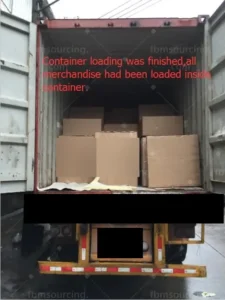
On wood packages — furniture, doors, engineered flooring, plywood — a china sourcing agent earns its fee partly in this paperwork layer. Our working sequence: shortlist factories that can already document species and origin (for EU projects, factories buying certified or plantation timber with traceable supply); lock the documentation list into the purchase contract so the species declaration, timber invoices and certificates are deliverables alongside the goods; collect and cross-check the pack against the packing list before the container closes; and hand the importer a complete file mapped to their filing — Form 505 fields for US entries, DDS data for EU entries. Goods are inspected before shipment by our own team, with photo and video records, and that inspection includes checking that panel gradestamps and markings match the declared materials. FBM Sourcing charges a 5% commission for suppliers you nominate (products we source for you are quoted at a direct price); chasing a Chinese mill for a retroactive species declaration three weeks after the container sailed is the expensive alternative.
Two failure patterns account for most timber-document problems we see. First, the trading-company gap: the exporter on the invoice holds no relationship with the mill, so nobody can state the core species with confidence — declarations get filled with a guess, which is exactly what the Lacey Act penalises. Second, the substitution problem: the sample was poplar-core, the production run quietly switched to a cheaper mixed-hardwood core, and the declaration no longer matches the goods. Both are procurement problems before they are legal problems, and both are preventable with factory selection and pre-shipment verification.
FSC chain-of-custody is also one of the documents that earns LEED and WELL materials credits; see what LEED and WELL documentation Chinese factories can provide.
Get a China Procurement Quote for Your Project
If your project includes wood furniture, doors, flooring, joinery or panel products bound for the US, EU, UK or Australia, we can source it with the legality documentation built into the order rather than bolted on afterwards — species declarations, FSC COC where the spec requires it, formaldehyde certificates, and filing-ready data for Lacey or EUDR. Submit your drawings, quantities, destination port and timeline through our China building materials and FF&E procurement page, and our team will review the package and come back to you.